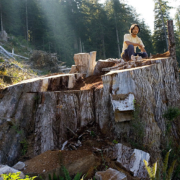
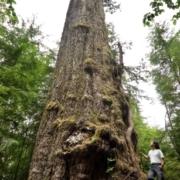
Wu atop a red cedar stump in Upper Walbran Valley.

Ken Wu Wants to Save ‘the Avatar Grove’

Ken Wu knows how to get attention for ancient forests.

When we met at the Bread Garden Café on Broadway in Vancouver just after the news broke a few weeks ago that he and several other tree-hugging stalwarts from Vancouver Island had splintered from the Western Canada Wilderness Committee to form the Ancient Forest Alliance, the former Victoria campaign director for WCWC mentioned how much he enjoyed the movie Avatar.

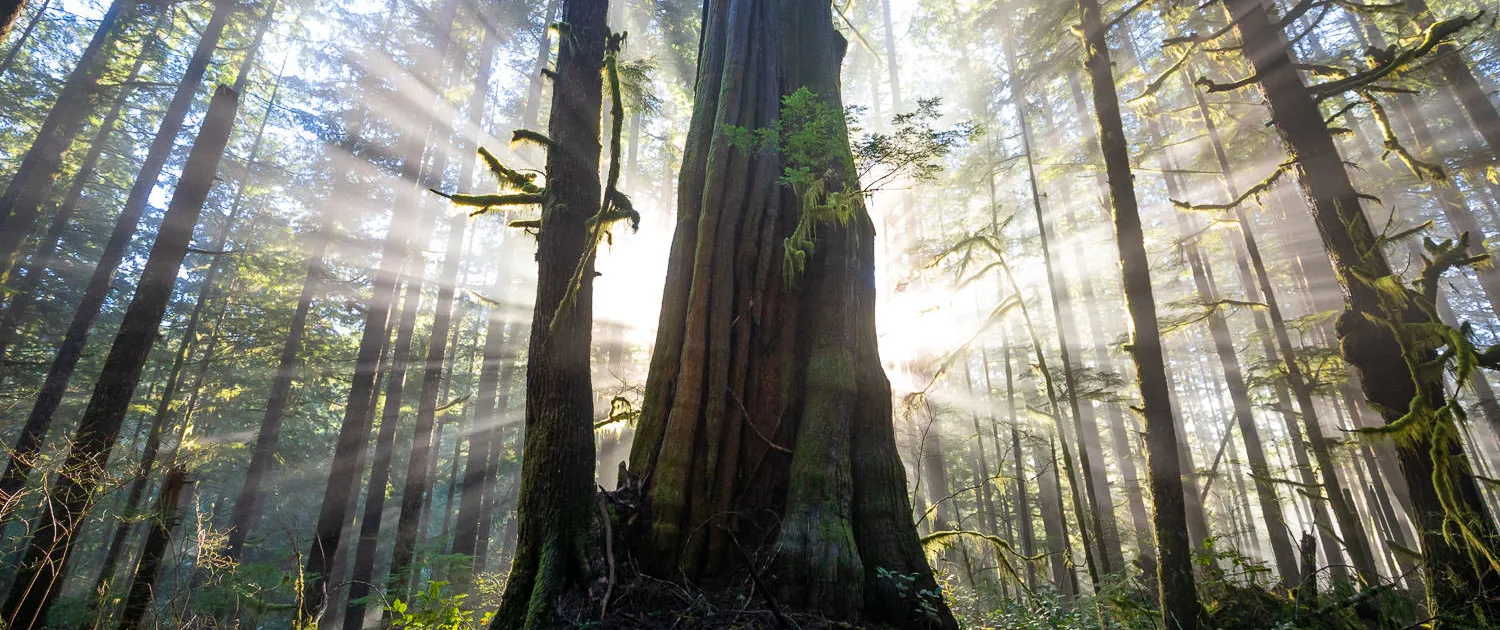
A few weeks later he’d not only shone the media spotlight at his new organization — while repeatedly resisting the opportunity to take potshots at his old one for closing down the office that has been home base for many Vancouver Island environmentalists — he’d launched a new high-profile campaign to save an ancient forest near Port Renfrew that his group has dubbed what else but “the Avatar Grove.” Also known as TFL (Tree Farm License) 46, the stand, which includes some of South Island’s largest red cedars and Douglas firs, is scheduled to be logged any second now.

If the name attracts the attention of Avatar creator James Cameron — and in the days of Twitter and Google alerts you never know (this’d be the hint for whoever reads Cameron’s press to alert him before it’s too late) — this could be the most inspired new name for a patch of endangered land since “The Great Bear Rainforest.”

I spoke to Wu about the challenges of starting a new group — their total bankroll when we met was just over $200 — his excitement at the freedom that comes with not being part of a group with charitable status and his conviction that he could build an effective new organization from scratch with the magic of Facebook and the alliance he helped build on Vancouver Island.

At press time the Alliance’s two Facebook groups already had close to 7,000 members.

Ancient Forest Alliance

No logging plans near giant fir: TimberWest

Flagging tape in the immediate vicinity of the world’s largest Douglas fir does not mean the area will be logged in the near future, according to forest company TimberWest.

The marked cutblock, less than 100 metres from the Red Creek Fir, was found by members of the Ancient Forest Alliance who say that if surrounding trees are cut, the 74-metre tall tree will be in danger of blow-down.

The tree is 15 kilometres east of Port Renfrew.

The flagging tape is on TimberWest private land, although the Red Creek Fir is on Crown land. Company spokeswoman Sue Handel said the tape does not necessarily indicate harvesting plans.

“We use it in many ways — to determine boundaries and what we have on the land base as assets,” she said.

“We don’t have any immediate plans for harvesting in the area. In the next year or two, it’s not in our short-term harvesting plans.”
TimberWest is aware of public interest in the Red Creek Fir and is planning to improve access to the area, Handel said.

Part of the trail leading to the tree is on TimberWest land, so the company is looking at an access agreement with the province and possible “parking opportunities,” she said.

However, members of the Alliance are skeptical about the company’s long-term plans and want to see the surrounding area protected to ensure the tree survives.

“We believe it is the B.C. Liberal government’s obligation to protect the surrounding Crown lands and to purchase the adjacent private lands to protect the ecosystem where the Red Creek Fir survives,” said Ken Wu. “That would ensure the area’s integrity for biodiversity, tourism, recreation and other important values.”

Ancient Forest Alliance

Protect old grove before it’s too late

The provincial government should not let the mostly undisturbed grove in the Gordon River Valley, nicknamed Avatar Grove, be logged. It is a gem of an ecosystem and with so little of our old-growth forests left, it is not something we can afford to lose. With its proximity to Port Renfrew, it will be very beneficial for bringing in tourists, which will support local economies.

People will not come from all over the world to see giant stumps and ugly clearcuts. Tourists come to Canada to see the natural beauty that we have left.

An immediate land-use order is needed to protect this grove of old-growth red cedar and Douglas fir trees. A provincial old-growth strategy is also needed to protect and sustainably manage the remaining old growth in our province. All logging that goes on in our second-growth forests should be sustainable so that they remain healthy for many generations to come.

Ancient Forest Alliance

World’s Largest Douglas fir Threatened by Proposed Logging in Adjacent Old-Growth Forest

A new proposed logging cutblock near the world’s largest Douglas fir tree, the Red Creek Fir, has been identified as that of TimberWest, a BC-based logging company. The Red Creek Fir, located 15 kilometers east of Port Renfrew, is recognized as the largest Douglas Fir Tree on Earth, with enough wood to make 349 telephone poles (ie. 349 cubic meters in total timber volume – see The BC Big Tree Registry. It is 73.8 meters in height and has a trunk 4.2 meters wide (Diameter-at-Breast-Height or DBH).

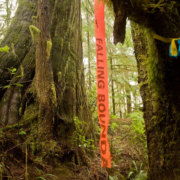
In a recent conversation with Ancient Forest Alliance campaigner TJ Watt, a TimberWest representative confirmed that the flagging tape labelled “falling boundary” was likely laid out by the company. The BC government`s BC Timber Sales division, the only other possible source of logging activity in the area, has stated that they have no cutblocks planned immediately adjacent to the Red Creek Fir. The TimberWest representative also stated that flagging had been done “as part of an early exploratory mission” for future logging, which she stated they would “defer for one to two years”.

“It would be insane to allow a cutblock beside the largest Douglas fir tree on Earth. Not only will this ruin the experience for visitors with a new clearcut, but it will endanger the tree itself by exposing it to being blown down by strong West Coast winds. We believe that it is the BC Liberal government’s obligation to protect the surrounding Crown lands and to purchase the adjacent private lands to protect the ecosystem where the Red Creek Fir survives, to ensure the area’s integrity for biodiversity, tourism, recreation, and other important values. This should also include protection of the San Juan Spruce, just a few kilometres away, Canada’s largest spruce tree,” stated Ken Wu, co-founder of the Ancient Forest Alliance (www.ancientforestalliance.org). “The Capital Regional District and federal government could also play important roles to facilitate the area’s protection. Most importantly, the BC Liberal government must commit to undertaking a Provincial Old-Growth Strategy to ensure the protection of the remaining old-growth forests in BC where they are scarce, such as on Vancouver Island, around the Lower Mainland, and in the southern Interior, while ensuring the sustainable logging of second-growth stands.” 

The Red Creek Fir stands along the edge of the public-private lands divide on Vancouver Island, slightly on the public (Crown) lands side of the divide by a few dozen meters. About 20% of Vancouver Island was privatized over 100 years ago through the Esquimalt and Nanaimo (“E&N”) Land Grant to a coal baron Robert Dunsmuir, and the lands are now primarily owned by TimberWest, Island Timberlands, and Western Forest Products. The lands are public (Crown) to the northwest side of the Red Creek Fir, while lands to the southeast – literally within a few dozen meters – are privately held by TimberWest. A BC Ministry of Forests and Range spokesperson stated last week that the Red Creek Fir lies within a Forest Service Recreation Site, a tenuous designation that confers no legislated protection for the area and that can be easily removed on the whims of a Forest Service manager.

Along with establishing a comprehensive Provincial Old-Growth Strategy, the Ancient Forest Alliance is calling on the BC Liberal government to establish a Provincial Heritage Trees designation that will identify and immediately protect the 100 largest and oldest specimens of each of BC’s tree species. Currently there is no provincial legislation that specifically protects the largest or oldest specimens of BC’s world-reknowned old-growth trees.

“If we have laws that recognize and protect Heritage Buildings that are 100 years old, why don’t we have laws that recognize and protect our 1000 year old Heritage Trees? How many jurisdictions have trees that can grow as wide as a living room and as tall as a downtown skyscraper,” states TJ Watt, photographer and explorer with the Ancient Forest Alliance. “Not only do we need to save heritage trees, we need to protect the last old-growth ecosystems in southern BC where the old-growth is scarce, while ensuring sustainable second-growth forestry in appropriate places and ending the export of raw logs to protect BC forestry jobs. They’ve already logged almost 90% of the old-growth forests on the south island, including 99% of the ancient Douglas firs. It should be a no-brainer to protect what’s left of the old-growth here.”

Through BC government neglect, the old information sign at the Red Creek Fir itself has been smashed by falling branches and left to rust on the ground for several years. Members of the Ancient Forest Alliance have erected a new sign to replace the old sign. Local tourism operators in Port Renfrew last summer also erected directional signs leading to the largest trees in the area.

“One gets the impression that the BC Liberal government doesn’t want to promote the existence of BC’s magnificent old-growth trees, despite their importance for tourism, endangered species, and the climate, and despite the fact they are some of the largest trees on Earth,” states TJ Watt. “For example, there are no government signs or indications on the whereabouts of two of the largest trees in the world, the San Juan Spruce, Canada’s largest spruce tree, and the Red Creek Fir, the world’s largest Douglas Fir tree, both found on public lands near Port Renfrew. Local tourism operators from Port Renfrew had to make their own signs and erect them along the roads a few months ago.”

British Columbia is home to the world’s largest Douglas fir (the Red Creek Fir near Port Renfrew – height 73.8 meters, diameter 4.2 meters), the world’s second largest western redcedar (the Cheewhat Cedar by the West Coast Trail/ Nitinat Lake – height 55.5 meters, diameter 5.8 meters), and the world’s second largest Sitka spruce tree (the San Juan Spruce by Port Renfrew – height 62.5 meters, diameter 3.7 meters). Hundreds of other near record-size ancient trees are found throughout the province, most of which don’t have any official recognition or protection. The oldest tree found in BC was an ancient yellow cedar tree logged on the Sunshine Coast in the 1980’s; the tree was almost 1900 years old by the time it was cut down.

Logging markings in Port Renfrew.

World’s Largest Douglas-fir Under Threat

Please Note: Keith Martin supports an expansion of Pacific Rim National Park, not necessarily the heritage trees designation as stated in the article.

The world’s largest Douglas fir tree, the famous Red Creek Fir tree, located in Port Renfrew at the southern tip of Vancouver Island, remains vulnerable to the effects of logging in an adjacent old-growth forest, claim environmentalists.

The Red Creek Fir giant, a major tourist attraction in the region, stretches more than 73.8m (242ft) in height with a trunk 4.2m (13’ 9”) wide, has environmentalists concerned that the venerable fir will loose its forest padding sheltering the enormous tree to future logging in the area.

“They’ve already logged almost 90% of the old-growth forests on the south island, including 99% of the ancient Douglas firs,” explains Ken Wu, co-founder of the newly-formed Ancient Forest Alliance.

A Ministry of Forest and Range spokesperson, in a recent Times Colonist interview, stated that British Columbia Timber Sales has no immediate plans to log in the area.

However, Ancient Forest Alliance, in conjunction with Esquimalt-Juan de Fuca MP Keith Martin, want the British Columbia government to establish a Provincial Heritage Trees designation that will identify and protect the 100 largest and oldest specimens of each of the province’s tree species. Currently there is no provincial legislation that specifically protects the largest or oldest specimens of BC’s world-renowned old-growth trees.

“If we have laws that recognize and protect heritage buildings that are 100 years old, why don’t we have laws that recognize and protect our 1000 year old heritage trees? How many jurisdictions have trees that can grow as wide as a living room and as tall as a downtown skyscraper,” asks TJ Watt, photographer and co-founder of the Ancient Forest Alliance.

British Columbia is home to a number of record-size ancient trees including the world’s largest Douglas fir (the Red Creek Fir near Port Renfrew), the world’s second largest western red cedar (the Cheewhat Cedar by the West Coast Trail/ Nitinat Lake), and the world’s second largest Sitka spruce tree (the San Juan Spruce by Port Renfrew). The majority of British Columbia giant trees lack official recognition or protection.

world's largest Douglas fir tree
Ken Wu stands beside the Red Creek Fir tree. Image courtesy TJ Watt.

Ancient Forest Alliance

Old-growth forests could bring tourists

The Feb. 20 Raeside cartoon is a perfect representation of the Liberal government’s stance on the fate of our world-class ancient forests. The cartoon depicts Gordon Campbell promoting the province to Olympic tourists by showing off our spectacular old-growth forests. The tourists, upon returning next summer to take photos, find a field of giant stumps.

This continues to be the fate of many of our last stands of giant trees in southern B.C. and shows a lack of understanding of what draws many people to the best place on Earth.

Vancouver Island has the potential to be the Costa Rica of the north, with a thriving eco-tourism market that brings in tourists from all over the globe to see our amazing temperate rainforests. These dynamic ecosystems clean our water, fight climate change and contain mammoth 1,000-year-old trees with trunks more than six metres wide and 90 metres tall.

The government is complacently allowing the clearcutting of these rare gems and their subsequent conversion to much smaller and ecologically simpler second-growth tree plantations.

People are not travelling from across the world to see plantations and clearcuts. The government needs to say enough is enough in regard to logging our natural old-growth heritage and protect what little we do have left, while ensuring a sustainable second-growth, value-added industry.

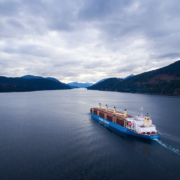
A ship loaded with raw logs leaves the Alberni Inlet on Vancouver Island.

It’s time for the BC government to curb raw log exports and boost value-added forestry jobs, say unions and environmental groups

Vancouver – Between 2013 and 2016, more raw logs were shipped from BC than during any other four-year period in the province’s history, prompting two forest industry unions and three leading environmental groups to call for a ban on raw log exports from old-growth forests and a bold government action to plan to stimulate BC’s flagging forest sector. See the Canadian Centre for Policy Alterniatives Press Release with communications info for intereviews.
The call follows new research released today by the Canadian Centre for Policy Alternatives’ BC Office (CCPA-BC) that shows how exports of raw, unprocessed logs are surging. If these logs were processed in some of BC’s hardest hit forestry communities, at least 3,600 new jobs could be generated.
“This carnage has to stop,” says Arnold Bercov, president of the Public and Private Workers of Canada (PPWC), one of two unions representing BC pulp and paper mill workers.
“Last year, BC forest companies exported enough raw logs to frame nearly 134,000 homes, which equals roughly half of Vancouver’s standing single-family homes. Thousands of good-paying jobs in rural communities are at risk every day that the government fails to act,” he added.
The PPWC, along with Unifor, Canada’s largest private sector union, the Ancient Forests Alliance, Sierra Club of BC and the Wilderness Committee, say the Province should enact a bold three-point plan to curb exports and stimulate jobs.
1. Place an immediate ban on all exports of raw logs from old-growth forests.
2. Immediately impose progressively higher taxes on log exports from second-growth forests to encourage investment in domestic mills.
3. Introduce new policies to increase value-added forest manufacturing and jobs in rural and First Nations communities.
“We are extremely troubled by present trends. BC’s biggest log exporters are decimating old-growth forests and exporting huge numbers of raw logs, while the industry continues to bleed manufacturing jobs,” says Torrance Coste, Vancouver Island campaigner for the Wilderness Committee. “Worse, the industry is on the same dangerous path in younger, second-growth forests which are our only hope for the future. ”
Four years of log export data analyzed by CCPA-BC researcher and resource policy analyst Ben Parfitt uncovered a number of disturbing trends in log exports from BC.
• Between 2013 and 2016, nearly 26 million cubic meters of raw logs, with a combined sales value of more than $3 billion, were shipped from BC  – more than any other four-year period since record keeping began.
• More than one in three logs exported in the past five years came from centuries-old old-growth forests, including from the Great Bear Rainforest.
• Most log exports in the past five years came from public lands under direct provincial control, not from private lands where the BC government has no jurisdiction, which is a sharp reversal from previous norms.
• Nearly half of all export applications in 2016 were by member companies of the Coast Forest Products Association, one of BC’s most powerful lobbies for continued raw log exports.
“One huge concern for forest industry workers and environmental organizations alike is that the door appears to be wide open for companies to close sawmills and simply increase their log exports. That is a recipe for disaster for our environment, our economy and rural and First Nation communities,” Parfitt says.
Ancient Forest Alliance

World’s largest Douglas fir at risk, fearful environmentalists charge

The world’s largest Douglas fir could be at risk, say Vancouver Island environmentalists.

The 74-metre-tall tree towers over the surrounding forest in the Red Creek area east of west coast town of Port Renfrew, about 100 km northwest of Victoria.

But new logging tape marks an area about 50 metres away from the giant tree and environmentalists fear the tourist attraction will shortly be surrounded by a clearcut, making it susceptible to being blown down.

“The San Juan Valley is like a giant wind tunnel and this increases its exposure,” said Ken Wu of the Ancient Forest Alliance, a Vancouver Island-based environmental organization.

“This is the biggest Douglas fir on earth and it should be a first-class tourist attraction, but people will be walking through a clearcut to get to it. It is totally myopic.”

In Port Renfrew, tourists often ask how to find the Red Creek fir, said Chamber of Commerce president John Cash.

Chamber members, who want to see big trees preserved as tourist attractions, recently put up directional signs to the fir so visitors would not get lost on logging roads.

Wu said it appears the area comes under B.C. timber sales designation, meaning the province considers it a cut-block for small businesses.

But Forests Ministry spokeswoman Vivian Thomas said there are no immediate plans to harvest in the Red Creek fir area.

“In fact they helped improve the road access so people could go view the tree,” she said.

“Also, the tree itself is part of a public recreation site, so the immediate area is protected from logging.”

The Ancient Forest Alliance is supporting a proposal by Esquimalt-Juan de Fuca Liberal MP Keith Martin to extend Pacific Rim National Park down the west coast of Vancouver Island, with an expanded park to include the Red Creek fir.

Some moviegoers leave Avatar depressed

The Avatar blues

When you stop and think about it, post-Avatar depression isn’t as bizarre a phenomenon as it seems.

If news reports and postings on fansites such as Naviblue and Avatar Forums are to be believed, many filmgoers are feeling as blue as those tall, peace-loving Na’vi aliens after watching James Cameron’s stunning 3-D sci-fi epic.

Some have even said they felt suicidal after removing their 3-D goggles when the closing credits rolled on the blockbuster that, with a $2.5-billion box-office take, has dethroned Titanic as the world’s top-grossing film.

Such dark thoughts have spawned online forum threads with titles like Ways to Cope With the Depression of the Dream of Pandora Being Intangible.

“I have a depression. It makes me want to go to Pandora and stay there,” wrote a user named loverofnature, referring to the idyllic planet where gentle blue-skinned natives who live in harmony with nature are threatened by Earthmen.

In an apparent metaphor for the way European settlers wiped out native Americans, the glowing planet is being exploited by a corporation strip-mining a rare mineral, since the human race has depleted Earth’s natural resources.

When some twentysomething moviegoers left a screening of Avatar at Silver City the other day complaining they felt “bummed-out” that Earth wasn’t more like Pandora, I felt like snapping: “Get a grip! It’s only a movie.”

It wasn’t until I took a closer look at some online forums for fans and like-minded victims of Avatar-induced melancholia that I realized it isn’t just the usual web wingnuts sounding off. Reassuringly, thoughtful concerns are also being aired.

Many viewers recognize that Avatar — apart from its exotic, computer-generated and Oscar-worthy beauty — is a cautionary environmental parable that shrewdly blurs the line between fact and fiction.

While it’s bizarre some avid Avatar fans don’t seem to get that Pandora, with its wondrous alien ecosystem and weird wildlife, is a Utopian fantasy world, their sudden sorrow is understandable.

The pristine planet is a reminder of how beautiful our own blue planet was before we messed with it.

(One idealistic poster named Jorba has even pledged to start his own Na’vi tribe on Earth. OK.)

“Are there other people out there who think humanity is going south?” asks another, LifeOnATree.

She laments how she and so many others feel compelled to buy things that aren’t necessary.

“I need them to ‘bear’ the world around me,” LifeOnATree writes.

Avatar is just one of many tales of doom and gloom out there. From such apocalyptic fantasies as I Am Legend, The Road and The Book of Eli to chilling real-world exposés of humanity’s self-destruction like An Inconvenient Truth and Collapse, it appears “feel-bad” movies have become fashionable.

“When we have these movies that talk about the end of the world or life as we know it, or an unstoppable force, it can put us into a sense of helplessness or dread or fear,” Victoria registered clinical counsellor Lisa Mortimore explains. “Psychophysiologically our bodies can go into immobility in response to that shutdown, and that can translate into depression.”

While Avatar might spark a so-called depression, I see it as more of a rude awakening with an upside. Such films can inspire a shift in consciousness and an appreciation for what we’ve too long taken for granted.

Ken Wu, co-founder of Victoria-based Ancient Forest Alliance, a non-profit organization dedicated to the protection of B.C.’s old-growth forests, says it irks him so many people are unaware we have “the real Pandora” on our doorstep.

“It struck me as being an incredible analogy of what’s happening on earth,” says the five-time Avatar viewer. “We have giant moss and fern-draped ancient trees almost as large as Home Tree, spectacular creatures like bears, wolves, mountain lions, wolverine and elk in our forests, and giant blue whales, killer whales, elephant seals and huge stellar sea lions along our wild coast. People just need to be more aware.”

Wu advises those stricken with depression to take a stand.

His group has even come up with a three-step “cure”, starting with helping to protect disappearing ancient trees such as Avatar Grove, the film-inspired nickname for a 10-hectare stand on Crown land near Port Renfrew designated for logging.

“Get out and experience nature, take action to defend nature and get others to do the same,” Wu says. “You have to learn to appreciate this beautiful planet.”

Related Stories

Ken Wu beside the Red Creek Fir. Growing in the San Juan Valley near Port Renfrew BC

Largest Douglas fir in the world at risk say environmentalists

Note: In the following article the Forests Ministry representative states that there are no immediate plans to log near the Red Creek Fir – despite the fact that there is an entire logging cutblock laid out adjacent to the Red Creek Fir demarcated by flagging tape labelled “Falling Boundary” (see photos) and a “BC Timber Sales” sign at the top of the hill. We will be inquiring with them for more specifics regarding their statement and the nature of the situation. Note also that my quote should read that visitors would walk “by” a clearcut (ie. in very close proximity to), rather than “through” a clearcut. Also note that Forest Service Recreation Sites offer no legislated protection – they regularly disappear on the whims of the Forest Ministry – and clearly this one isn’t even big enough to prevent a falling boundary just one trees length away from the Red Creek Fir. – Ken Wu and TJ Watt, Ancient Forest Alliance

At almost 74 metres tall, the largest Douglas fir in the world towers over the surrounding forest in the Red Creek area east of Port Renfrew.

But new logging tape marks an area about 50 metres away from the giant tree, and environmentalists fear the tourist attraction will shortly be surrounded by a clearcut, making it susceptible to blowdown.

“The San Juan Valley is like a giant wind tunnel and this increases its exposure,” said Ken Wu of the Ancient Forest Alliance, an Island-based environmental group.

“This is the biggest Douglas fir on earth and it should be a first-class tourist attraction, but people will be walking through a clearcut to get to it. It is totally myopic.”

In Port Renfrew, tourists often ask how to find the Red Creek fir, said Chamber of Commerce president John Cash.

Chamber members, who want to see big trees preserved as tourist draws, recently put up directional signs to the fir so tourists would not get lost on logging roads.

The Ancient Forest Alliance has erected its own sign beside the 1,000-year-old tree, giving its dimensions. The sign replaces one erected by the province decades ago, which was rusted, lying on the ground and surrounded by broken glass.

Wu said it appears the area comes under B.C. Timber Sales designation, meaning the province plans out cutblocks for small businesses.

But Forests Ministry spokeswoman Vivian Thomas said BCTS has no immediate plans to harvest in the Red Creek fir area.

“In fact they helped improve the road access so people could go view the tree,” she said.

“Also, the tree itself is part of a public recreation site, so the immediate area is protected from logging.”

The Ancient Forest Alliance is supporting a proposal by Esquimalt-Juan de Fuca MP Keith Martin to extend Pacific Rim National Park down the west coast of Vancouver Island, with an expanded park to include the Red Creek fir.

Photos by TJ Watt showing Falling Boundary tape – Click for Larger versions