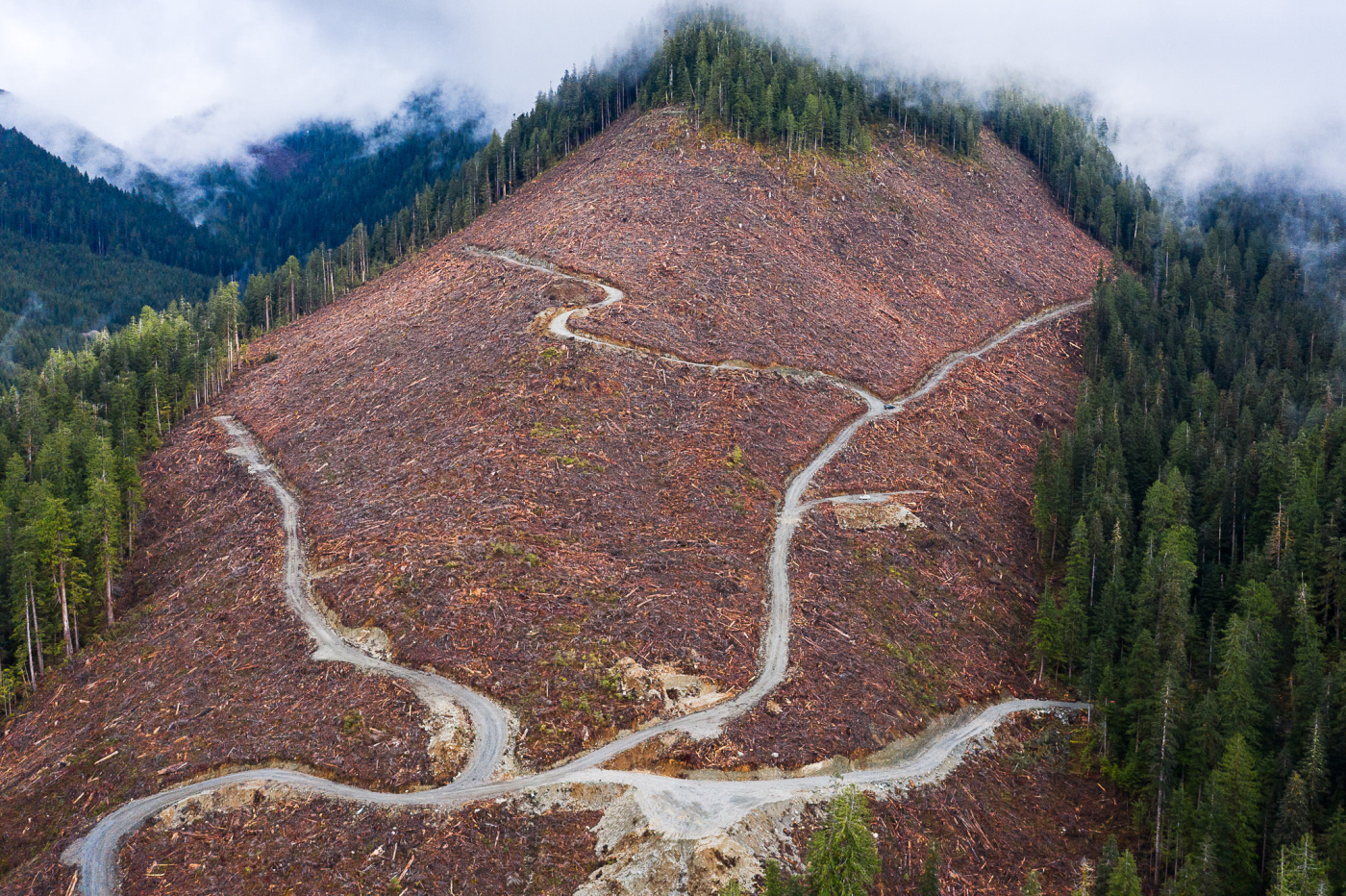
 https://ancientforestalliance.org/wp-content/uploads/2026/09/Old-Growth-Clearcut-Caycuse-Vancouver-Island.jpg
1364
2048
TJ Watt
https://ancientforestalliance.org/wp-content/uploads/2026/05/Ancient-Forest-Alliance-logo.svg
TJ Watt2026-10-26 15:06:162026-10-26 15:06:16Victoria Buzz: Environmental advocates concerned over results of BC election
Related Posts
https://ancientforestalliance.org/wp-content/uploads/2026/09/Old-Growth-Clearcut-Caycuse-Vancouver-Island.jpg
1364
2048
TJ Watt
https://ancientforestalliance.org/wp-content/uploads/2026/05/Ancient-Forest-Alliance-logo.svg
TJ Watt2026-10-26 15:06:162026-10-26 15:06:16Victoria Buzz: Environmental advocates concerned over results of BC election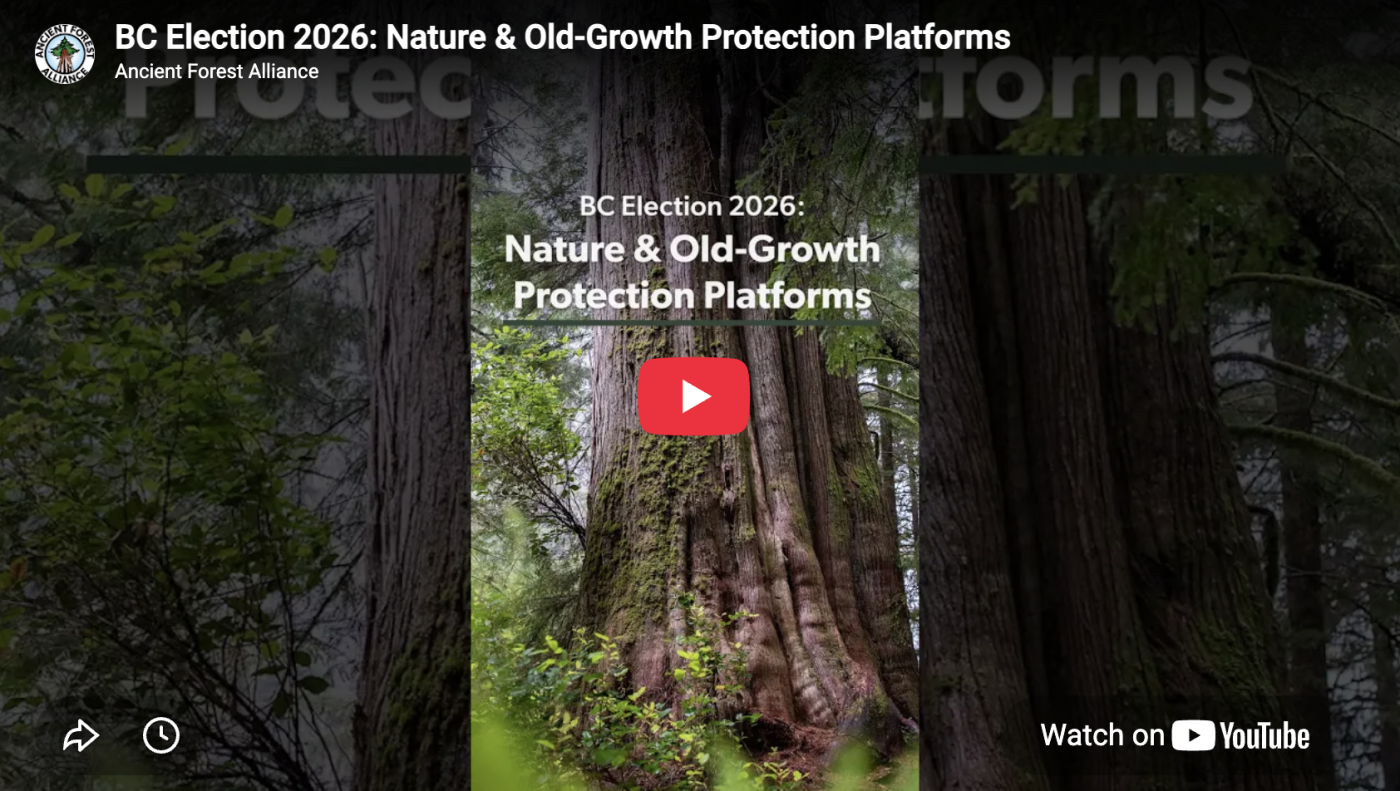 https://ancientforestalliance.org/wp-content/uploads/2026/10/Screenshot-2026-10-22-at-4.54.32-PM.png
952
1684
TJ Watt
https://ancientforestalliance.org/wp-content/uploads/2026/05/Ancient-Forest-Alliance-logo.svg
TJ Watt2026-10-22 16:54:062026-10-22 16:59:41NEW Video: BC Election 2026: Nature & Old-Growth Protection
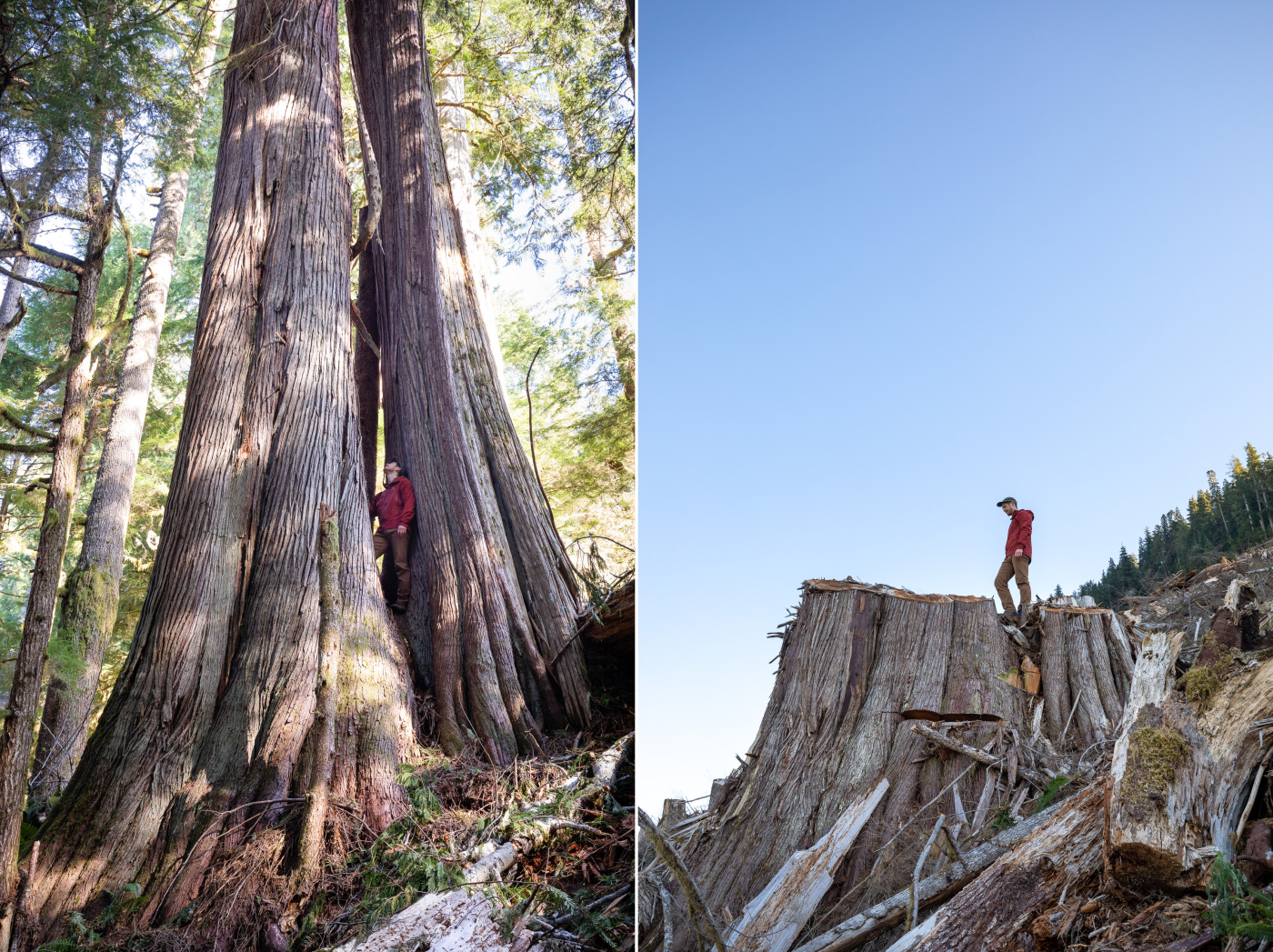 https://ancientforestalliance.org/wp-content/uploads/2026/10/Before-After-Caycuse-TJ-Watt-4-scaled.jpg
1915
2560
TJ Watt
https://ancientforestalliance.org/wp-content/uploads/2026/05/Ancient-Forest-Alliance-logo.svg
TJ Watt2026-10-16 17:36:002026-10-21 13:40:23BC Election 2026: Where do Parties Stand on Nature & Old-Growth?
 https://ancientforestalliance.org/wp-content/uploads/2026/10/BC-Election-2026-Banner-1-1-scaled.jpg
1439
2560
TJ Watt
https://ancientforestalliance.org/wp-content/uploads/2026/05/Ancient-Forest-Alliance-logo.svg
TJ Watt2026-10-09 18:16:372026-10-16 17:44:41Where do BC’s Major Political Parties Stand on Nature Protection?
Take Action
 Donate
Support the Ancient Forest Alliance with a one-time or monthly donation. Send a Message
Send an instant message to key provincial decision-makers.
The Economics of Protecting Old-Growth Forest: An Analysis of Spotted Owl Habitat in the Fraser Timber Supply Area of British Columbia
/in AnnouncementsA 2008 study from SFU showed that old-growth forests in the southwestern mainland of BC are more valuable if left standing than if logged, based on their value for tourism, recreation, carbon, and non-timber forest products. Vancouver Island has even more old-growth forest tourism and carbon rich forests than the Fraser Timber Supply Area on the mainland where the study focused, and it's likely that any such economic analysis would show even stronger results for the economic case to protect our old-growth forests on the Island. See the study: https://davidsuzuki.org/publications/reports/2008/the-economics-of-protecting-old-growth-forest-an-analysis-of-spotted-owl-habitat/ And see the full resolution of the BC Chamber of Commerce calling for expanded protection of old-growth forests here:
https://ancientforestalliance.org/news-item.php?ID=1009
********
This document is a detailed economic study of forests inhabited by the endangered spotted owl. The study, led by Duncan Knowler, an associate professor at Simon Fraser University's School of Resource and Environmental Management, looks at the economics of protecting old-growth forests inhabited or known to have been home to the spotted owl, one of the most endangered forest-dwelling bird species on the North American continent.
The goal of this study was to take a first step towards a rigorous examination of the main land use options for coastal old growth forest with the intent of determining which one is optimal for society. Its authors do not estimate the value of all costs and benefits associated with the different land use options; instead, they focus on estimating the forest values related to timber, non-timber forest products, recreation and carbon sequestration/storage. They do not attempt to estimate other ecosystem services such as watersheds, nutrient cycling, and control of soil erosion. The report assesses the opportunity costs of preservation of old growth forests with adjustment for these selected potential benefits from preservation. As such, the study is concerned with spotted owl conservation but not exclusively so. The study considers a specific forest area, the Fraser Timber Supply Area (TSA), which is located in southwestern British Columbia to the east and northeast of Vancouver.
The results suggest that under a broad range of parameter assumptions there would be a net benefit rather than an opportunity cost associated with increased preservation of old growth forests. In other words, the benefits of preservation in terms of increased recreational opportunities, non-timber forest products, and carbon sequestration and storage outweigh the costs in terms of lost producer surplus from timber harvesting.
A short summary of this report, Dollars and Sense: The Economic Rationale to Protect Spotted Owl Habitat in BC, is also available.
See here to download PDF of report
Editorial: Good ecology is good economics
/in News CoverageWhat’s good for the environment is good for the economy. That’s a concept most British Columbians embrace and it’s what the B.C. Chamber of Commerce appears to have decided in seeking protection for some old-growth forests.
The chamber voted this week to ask the province to expand protection of old-growth forests in areas where they have, or likely would have, greater economic value if left standing.
The resolution also called on the province to enact new regulations — incorporating such strategies as an old-growth management area, wildlife-habitat area or land-use order — with an eye on eventually legislating permanent protection through provincial-park or conservancy status.
The doesn’t mean the chamber of commerce has suddenly become an environmental-advocacy group — it still has its eye firmly on the economy. The proposal applies only to old-growth forests in areas accessible for tourism — the chamber still supports loggers’ rights to harvest timber for more remote forest stands, even if they have ecological value.
Still, it’s an acknowledgment that forests can have value beyond the amount of timber than can be taken out of them.
Natural resources have always been important to B.C. — logging, mining and fishing have long been mainstays of the province’s economy. But B.C. is also known for its incredible natural environment, and the province’s two aspects often collide.
The conflict between the economy and the environment reached a peak in the mid-1990s, when protests and blockades were set up to prevent the clear-cutting of old-growth forest in Clayoquot Sound. It was a tipping point that brought about a major shift in policies and attitudes.
The timber industry was no longer “king” in B.C., and non-aboriginals began increasingly to see through the eyes of peoples for whom the forest has been home for millennia. It moved us closer to a balance between protecting the environment and sustainably harvesting its resources.
It’s an uneasy balance and, sadly, is often not achieved, but at least “sustainability” and “environmentally friendly” are widely accepted as worthwhile goals. It’s becoming more widely accepted that a healthy environment and a healthy economy are not mutually exclusive.
In fact, as the B.C. Chamber of Commerce indicates in its motion, protecting the environment can be good for business.
Old-growth forests and other pristine areas of B.C. attract an increasing number of visitors, and will continue to generate jobs forever. When an area is logged off, the jobs are gone until the forest regenerates, and that takes a long, long time. We should remember, too, that forests are about more than esthetics or recreation — they are vital to the health of our watersheds and even the air we breathe.
Businesses are increasingly recognizing that environmental sustainability is not only good business, it is essential. More and more investors are demanding that corporations be environmentally responsible as well as fiscally responsible.
They have recognized what we must all recognize — that if we don’t look after the environment, we won’t have an economy.
Read more: https://www.timescolonist.com/opinion/editorials/editorial-good-ecology-is-good-economics-1.2268661
B.C. Chamber of Commerce hugs old-growth trees
/in News CoverageThe largest business-advocacy organization in B.C. has voted to protect old-growth forests while still also supporting loggers’ access to valuable resources.
In a move environmentalists are calling a “historic shift,” the B.C. Chamber of Commerce voted this week in favour of a motion calling on the province to expand protection of old-growth forests in areas where they have, or likely would have, greater economic value if left standing.
“It’s a huge, huge tectonic shift in the politics of land use in B.C.,” said Ken Wu, executive director for the Ancient Forest Alliance.
“It changes the narrative for a lot of the province, especially rural B.C., where the traditional belief has been that if you protect old-growth forests, you undermine the economy. But the opposite is being shown to be true now.”
The resolution also called on the province to enact new regulations — incorporating such strategies as an old-growth management area, wildlife-habitat area or land-use order — with an eye on eventually legislating permanent protection through provincial park or conservancy status.
The proposal would apply only to accessible old-growth forests and not to isolated forest stands, even if they have ecological value.
Dan Baxter, spokesman for the B.C. Chamber of Commerce, said the members took a balanced approach, recognizing that natural resources, forestry and mining remain the foundation of the economy.
“I think our membership took a holistic look at the issue and recognized that there are certain situations and communities where old-growth forests are a viable, long-term economic generator,” Baxter said.
“At the same time, our membership does recognize that we need to have certainty and predictability accessing land, so we have a resolution that also passed that looked at ways to ensure that we don’t unduly impact access to timber harvest lands, either.”
Dan Hager, president of the Port Renfrew Chamber of Commerce, said his community’s economy has shifted from logging to tourism — first sport fishing, but more recently as a big-tree destination with draws like Big Lonely Doug and the Red Creek Fir.
Since Avatar Grove was protected in 2012, area accommodation providers report increased demand of about 75 to 100 per cent each year, Hager said. And while tourism used to drop significantly in winter months — off-season for sport fishing — activity has steadily increased even when fishing charters are not operating.
“Thanks to the trees, Port Renfrew is no longer a one-industry tourism town and has been able to successfully brand itself the ‘Tall Tree Capital of Canada,’ ” said Hager, who co-owns Handsome Dan’s cottage rentals. Hager sponsored the old-growth protection resolution.
Both Wu and Hager expressed hope that the resolution might push the province to give regulatory protection to 3.2 hectares of Crown land in the Central Walbran Valley, where forest products company Teal Jones Group has a cutblock permit.
The old-growth forest already draws hikers and visitors. But B.C. Supreme Court granted the logging company an injunction extension to keep environmental activists from impeding its work.
Forests Minister Steve Thomson was not available for comment and a ministry spokesman did not say whether the province would consider the chamber’s resolution.
“While some communities on Vancouver Island have successfully diversified their local economies more into tourism, many are still heavily dependent on forestry,” a ministry spokesman said.
“Given that old-growth forests make up 45 per cent of public coastal forests, it is not possible to fully stop logging in old-growth forests without having a severe negative impact on local employment.”
Seventy-five per cent of the original, productive old-growth forests have been logged on B.C.’s southern coast, according to the Ancient Forest Alliance.
Read more: https://www.timescolonist.com/news/local/b-c-chamber-of-commerce-hugs-old-growth-trees-1.2267701