 https://ancientforestalliance.org/wp-content/uploads/2026/09/Old-Growth-Clearcut-Caycuse-Vancouver-Island.jpg
1364
2048
TJ Watt
https://ancientforestalliance.org/wp-content/uploads/2026/05/Ancient-Forest-Alliance-logo.svg
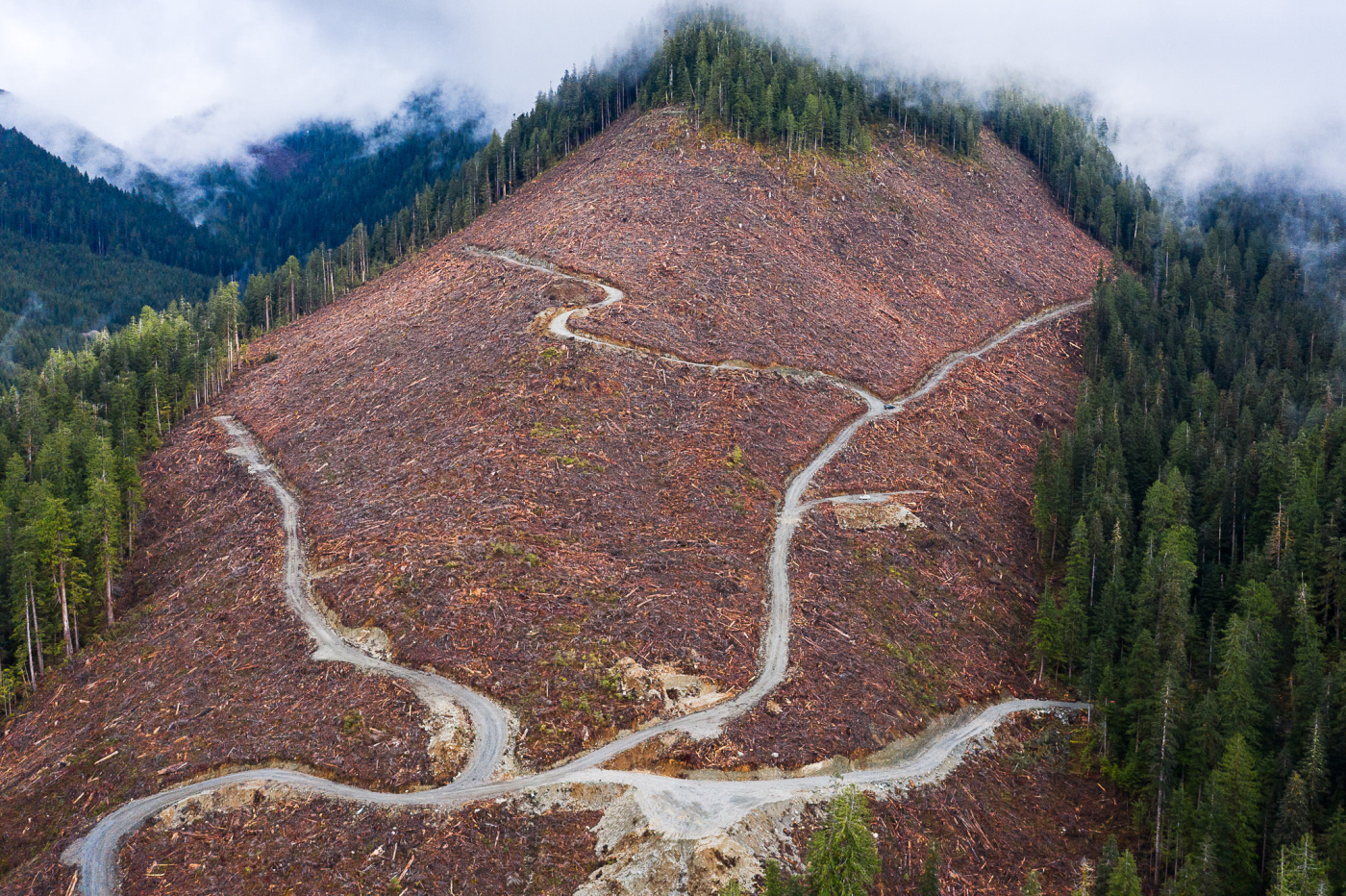
TJ Watt2026-10-26 15:06:162026-10-26 15:06:16Victoria Buzz: Environmental advocates concerned over results of BC election
Related Posts
https://ancientforestalliance.org/wp-content/uploads/2026/09/Old-Growth-Clearcut-Caycuse-Vancouver-Island.jpg
1364
2048
TJ Watt
https://ancientforestalliance.org/wp-content/uploads/2026/05/Ancient-Forest-Alliance-logo.svg
TJ Watt2026-10-26 15:06:162026-10-26 15:06:16Victoria Buzz: Environmental advocates concerned over results of BC election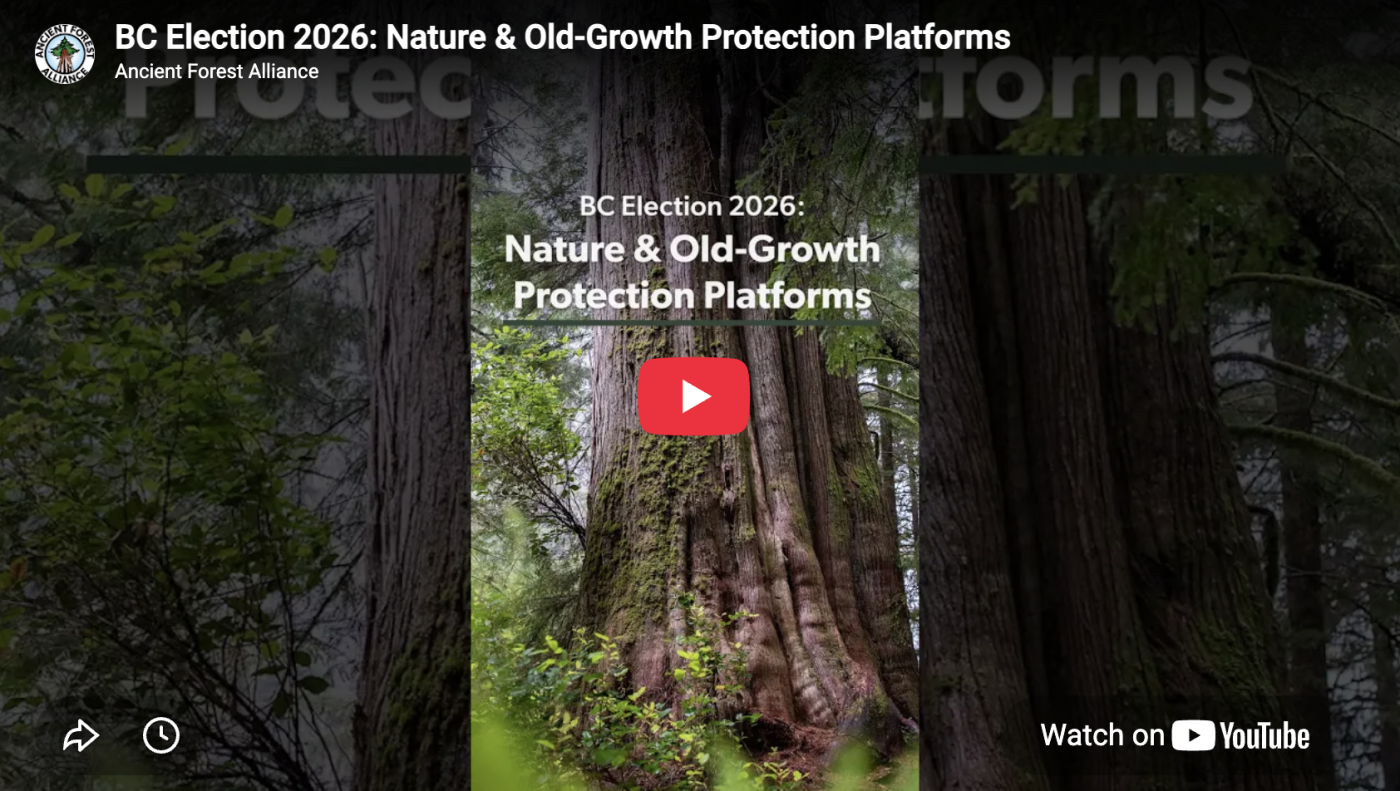 https://ancientforestalliance.org/wp-content/uploads/2026/10/Screenshot-2026-10-22-at-4.54.32-PM.png
952
1684
TJ Watt
https://ancientforestalliance.org/wp-content/uploads/2026/05/Ancient-Forest-Alliance-logo.svg
TJ Watt2026-10-22 16:54:062026-10-22 16:59:41NEW Video: BC Election 2026: Nature & Old-Growth Protection
 https://ancientforestalliance.org/wp-content/uploads/2026/10/Before-After-Caycuse-TJ-Watt-4-scaled.jpg
1915
2560
TJ Watt
https://ancientforestalliance.org/wp-content/uploads/2026/05/Ancient-Forest-Alliance-logo.svg
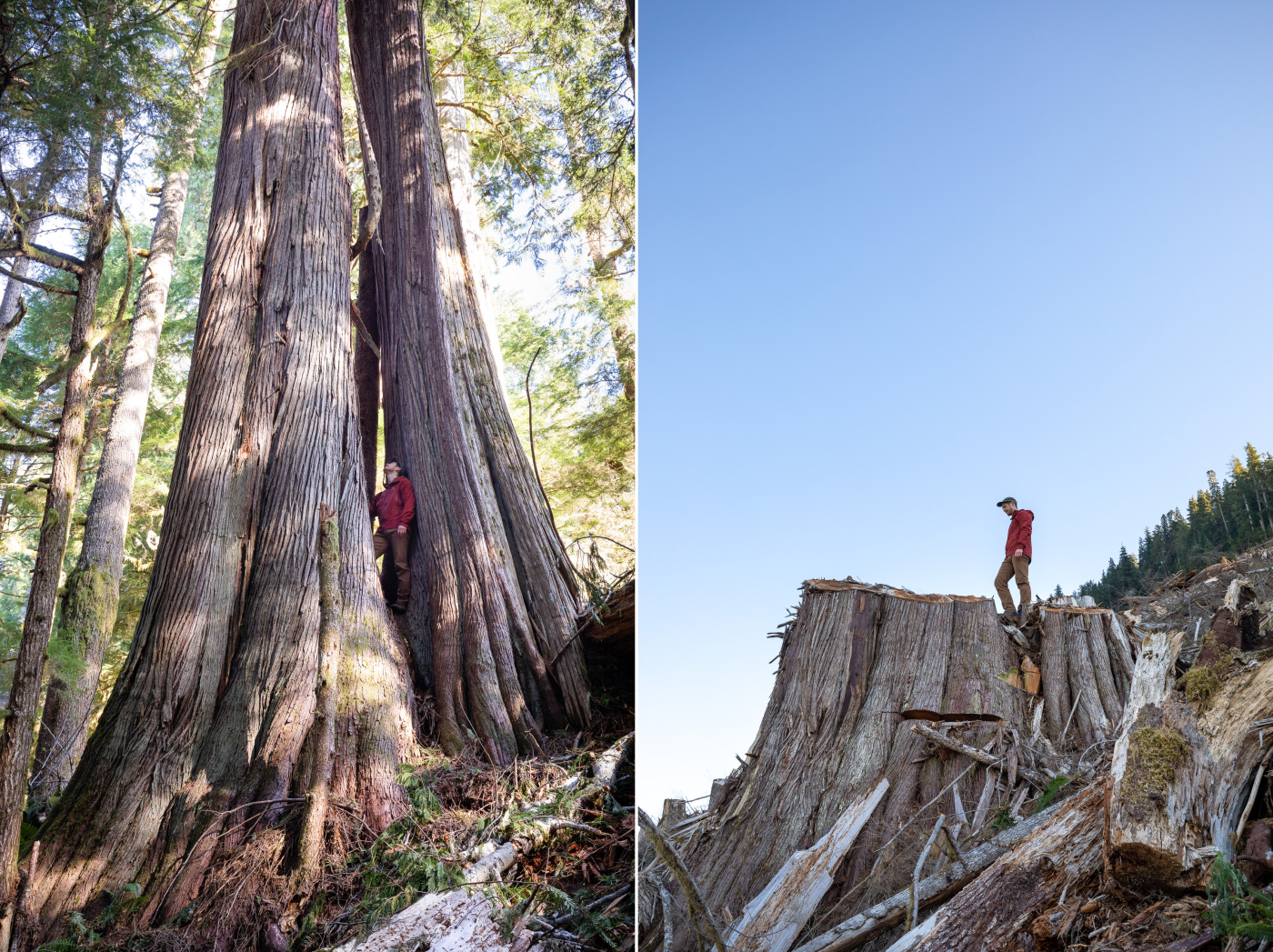
TJ Watt2026-10-16 17:36:002026-10-21 13:40:23BC Election 2026: Where do Parties Stand on Nature & Old-Growth?
 https://ancientforestalliance.org/wp-content/uploads/2026/10/BC-Election-2026-Banner-1-1-scaled.jpg
1439
2560
TJ Watt
https://ancientforestalliance.org/wp-content/uploads/2026/05/Ancient-Forest-Alliance-logo.svg
TJ Watt2026-10-09 18:16:372026-10-16 17:44:41Where do BC’s Major Political Parties Stand on Nature Protection?
Take Action
 Donate
Support the Ancient Forest Alliance with a one-time or monthly donation. Send a Message
Send an instant message to key provincial decision-makers.
Twenty years after clash at Clayoquot Sound, activists see new wave of unrest on the horizon
/in News CoverageTwenty years after a protest led to massive arrests on logging roads in Clayoquot Sound the organizers say a lot has changed – but a lot hasn’t, and they predict a new generation of activists may soon be on the barricades again.
The issue next time could be pipeline development or, once again, logging.
Where or when remains unpredictable, as was the Clayoquot rally. That summer thousands of people flocked to camp out in the Black Hole, just outside Tofino on Vancouver Island, and to stand in ranks across logging roads despite threats of arrest by the RCMP.
Hundreds were dragged away. But the Australian band Midnight Oil rocked through the night and the next day people got up and defied the law again.
The event threw the NDP government into shock – and led to a negotiated compromise. Clear-cut logging, then a practice favoured by industry and government, would be ended and a scientific panel would guide logging in the area.
It was a dramatic victory – but it didn’t end the environmental problems in B.C. Clayoquot Sound is still being logged and a mine is proposed in the area. B.C.’s Interior forests are currently being logged at a rate many say is unsustainable. Old-growth trees, some more than 1,000 years old, are routinely cut down. The Port of Metro Vancouver is pushing for increased coal shipments – and two separate oil pipeline projects are being proposed in B.C., despite widespread public concern.
“People have asked me many times, is there going to be another Clayoquot? Is this the next Clayoquot? Is that the next Clayoquot?” said Valerie Langer, a key organizer of the 1993 protest who was then with Friends of Clayoquot Sound.
“But I don’t think you manufacture things like Clayoquot ’93,” she said. “That was a factor of a broad provincewide tension about forestry, a good place to focus that [concern] – and a group that was ready to fly with it.”
However, all those factors could easily come together again in B.C., said Ms. Langer, who is now with the environmental group, ForestEthics Solutions.
“I do feel that kind of happening with the tar sands/pipeline campaign,” she said, referring to the movement to stop Enbridge Inc. from building its proposed project across B.C.
Ms. Langer said the Clayoquot protest seemed to come out of nowhere, but the mood that drove it had actually been building for years, as the government allowed industry to clear cut the forests of B.C., despite growing public objections.
She senses that same “kind of desperate feeling” simmering in the public now over the prospect of a pipeline snaking across the province to feed a parade of oil tankers plying the waters of the Great Bear Rainforest.
“I don’t think the federal and provincial governments have really cottoned on to that [public unrest] yet,” said Ms. Langer. “But this is something that builds and then there is a moment – and you never know exactly where and exactly when that will be – when it explodes.”
Vicky Husband, who was head of the Sierra Club in B.C. in 1993, said one of the reasons the Clayoquot protest got so big so fast was because people could easily drive to the area to see for themselves what environmentalists were complaining about.
The highway from Port Alberni to Tofino cut right through an active logging area, including the Black Hole, where the old-growth forest had been stripped, and then the landscape burned.
“Clayoquot Sound and Tofino were at the end of the only paved road to the open Pacific. And that’s critical. People could get there. They could see the horror show of what was going on with the logging,” she said.
Ms. Husband said she’s alarmed at the level of logging now taking place in B.C., and at government plans to privatize public forest lands. She’s horrified by the prospect of oil pipelines crossing B.C.
Do you think, she was asked, that we need another big environmental protest in B.C?
“Yes, I do,” she said, “because I don’t think we have a government that understands.”
Read more: https://www.theglobeandmail.com/news/national/mass-arrests-during-war-in-the-woods-20-years-ago-prompted-lasting-change/article13703844/
Clayoquot protest 20 years ago transformed face of environmentalism
/in News CoverageIt’s hard to believe, for me at any rate, that Friday marked the 20th anniversary of the mass arrests at Clayoquot Sound, an event that transformed the face of environmentalism and forced governments and corporations to start taking such concerns seriously.
The protests at Clayoquot Sound, which lies just off Tofino on Vancouver Island’s outer coast of pristine beaches, rugged coastlines, islets, inlets and tranquil sheltered coves, represented the coalescing of public objections to clearcut logging plans by corporations who were following government policy in majestic old-growth forests.
There had been sporadic protests from Haida Gwaii to Meares Island involving First Nations activists and environmentalists, but they were considered a radical fringe by government and routinely dismissed by media as nutty extremists, “tree huggers” and flakes.
However, at Clayoquot Sound, the protest went big and it went mainstream. People came from all over the country and beyond. Teachers, artists, musicians, university students and their professors, working folk, soccer moms, dentists, doctors and First Nations elders descended on the West Coast to put a stop to clearcutting by blockading a road.
What followed was the largest mass arrest for civil disobedience in the province’s history.
Twenty years on, perhaps it’s worth remembering what launched the protests — and what the protests launched.
For one thing, they represented a new approach to public protest over environmental issues.
Five months earlier, a couple of Tofino-based activists, Garth Lenz and Valerie Langer, took the principle of thinking globally while acting locally to heart. They got on a plane and flew to Europe to persuade international organizations in Britain, Germany, Austria and other countries that protecting at least a remnant of B.C.’s ancient rainforest was important.
And they next took their campaign into the marketplace itself, urging organizations to pressure major buyers to cancel contracts with B.C. suppliers of paper and paper products on moral grounds.
As history shows, it was a stroke of strategic genius. Major environmental organizations like Greenpeace International came on board. The Washington-based Natural Resources Defense Council and its high profile spokesman Bobby Kennedy Jr. took up the cause. The Australian rock band Midnight Oil flew in to put on a concert for the protesters.
Langer and other campaigners adroitly got the campaign branded the “War in the Woods,” polarizing debate into those who favoured mowing down the forests for industry and those who wanted to save an ecosystem from corporate greed.
Whether one agrees with this perception or not — and many in resource communities didn’t — it proved a defining wedge issue that made it easy for people to choose sides.
Eventually, the NDP government struck a special science panel to address the environmental concerns in Clayoquot Sound and, in 1995, all of its unanimous recommendations for resource and ecosystem management were adopted by the province.
Five years later, the entire Clayoquot Sound was designated as a global biosphere reserve by UNESCO.
But the tremors from the Clayoquot protests and the campaigns that emerged from them continue to shape our political landscape.
Fallout from the Clayoquot campaign continues to conflict the provincial NDP, which in 1993 had to choose between its blue-collar labour union roots and a new generation of young people concerned about green issues. The resulting rupture and subsequent migration of the disaffected to the Green party continues to plague it today.
Many of those who went to Clayoquot Sound as teenagers or students are now at the forefront of campaigns that seek to shape environmental policy on Alberta’ oilsands, pipelines across B.C., Canada and the U.S., tanker traffic, fish farms, mining ventures and protection for the boreal forest.
The market campaign strategies formulated to pressure government and business with respect to old-growth forests in Clayoquot Sound led to the campaign to protect the so-called “Great Bear Rainforest” on B.C.’s mid-coast, another example of shrewd branding.
The commercial salmon farming industry was forced to treat environmental concerns seriously when market campaigns were launched in the U.S. differentiating wild from farmed product.
And today there’s a pantheon of environmental organizations that are household names — Greenpeace, Rainforest Action Network, Dogwood Alliance, Natural Resources Defense Council, Living Oceans Society, Friends of Clayoquot Sound — which employ similar market-based campaigns from Brazil to the United Kingdom over everything from biofuels to logging of tropical hardwoods.
Among the individuals who emerged from the Clayoquot protests to take leading roles in helping shape and influence environmental policy at the international, national and provincial level:
• Tzeporah Berman, one of those arrested and jailed in 1993, went on to an international role with Greenpeace. She helped found ForestEthics and, in 2009, was appointed by B.C.’s premier to the Green Energy Task Force and granted an honorary doctorate from UBC this spring.
• Ken Wu, leads the Ancient Forest Alliance in seeking protection for B.C.’s biggest, oldest and most significant forests, an end to raw log exports in order to guarantee supply for B.C. mills and a re-tooling of those mills to shift their resource base from old growth to second growth.
• Chris Genovali is executive-director of Raincoast Conservation Foundation, which enables scientific research that supports conservation and protection of waters, wildlife and lands in coastal B.C. Its campaigns include ending the trophy hunting of grizzly bears, mapping marine bird distribution and abundance and protecting resident killer whales.
• And, of course, Langer, who’s now with the Canadian arm of ForestEthics, ForestEthics Solutions and still campaigns tirelessly to protect the boreal forest and the mid-coast rainforest and Lenz, who’s had a distinguished career as a wildlife and conservation photographer with an international reputation.
Agree with them or not, the graduates of Clayoquot Sound care about the world they live in. They were prepared to fight for it then — and they are still fighting now — and that has made Canada a better place.
Thank you to Seventh Heaven Bio Salon Fundraiser!
/in AnnouncementsThanks to Seventh Heaven Bio Salon in co-operation with Green Circle Salons for their “Haircuts not Clearcuts” fundraiser for the Ancient Forest Alliance this past Sunday, August 4th, at the Spirit of the Sea Festival in White Rock!
Entertaining, educational and hair enhancing master stylist, Champ Waterhouse, dressed as a cowboy, was a scissor slinging, straight cutter raising funds and awareness for AFA, with the ‘clearcut’ hair being re-purposed for such uses as oil spill cleanup.
For more information about Seventh Heaven and their evolution for healthy beauty, visit www.seventhheavenbiosalon.com