https://ancientforestalliance.org/wp-content/uploads/2026/04/2025-Activity-Report-Financials-scaled.png
1440
2560
TJ Watt
https://staging.ancientforestalliance.org/wp-content/uploads/2014/10/cropped-AFA-Logo-1000px.png
TJ Watt2026-04-30 16:32:192026-04-30 16:32:192025 Activity Report & FinancialsRelated Posts
https://ancientforestalliance.org/wp-content/uploads/2026/04/2025-Activity-Report-Financials-scaled.png
1440
2560
TJ Watt
https://staging.ancientforestalliance.org/wp-content/uploads/2014/10/cropped-AFA-Logo-1000px.png
TJ Watt2026-04-30 16:32:192026-04-30 16:32:192025 Activity Report & Financials
The Tyee: BC ‘Going Backwards’ on Ecosystem Protections
Advocates, the BC Greens, and a former cabinet minister take aim at the NDP’s stalled efforts to protect ecosystems, such as old-growth forests.

The Tyee: BC Must Stop Blaming First Nations for Old-Growth Logging
BC is increasing logging while lagging on old-growth protection. Experts say the province should fund First Nations to conserve forests instead.

Western Coralroot
Meet one of the rainforest’s loveliest yet strangest flowers: the western coralroot!
Take Action
Donate
Support the Ancient Forest Alliance with a one-time or monthly donation.
Send a Message
Send an instant message to key provincial decision-makers.
Get in Touch
AFA’s office is located on the territories of the Lekwungen Peoples, also known as the Songhees and Esquimalt Nations.
Copyright © 2026 Ancient Forest Alliance • All Rights Reserved
Earth-Friendly Web Design by Fairwind Creative


Red Cedar: The Amazing Giving Tree
/in News CoverageThe Tyee
September 15, 2020
Its future in doubt, no other tree has provided such abundance and identity for northwest peoples, or such habitat and carbon storage in the forest. First in a series.
[Editor’s note: This is the first of a series about the cedars of British Columbia, their vital role in this place’s ecologies, their endangered future, and people working on ways to save them from impending extinction.]
Western red cedar takes hold of the senses. The Big Tree Trail boardwalk in protected Wah-Nah-Jus Hilth-hoo-is (Meares Island Tribal Park), a short boat ride from Tofino in Tla-o-qui-aht territory, is built of hand-split cedar planks redolent of the tree’s sweet oil. All around is shaggy cedar bark. Branches of feathering leaves dance in the breeze like a fringe skirt, curving upward at the ends as if giving thanks to the sun.
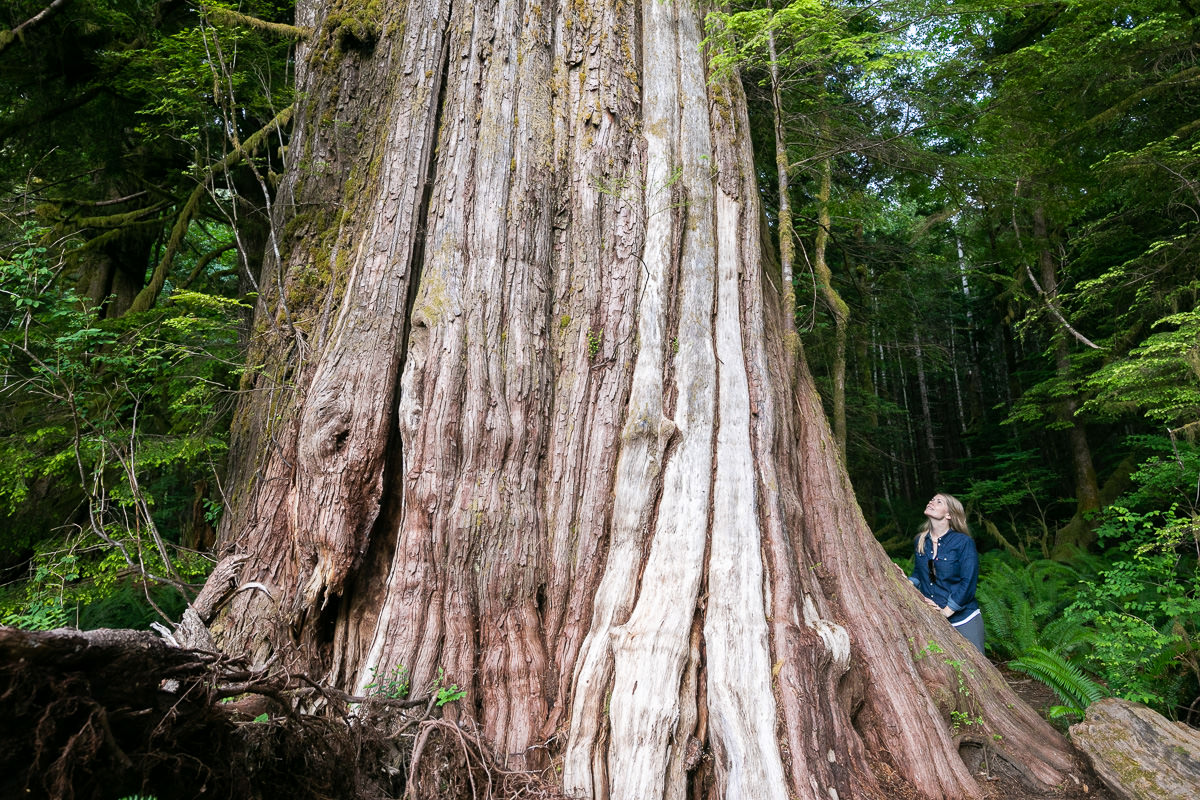
The trail leads to a sign marking “Hanging Garden.” From the decaying trunk of a 1,500-year-old, five-and-a-half-metre-wide red cedar — one of the largest and oldest life forms on Earth — lichens cling, hemlock and alder trees sprout, sword ferns unfurl, and bats and bears make their roosts. It may be slowly dying, but this tree is full of life.
Elsewhere in British Columbia, the red cedar is not so lucky. It’s having trouble adapting to capitalism and climate change, and living out its long life in a shifting forest.
Red cedar, proclaimed the official tree of B.C. in 1988, naturally grows in cool, moist climates from Northern California to Alaska and just west of the Rocky Mountains in one of the world’s only inland temperate rainforests. The tree is known to scientists as thuja plicata, but it goes by many names: Pacific red cedar, giant cedar, canoe cedar, giant arborvitae. Not a true cedar but a woody member of the cypress family, the Latin arbor-vitae may be most accurate; it translates to “tree of life.” Indigenous terms of affection include “mother” or “grandmother cedar,” “maker of rich women,” and “long life maker.” The Nuu-chah-nulth name is huu-mis, huu signifying something long-lasting, perhaps across space and time.
While plant fossils show that a tree like red cedar has been growing around the northwest for as long as 50 million years, the species has only become widespread in the past 4,000 to 5,000 years — long after humans arrived in the region, says Richard Hebda, a paleontologist and adjunct associate professor at the University of Victoria.
Coast Salish oral history tells that before there was red cedar, there was a generous man. Whenever his people were in need, the man gave food and clothing. Recognizing the man’s good work, the Creator declared that when he died, a red cedar would grow where he was buried and continue to provide for the people. Red cedar did just that, co-evolving with First Nations and helping them build sophisticated societies of unparalleled wealth, abundance and ingenuity.
Prior to cedar, canoes and homes on the coast were often built of Sitka spruce. But once abundant, mother cedar became the tree of choice at least 3,000 years ago. “Without the environment we live in, we are not who we are,” Hebda says.
There are several likely reasons for the shift. The wood is lightweight and straight-grained, making it easy to split without a saw. Perhaps more important, mature cedars produce a natural fungicide, thujaplicin, which prevents rot in moldy northwest climates.
The largest cedar trees offered their wood for homes, totem poles and canoes. These vessels were packed with cedar tools, from paddles and nets to hooks, lures and fishing floats. Cedar’s soft inner bark supplied clothing and comfort; it was woven into tunics, mats, and blankets or shredded to make fluffy towels, diapers and sanitary pads. (Yellow cedar is also prized for its strong, dense wood and silky inner bark; see sidebar for more about B.C.’s other sacred cedar).
Red cedar withes — vine-like appendages that swoop down from branches — were twisted into ropes so strong they could haul in 40-tonne whales. Roots were coiled into baskets tight enough to boil water. And the flat green leaves, which look like scaly braids, offered spiritual protection or calcium-rich medicine.
Babies were delivered into woven cedar cradles. Placenta was sometimes buried at the base of an old cedar to ensure long life. At the end of that life, people were laid to rest in cedar canoes and coffins, the tree embracing its people for eternity.
But industrial logging and climate change threaten to cut the tree’s future short, severing ancestral connections that spread wide and strong like roots. A central question may define red cedar’s fate: Can we learn to respect and protect the great giving tree before it’s too late?
The ‘tree of life’ and its people
Despite the forced separation from their native lands and cultures by white colonizers, many Indigenous people have maintained an intimate bond with red cedar. Tla-o-qui-aht Tribal Parks guardian and educator Gisele Maria Martin grew up with the sound of crackling cedar kindling and the smell of cedar sawdust on her father, Tla-o-qui-aht master canoe carver Joe Martin.
“I remember learning to make feathers to start fires with cedar and the tuck tuck tuck of a big log being carved with a hand adze,” Martin says.
But she’s wary of the focus on cedars’ many “uses,” which she says is a colonial frame that ignores the deep and spiritual relationship, built on care and reciprocity. “We did use cedar, of course,” Martin says. “But we also have a huge responsibility to cedar.”
Some Nations cut down whole trees for canoes and poles, but wood has been more often sourced from windfalls, or from standing trees without killing them. People were taught not to cut trees in the summer when eagles are nesting, and to avoid taking too much wood or risk being cursed by other cedars.
Before women collect bark from a young cedar, only in spring when the sap is running, prayers are offered and songs are sung. Removing bark triggers scars to heal over, but signs of historic and modern harvests are etched in the trunks — living archaeology.
“It’s impossible to not see cedar in a very particular way when you’re Indigenous to the west coast,” says Rande Cook, an artist and carver who’s a hereditary chief of the ’Na̱mg̱is and Ma’amtagila (Kwakwaka’wakw) First Nations.
Cook grew up with his grandparents in ’Na̱mg̱is territory (Alert Bay). He remembers cedar baskets full of berries, cedar bowls of eulachon oil, and teachings about red cedar trees holding the spirits of his ancestors.
“The trees are alive, they talk to each other, they create oxygen, they protect us,” Cook says. “They are serving a great purpose for all of us on this planet.”
Red cedar in the forest
Red cedar’s home — the northwest temperate rainforest — is a globally rare ecosystem that’s critical for purifying air and water, protecting biodiversity, defending salmon, and cooling the Earth. Old-growth temperate rainforest gulps and stores more carbon in its biomass than any other terrestrial environment and is less vulnerable to fires, floods, and other natural disturbances, making it one of our best defences in the fight against global climate change. Intact ancient rainforests with large trees are our greatest shield.
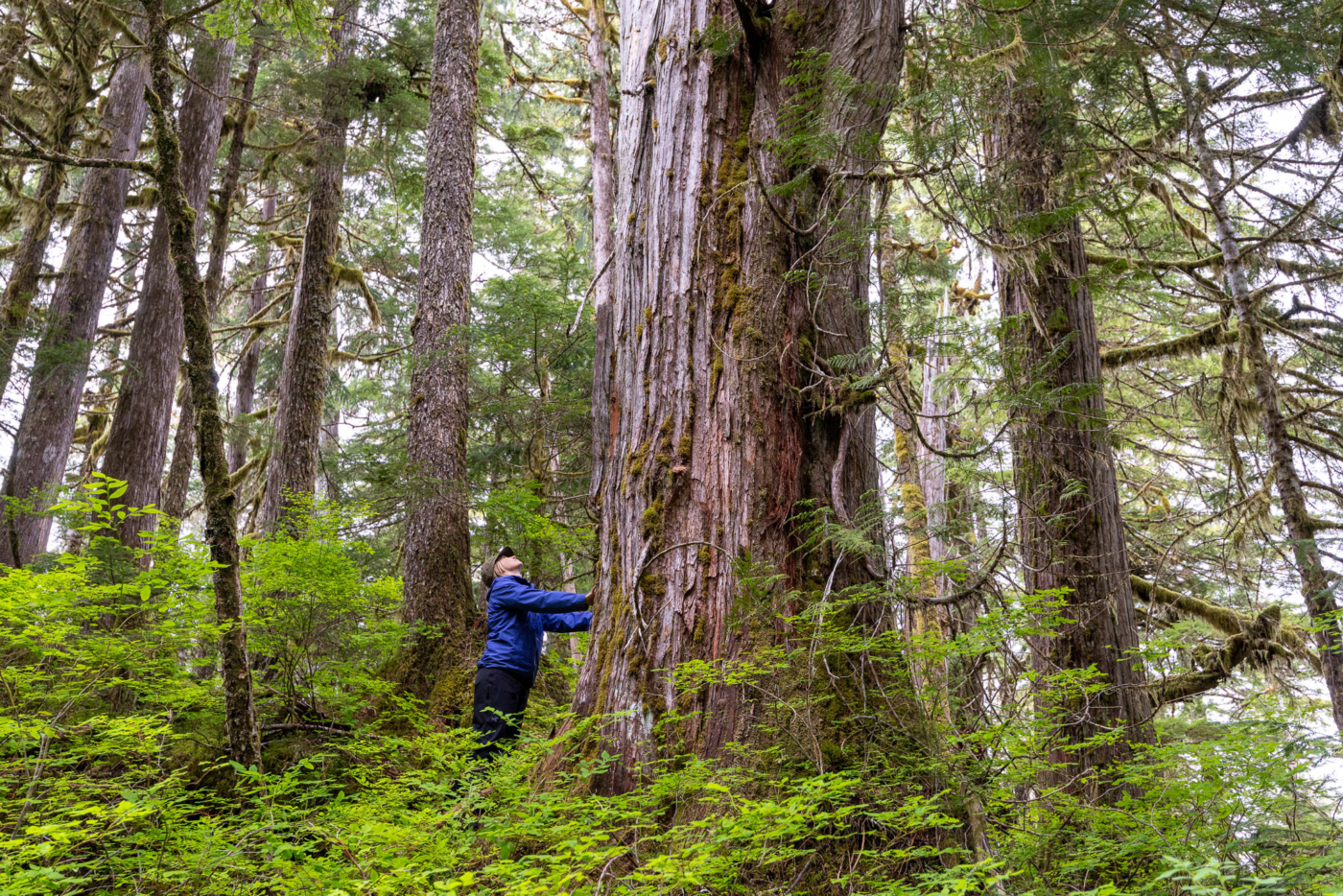
You can’t separate trees from the forest, but if you could, red cedar would play an outsized role. Commonly growing alongside western hemlock, Sitka spruce, and Douglas fir, red cedar is the largest tree in Canada. Record holders reach more than 20 stories tall, 20 metres around, and 450 cubic metres in volume. If you stacked five city buses vertically, you’d have something nearing the size of the Cheewhat Giant, the king of the B.C. forest. It’s not the biggest tree in the world — that’s red cedar’s cousin, the giant sequoia — but it’s up there.
Adding to its biomass, red cedar can reproduce asexually in a process known as layering. Branches or foliage that touch damp earth can sprout roots and become new saplings. Cedars are sometimes found in clusters of three to five, like a family or close circle of friends. Red cedar growing in isolation might just develop a mutant limb or a second head. But the finest cedars, those born under an old-growth canopy with feet deep in wet soil, rise straight and tall, slowly, toward the light.
“Red cedar shows its age and beauty but never looks old,” Hebda says. “It’s like an Ent in The Lord of the Rings, just this incredible, venerable being.”
Cedar is one of the best natural carbon banks on the planet thanks to its burly biomass and slow rate of decay. It can live for more than 1,000 years and, because of its anti-rot properties, dead trees or “snags” take hundreds more years to decompose. That can mean several metric tonnes of carbon stored by a single tree.
In fact, a dead cedar left in place is arguably even more important than a live one. Downed cedar trees become “nurse logs,” their spongy bark welcoming mosses, lichens, seedlings and insects to move in. Ancient cedars often hollow out like upside-down ice-cream cones, becoming favoured hibernation dens for black bears.
From talking trees to Timber Kings
Once considered a nuisance for the logging industry to cut down, red cedar became profitable starting in the late 1960s, as primary stands in Oregon and Washington were depleted. Before that, cedar was sometimes dumped into lakes where it floated until values increased enough for companies to come salvaging. But by 1988, the tree’s commercial reputation had turned around; red cedar was declared B.C.’s provincial tree due to its increasing worth and profound significance to First Nations.
Today, old-growth red cedar, defined by the province as being 250 years or older, is the most valuable log type, currently selling for two to five times the price of other conifers. Red cedar is made into a diverse range of products from acoustic guitars to utility poles, but it’s mostly cut into lumber, shingles, and shakes — more than 80 per cent of which is exported to the U.S.
Its long fibres are good for paper and pulp production, too. The Harmac Pacific pulp mill in Nanaimo has been churning out red cedar pulp to make the disposable blue masks and hospital gowns fighting COVID-19. The “tree of life” is literally saving lives.
BC’S SECOND CEDAR
Western red cedar has much in common with its sister in the cypress family: the yellow cedar, or yellow cypress. Both trees are long-lived, rot-resistant, revered members of the temperate rainforest, but yellow cedar is more rugged, rare, and lean. The heartwood is strong and dense, making it good for First Nations’ totem poles, house posts, and support beams. Yet, the inner bark is more pliable, absorbent, and anti-inflammatory than red cedar bark, so women often preferred it for baby diapers, sanitary napkins, wound dressings and fleecy nests to catch newborn infants.
In Hesquiaht oral history, three women were drying salmon on a beach when trickster raven scared them by pretending to be an owl. The women ran up the mountain in fright. Out of breath, they were transformed into the beautiful yellow cedars we often see on hillsides.
Like red cedar, yellow cedar can survive in diverse terrain. But it’s being hit hard by climate change, particularly receding snowpack that leaves its roots exposed to winter frost. Yellow cedar is, counterintuitively, freezing to death in a warming climate. Ancient yellow cedar is also being targeted by timber companies, notably on the Sunshine Coast and near the Fairy Creek watershed on southern Vancouver Island, where logging blockades broke out in August.
Bryan Reid Sr., a co-owner of Harmac Pacific, founded Pioneer Log Homes of B.C. in 1973. The company, now run by his son Bryan Reid Jr., builds and sells log homes almost entirely made of red cedar. Reid, who starred in the HGTV show Timber Kings and lives in a red cedar log home in Williams Lake, chose to base his business on the tree because of its durability against weather and termites. The wood also shrinks 30 per cent less than white woods such as spruce, fir, and pine, Reid says, making it less likely to crack.
“[Other wooden shakes would] rot or just split and blow off the roof,” Reid says, adding that red cedar wood has low density, making it a great insulator from heat, cold, and sound. “Cedar shines as being probably the most desirable fibre in the world for log homes.”
Pioneer Log Homes works with timber companies to select red cedar logs that have unique flutes, bark seams, and character for “Family Trees,” named by the Mormon family that first ordered one. These distinctive cedars, harvested down to their roots, often star as the centrepiece of a multi-million-dollar home.
“It’s like building a castle,” Reid says. “And you build it out of cedar, so you know it’s going to be there.”
The canary in the cutblock
But concern is mounting that red cedar, along with the old-growth forests that shelter them, may not always be with us. Once a prominent member of the coastal rainforest, red cedar made up 15 per cent of coastal vegetation by 2011, according to the B.C. Vegetation Resources Inventory. A recent scientific report found that less than one per cent of provincial forests contain the largest trees today.
Since becoming a high-value species in the mid-1990s, the forest industry has targeted old-growth red cedar to boost timber sales. And this may be getting worse. Representing about 20 per cent of the coastal wood supply, red cedar has comprised nearly 40 per cent of recent cuts.
Cedar struggles to reestablish after logging and is often browsed by deer, making it much less abundant in post-harvest stands than in mature and naturally regenerated forests. There’s a growing movement among First Nations, environmentalists, communities and ecologists to protect the ancient cedars and old-growth ecosystems that remain.
Adding to the assault on red cedar is climate change. It’s believed that drought stress causes leaves to turn reddish-brown and branches to drop off the crown, creating the characteristic “candelabra” or “cake fork” spikes (which also result from wind and other types of disturbance).
“They will essentially prune the less efficient parts distant to the supply of water,” Hebda says. “So the top of the tree will die, but the core of the tree lives, and can sprout and grow again.”
Climate models run by Hebda and others project that much of red cedar’s current range will be too warm and dry in the not-so-distant future. An extreme scenario shows the tree only surviving on about five per cent of Vancouver Island by 2080, as favourable climatic conditions migrate upslope, northward, and to parts of the interior predicted to get wetter.
Climate models aren’t perfect, Hebda admits, but the warnings for red cedar are clear: “It gets warm, it gets dry, you lose cedars,” he says. “It plays the canary in the coal mine when it comes to climate change.”
The same tree performs a vital function in reducing atmospheric carbon that causes climate change. It’s a paradox that Hebda muses may be understood, in some primal way, by the cedars themselves. “Some of these trees have experienced multiple cycles of climate variation in the last 1,000 years, and their connections to the past stretch back 50 million years, so they genetically know about this,” he says. “And the trees are going to be taking carbon dioxide out of the atmosphere, saving us from ourselves.”
“Old-growth has to be saved everywhere, whether it be cedar or otherwise,” Hebda adds. “And, of course, that means respecting and preserving the deep, multi-millennial relationship between the people and these ecosystems.”
Read the original article
B.C taking new approach to preserving old-growth forests
/in News CoverageMy Campbell River Now
September 12, 2020
The province is taking a new, holistic approach as a first step for the benefit of its old-growth forests.
This will include the protection of nine areas throughout the province, totalling almost 353,000 hectares.
In a break from the divisive practices of the past, the government plans to engage the full involvement of Indigenous leaders and organizations, labour, industry and environmental groups to work together in conserving biodiversity while supporting jobs and communities, especially on the coast and Vancouver Island.
The actions government is taking are informed by the independent panel report, A New Future for Old Forests.
“For many years, there has been a patchwork approach to how old-growth forests are managed in our province, and this has caused a loss of biodiversity. We need to do better and find a path forward that preserves old-growth forests, while supporting forest workers,” said Doug Donaldson, Minister of Forests, Lands, Natural Resource Operations and Rural Development.
“Those who are calling for the status quo to remain are risking crucial biodiversity loss, while those who are calling for immediate moratoriums on logging are ignoring the needs of tens of thousands of workers. Our government believes in supporting workers, while addressing the needs of old-growth forests, and these values will guide our new approach.”
Initial actions government is taking in formulating an old-growth strategy include:
The province says further work is also underway to protect up to 1,500 exceptionally large, individual trees under the Special Tree Protection Regulation.
This builds on the government’s announcement in 2019 that it would develop a permanent approach to protecting big, iconic trees.
To learn more about British Columbia’s commitment to forest stewardship is available at https://www2.gov.bc.ca/gov/content/industry/forestry/managing-our-forest-resources
Read the original article
Conservationists welcome old-growth panel report and positive first steps by BC government to address old-growth crisis
/in Media ReleaseVictoria BC – The Ancient Forest Alliance (AFA) is celebrating the BC government’s announcement today that it will defer logging in nine areas, including world-famous Clayoquot Sound, and protect some of BC’s biggest trees while it works to develop a new provincial approach to old-growth management. But they say much more work urgently needs to be done to protect BC’s at-risk old-growth forests while supporting BC forestry workers and First Nations communities.
The announcement coincides with the long-awaited release of a report, entitled A New Future for Old Forests, by an independent Old Growth Strategic Review panel, comprised of professional foresters Garry Merkel and Al Gorely, which contains 14 recommendations on how BC can better manage its endangered old-growth forests based on feedback gathered from thousands of British Columbians last fall and winter.
In addition to accepting and implementing the panel’s first recommendation to increase First Nations’ involvement in old-growth management, the BC government announced it will immediately defer logging in nine areas totaling almost 353,000 ha of forest across BC – 200,000 ha of which is old-growth.
The temporary deferrals include the entire unlogged McKelvie Valley near Tahsis in Mowachaht/Muchalaht territory on Vancouver Island, the Incomappleux Valley in Ktunaxa territory in BC’s Inland Temperate Rainforest, and over 250,000 ha in Clayoquot Sound, the largest intact area of old-growth forest on Vancouver Island, located in Tla-o-qui-aht, Ahousaht, and Hesquiaht territories.
“This is a positive first step, especially for Clayoquot Sound, which is home to some of BC’s most spectacular ancient forests,” stated Ancient Forest Alliance campaigner Andrea Inness. “Now, the province needs to uphold its commitment to work with First Nations in the region to further the implementation of their visions towards securing a future for their people and the old-growth forests in their territories.”
The province also announced a Special Tree Protection Regulation would be introduced to protect 1,000 to 1,500 of BC’s exceptionally large trees with one-hectare buffer zones around them.
“We welcome the BC government’s decision to protect more of BC’s biggest trees,” stated AFA campaigner and photographer TJ Watt. “We hope to see the Special Tree Protection Regulation expanded to capture additional trees as well as the province’s grandest groves.”
“More importantly, the BC government has signaled that it recognizes that fundamental changes are needed in the way old-growth forests are managed in BC. The panel’s report is a blueprint for a complete paradigm shift. The province now needs to commit to starting a process, based on science, to implement the Old-Growth Strategic Review panel’s recommendations over the three-year timeframe they suggest.”
“The immediate steps announced today are an encouraging start. However, they still leave out the vast majority of BC’s most endangered ecosystem types and highest productivity old-growth stands, which are of the greatest value to industry and species at risk. While the province has committed to working with First Nations leaders to identify and implement additional deferrals, they need to ensure these are located in BC’s highest risk ecosystems.”
According to a recent analysis by independent scientists, referenced in the panel’s report, only 2.7% of BC’s high productivity, big tree old-growth forests remain today and many of BC’s forest ecosystem types have very little old-growth remaining, leading to a high risk of permanent loss of biodiversity across much of BC. One of the panel’s recommendations to the province is to place logging deferrals in ecosystems and landscapes with very little old-growth forest remaining while a new strategy is implemented.
“We need to hear the BC government embrace both reports’ findings, make a strong commitment to put ecosystem health and biodiversity ahead of timber values, and set higher, science-based, legislated targets to protect old-growth forests, which the panel also recommends.”
“We also support the province’s commitment to work with First Nations leaders, governments, and organizations on old-growth management solutions – something the NDP government promised it would do in its 2017 election platform, but has only just begun,” stated Inness. “However, without funding for Indigenous-led land-use planning and sustainable economic alternatives for First Nations communities tied to old-growth protection, the main economic option being provided by the province for First Nations is old-growth logging.”
“A core part of the province’s strategy must include funding for the creation and stewardship of Indigenous Protected and Conserved Areas (IPCAs), First Nations’ sustainable economic development based on things like cultural and ecotourism, clean energy, and value-added wood manufacturing, and the purchase and protection of endangered old-growth forests on private lands.”
The BC government has stated that more work needs to be done to study the socio-economic impacts of the panel’s recommendations. To that end, the province has committed to undertaking an engagement process with conservation groups, stakeholders, labour unions, industry, and communities.
“Where there are socio-economic impacts, there needs to be economic support for First Nations, workers, and forest-dependent communities,” stated Inness. “This includes funding to support the transition to sustainable, second-growth forestry and away from logging old-growth, as recommended by the BC government’s own Select Standing Committee on Finance and Government Services in their Budget 2021 consultation report released last month. Without funding for these critical pieces, comprehensive old-growth protection cannot be achieved.”
“Today’s announcement could signal the start of a positive, new, science-based approach to old-growth management in BC. But it could just as easily signal the start of further delays and long, drawn-out consultation processes with few meaningful results. BC’s endangered ancient forests, communities, and at-risk species can’t afford to wait while the province decides which of the panel’s recommendations to implement and when. They need and expect action now.”
Facts about old-growth in BC:
Source: https://veridianecological.files.wordpress.com/2020/05/bcs-old-growth-forest-report-web.pdf