 https://ancientforestalliance.org/wp-content/uploads/2026/09/NorthernSpottedOwls.jpg
900
1200
TJ Watt
https://ancientforestalliance.org/wp-content/uploads/2026/05/Ancient-Forest-Alliance-logo.svg
TJ Watt2026-09-03 09:47:312026-09-03 09:47:31BC Has an Extinction Problem. Scientists Say There’s a Fix
https://ancientforestalliance.org/wp-content/uploads/2026/09/NorthernSpottedOwls.jpg
900
1200
TJ Watt
https://ancientforestalliance.org/wp-content/uploads/2026/05/Ancient-Forest-Alliance-logo.svg
TJ Watt2026-09-03 09:47:312026-09-03 09:47:31BC Has an Extinction Problem. Scientists Say There’s a FixRelated Posts
https://ancientforestalliance.org/wp-content/uploads/2026/09/NorthernSpottedOwls.jpg
900
1200
TJ Watt
https://ancientforestalliance.org/wp-content/uploads/2026/05/Ancient-Forest-Alliance-logo.svg
TJ Watt2026-09-03 09:47:312026-09-03 09:47:31BC Has an Extinction Problem. Scientists Say There’s a Fix https://ancientforestalliance.org/wp-content/uploads/2026/08/Canoe-Creek-Cedar-Tree-262.jpg
800
1200
TJ Watt
https://ancientforestalliance.org/wp-content/uploads/2026/05/Ancient-Forest-Alliance-logo.svg
TJ Watt2026-08-04 17:15:512026-08-04 17:15:51Thank you to our monthly business donors!
https://ancientforestalliance.org/wp-content/uploads/2026/08/Canoe-Creek-Cedar-Tree-262.jpg
800
1200
TJ Watt
https://ancientforestalliance.org/wp-content/uploads/2026/05/Ancient-Forest-Alliance-logo.svg
TJ Watt2026-08-04 17:15:512026-08-04 17:15:51Thank you to our monthly business donors! https://ancientforestalliance.org/wp-content/uploads/2026/07/Kaska-Territory.-Credit-Johnny-Mikes-CPAWS-BC-scaled-1.jpg
1707
2560
TJ Watt
https://ancientforestalliance.org/wp-content/uploads/2026/05/Ancient-Forest-Alliance-logo.svg
TJ Watt2026-07-24 15:34:372026-07-28 11:05:22Speak up for Three Major New Protected Areas in Northern BC
https://ancientforestalliance.org/wp-content/uploads/2026/07/Kaska-Territory.-Credit-Johnny-Mikes-CPAWS-BC-scaled-1.jpg
1707
2560
TJ Watt
https://ancientforestalliance.org/wp-content/uploads/2026/05/Ancient-Forest-Alliance-logo.svg
TJ Watt2026-07-24 15:34:372026-07-28 11:05:22Speak up for Three Major New Protected Areas in Northern BC https://ancientforestalliance.org/wp-content/uploads/2026/06/tahsish-river-old-growth-karst-forest-285-1.jpg
1366
2048
TJ Watt
https://ancientforestalliance.org/wp-content/uploads/2026/05/Ancient-Forest-Alliance-logo.svg
TJ Watt2026-07-20 10:46:412026-07-20 12:16:45Victoria Buzz: Old growth advocates call for protection of at-risk Vancouver Island forest
https://ancientforestalliance.org/wp-content/uploads/2026/06/tahsish-river-old-growth-karst-forest-285-1.jpg
1366
2048
TJ Watt
https://ancientforestalliance.org/wp-content/uploads/2026/05/Ancient-Forest-Alliance-logo.svg
TJ Watt2026-07-20 10:46:412026-07-20 12:16:45Victoria Buzz: Old growth advocates call for protection of at-risk Vancouver Island forestTake Action
 Donate
Support the Ancient Forest Alliance with a one-time or monthly donation. Send a Message
Send an instant message to key provincial decision-makers.
My Comox Valley Now: Commercial logging isn’t happening in BC parks; says BC Minister
/in News CoverageJune 29, 2025
By Hussam Elghussein
See original article
When it comes to commercial logging, BC parks are off-limits.
In a letter to the Ancient Forest Alliance and Endangered Ecosystems Alliance, Minister of Environment and Parks Tamara Davidson confirmed that there’s no commercial logging happening in provincial parks and it isn’t permitted under the BC Parks Act.
The letter comes following reports of potential commercial salvage logging and fuel load reduction projects happening in these parks.
Ecosystems Alliance Executive Director Ken Wu says this is good news.
“Logging for profit in parks and protected areas, in this case under the guise of reducing the risk of forest fires, is a red line that must not be crossed under any circumstance,” said Wu.
“This contrasts against non-commercial thinning, controlled burns and ecosystem-restoration efforts that sometimes are needed where decades of fire suppression have unnaturally altered fire-driven forest ecosystems.”
The Ancient Forest Alliance says this kind of logging poses serious risks to the environment like disrupting natural fire cycles, increased fuel loads, and dense fire ladder trees.
Along with these risks, logging for profit in these areas could lead to larger, more commercially valuable trees to be targeted, with them being the most resistant to fires.
With parks off-limits, the conservation groups still have concerns about conservation areas like Old-Growth Management Areas (OGMAs) and Wildlife Habitat Areas (WHAs).
Forest Alliance Campaign Director TJ Watt says logging under the guise of fire management within these areas is another clear red line for them.
“Commercial logging has no place in BC’s protected areas, now or ever,” said Watt.
Both groups are calling on the BC Government to ensure this type of commercial logging is prohibited in protected areas and reserves, to close logging loopholes for OGMAs and WHAs, and to work with First Nations on protected areas in priority ecosystems.
Endangered Ecosystems Alliance executive director Ken Wu stands beside an old-growth Ponderosa pine in the South Okanagan Grasslands Protected Area in Syilx territory.
BC Government Confirms No Commercial Logging in Provincial Parks Amid Rising Concerns in General for Protected Areas
/in Media ReleaseVictoria, BC — The BC Ministry of Environment and Parks has officially confirmed that provincial parks are off-limits to commercial logging, responding to a formal inquiry from the Ancient Forest Alliance (AFA) and Endangered Ecosystems Alliance (EEA). This comes amid growing public alarm that efforts to reduce the risk of forest fires can be misused to permit commercial logging in protected areas. While the confirmation provides some reassurance, the groups also warn that forest conservation reserves like Old-Growth Management Areas (OGMAs) may remain susceptible to commercial logging under the guise of fire-risk reduction, and like many conservation reserves, including Wildlife Habitat Areas (WHAs) and Visual Quality Objectives (VQOs), have logging loopholes that need to be closed.
In addition, the organizations are calling on the province to become proactive in working with First Nations with a goal to ensure legally binding surrogate protections that uphold the minimum protection standards (i.e. no logging, mining, or oil and gas development) of former parks and protected areas when they are affected by treaty and land title settlements.
In the letter to AFA and EEA, the Honourable Tamara Davidson, Minister of Environment and Parks, reaffirmed that “commercial logging in B.C. provincial parks is not occurring and is not permitted under the Park Act. Non-commercial tree removal is occurring in wildfire prevention projects to contribute to increased wildfire resiliency of adjacent communities and internal park values.” AFA and EEA raised the issue following reports of potential commercial salvage logging and fuel load reduction projects within parks.
“This is good news,” said Ken Wu, Executive Director of EEA. “Logging for profit in parks and protected areas, in this case under the guise of reducing the risk of forest fires, is a red line that must not be crossed under any circumstance, and any commercial logging for any reason in parks would set a dangerous precedent for scaled-up commercial logging in general in BC protected areas. This contrasts against non-commercial thinning, controlled burns and ecosystem-restoration efforts that sometimes are needed where decades of fire suppression have unnaturally altered fire-driven forest ecosystems. Unfortunately, we have seen increasing pressure from industry to allow commercial logging in parks and protected areas under the guise of fire management.. The provincial government will be held to its word that parks are safe.”
Endangered Ecosystems Alliance executive director Ken Wu stands beside an old-growth Ponderosa pine in the South Okanagan Grasslands Protected Area in Syilx territory.
While non-commercial wildfire risk reduction efforts, such as thinning and prescribed burns, can play a role in restoring fire-driven Interior ecosystems where natural cycles have been disrupted, commercial logging under the guise of fire management in parks poses serious ecological risks and sets a dangerous precedent.
In BC’s fire-driven Interior ecosystems dominated by lodgepole pine, Interior Douglas-fir, western larch, and Ponderosa pine, decades of fire suppression by the province, carried out to maximize timber values for logging companies, have disrupted natural fire cycles. In many areas, this has resulted in unnaturally dense stands with increased fuel loads. This includes the dense growth of in-grown trees (between the larger forest giants) that would normally be burned off by regular, natural ground fires, which then act as “fire ladders” that enable flames to climb from the forest floor into the canopies.
The forest giants (large Ponderosa pine, Interior Douglas-fir and western larch) are normally fire-resistant along their lower trunks due to their extremely thick, fire-resistant bark under natural circumstances and often survive successive natural fire cycles. However, due to fire suppression by the Forest Service over many natural fire cycles, the increased fuel loads and the dense fire ladder trees, combined with climate change, are today creating more intensive forest fires that, in some cases, can burn down entire stands. In these instances, ecosystem restoration in protected areas in the form of non-commercial thinning, prescribed burns, and where appropriate, an ecological wildfire policy of allowing natural wildfires to burn where it is deemed safe for human communities, can be merited to help restore the ecology of these fire-driven ecosystems (much biodiversity is dependent on the aftermath of these fires, where life proliferates) and to minimize the ultimate fire risk for any nearby communities. BC Parks has already used these methods over the years.
Thanks to its thick, fire-resistant bark, an old-growth Douglas-fir tree is still alive after a forest fire in the Tahsish River on Vancouver Island in Kyuquot/Checleseht & Kwakiutl territory.
However, commercial logging for profit in parks under the guise of fire management would be a completely different activity. It would open the door to include targeting the larger, more commercially valuable trees that are actually the most fire-resistant, and introduce many more impacts, including soil compaction, erosion, damage to watersheds, and habitat fragmentation.
“Decades of research have shown that industrial logging can actually increase fire risk and severity, as it replaces structurally complex natural forests with densely stocked plantations of smaller fire-prone trees,” stated Ian Thomas, Ancient Forest Alliance researcher. “At the same time, clearcuts are the most susceptible environments for fires to ignite, often from the use of logging machinery and workers. Any commercial logging in parks would increase the fire risk and set a dangerous precedent for a much greater scale of logging that is far more destructive than any non-commercial ecosystem-restoration initiatives. At stake is the primary value of protected areas, which exist to allow ecosystems to flourish under the natural processes that have shaped them for thousands of years. Fire and insect outbreaks are part of the natural set of disturbances for many ecosystems and, in fact, are essential drivers of biodiversity and ecosystem health.”
The conservation groups also point out that fire risk is also not a relevant justification for logging in Coastal or Interior rainforest ecosystems, which are not fundamentally fire-driven ecosystems like the drier forest types. Any attempts by industry or government to frame old-growth logging in these wet ecosystems as a fire-risk reduction strategy must be firmly rejected as sheer timber-centric opportunism.
Ancient Forest Alliance photographer TJ Watt stands beside an old-growth Douglas-fir tree in Strathcona Provincial Park on Vancouver Island, BC.
While parks have been confirmed to be off-limits to commercial logging, concerns remain about regulatory conservation areas, such as Old-Growth Management Areas (OGMAs) and Wildlife Habitat Areas (WHAs).
“It’s reassuring to receive confirmation that provincial parks are off-limits to commercial logging amid growing concerns,” said TJ Watt, Campaign Director of AFA. “Now, we need the same level of clarity extended to forest conservation reserves. Logging under the pretense of fire management within OGMAs is another clear red line for us. Commercial logging has no place in BC’s protected areas, now or ever.”
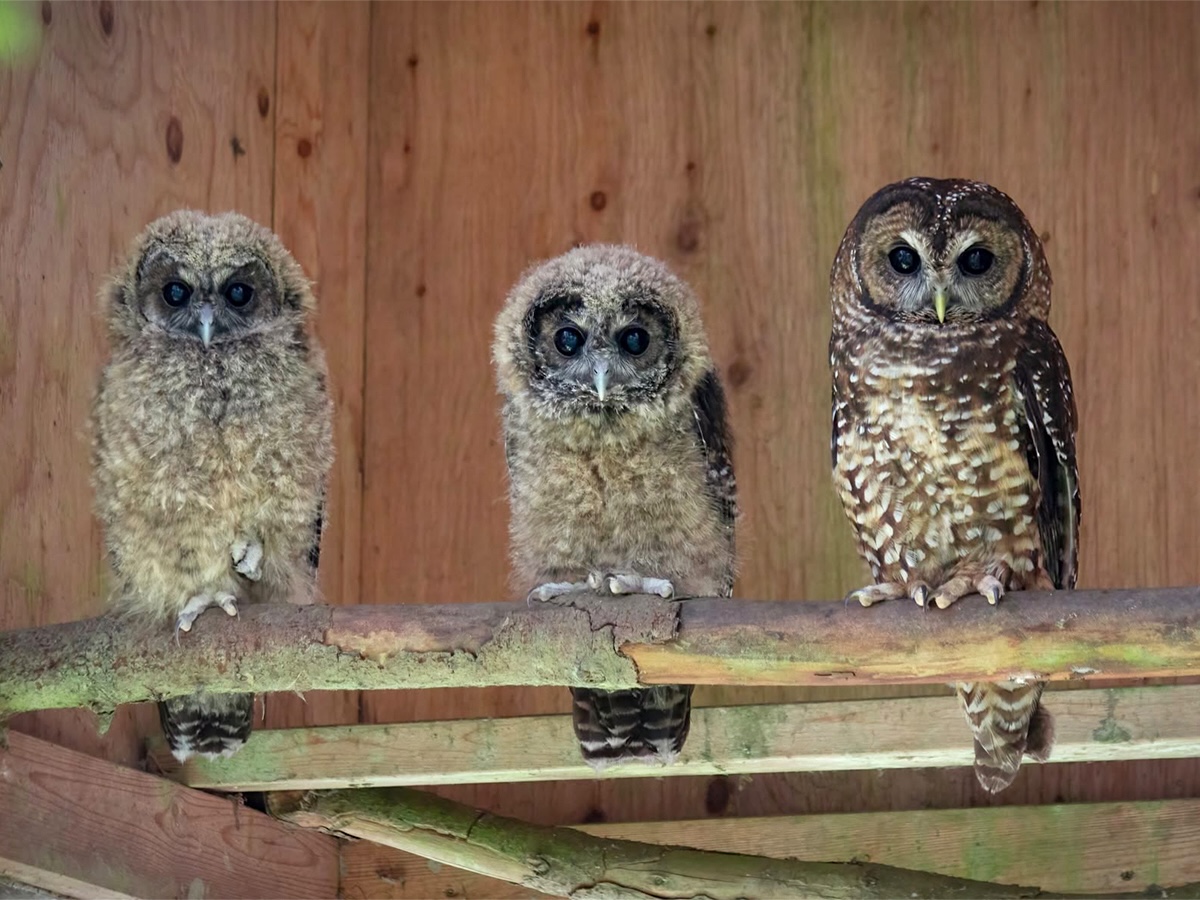
Additionally, regulatory loopholes allow the boundaries of OGMAs to be shifted under pressure from the timber industry and permit commercial logging in several types of WHAs that are designated to protect old-growth dependent species, including spotted owls, northern goshawks, and mountain caribou.
“If British Columbia is serious about meeting its 30% protection target, logging loopholes must be closed to end logging in conservation reserves,” said Wu. “The province claims to have protected 19.7% of its land base, but when these loopholes are accounted for, the actual level of meaningful protection is closer to 16%. This is far short of the 30% by 2030 target set by both the provincial and federal governments.”
As the needed reconciliation with BC First Nations moves forward via land title rulings and future treaty settlements, existing park lands are and may increasingly come under First Nations jurisdiction. Conservationists are calling on the BC NDP government to be proactive in attempting to work towards legal agreements with First Nations to ensure the ongoing protection of these old-growth forests and ecologically vital areas under First Nations governance authority. The province has largely done this in the Haida land title case for the parks and conservancies in Haida Gwaii, but should also undertake a similar effort for the former Nuchatlitz Provincial Park in the unceded territory of the Nuchatlaht First Nation on Vancouver Island to see if they are interested in expanding their system of Indigenous Protected and Conserved Areas (IPCAs) in the place of the former park if they are provided the needed support.
AFA and EEA support the rights and titles of First Nations, as well as First Nation co-management and co-governance of provincial parks and conservancies, while ensuring ecosystem health at all times. In protected areas, the groups advocate for rigorous protection standards that prohibit commercial logging, mining, and oil and gas development, as is currently the case, while protecting the rights of First Nations to hunt, fish, forage, and harvest individual trees for cultural purposes (such as for dugout canoes, longhouses, totem poles, etc.), as well as to co-manage or co-govern the lands. The organizations support the temporary closures of parks for First Nations cultural purposes, while also safeguarding public recreational access for much of the time in partnership with the First Nations stewards. A shortage of recreational lands in general in many parts of the province underscores the need for more protected areas in BC, as well as to address the overarching ecological imperative.
AFA and EEA are calling on the BC government to:
“If we are to have hope of securing the vital and overdue protection of endangered ecosystems in BC, we can’t be stuck second-guessing whether the government has backtracked and opened the door to commercial logging in parks and reserves,” said Watt. “What’s needed now is proactive leadership from the province to ensure the protection of candidate protected areas in priority ecosystems through shared decision-making with First Nations.”
One-Year Anniversary of Clayoquot Sound Old-Growth Protections
/in Announcements, Photo GalleryHistory was made in Clayoquot Sound one year ago with the most significant expansion of old-growth protection in decades!
The Ahousaht and Tla-o-qui-aht First Nation, in partnership with the BC NDP government, declared the protection of 760 km2 of land in 10 new conservancies in Clayoquot Sound near Tofino. These lands comprise some of the grandest and most intact coastal old-growth temperate rainforests on Earth.
The historic milestone also included significant support from provincial, federal and conservation sources to advance sustainable economic development opportunities for the communities.
A year on, we applaud the visionary leadership of the Ahousaht and Tla-o-qui-aht Nation for their work in protecting old-growth ecosystems in their territories while building pathways to conservation-based economies.
Victories like these serve as an inspiring model for what’s possible throughout BC. Clayoquot demonstrates that when First Nations’ protected area plans are supported through conservation financing, we can safeguard old-growth forests while supporting community economic, cultural, and social well-being.
From the mind-blowing ancient redcedar dubbed the “most impressive tree in Canada” on Flores Island to the world-famous ancient groves of Meares Island or the sweeping rainforest vistas of the Sydney River Valley, see what’s now protected thanks to this historic achievement!
Looking to explore this beautiful region? Be sure to check out Ahous Adventures, the Maaqutusiis Hahoulthee Stewardship Society and Tla-o-qui-aht Tribal Parks.
Inspired by these successes? We’re actively working with several First Nations communities in BC to help establish new Indigenous Protected and Conserved Areas in some of the world’s grandest old-growth and rarest ecosystems. Your support helps protect these irreplaceable forests for all who depend on them. Make a donation.
Flores Island
Meares Island
Sydney River Valley
Canada’s Most Impressive Tree – Flores Island