https://ancientforestalliance.org/wp-content/uploads/2026/02/Keith-River-Old-Growth-BC-333.jpg
1365
2048
TJ Watt
https://staging.ancientforestalliance.org/wp-content/uploads/2014/10/cropped-AFA-Logo-1000px.png
TJ Watt2026-03-03 09:07:112026-03-04 14:36:34NOW HIRING: Forest CampaignerRelated Posts
https://ancientforestalliance.org/wp-content/uploads/2026/02/Keith-River-Old-Growth-BC-333.jpg
1365
2048
TJ Watt
https://staging.ancientforestalliance.org/wp-content/uploads/2014/10/cropped-AFA-Logo-1000px.png
TJ Watt2026-03-03 09:07:112026-03-04 14:36:34NOW HIRING: Forest Campaigner
It’s AFA’s 16th Birthday!
On Tuesday, February 24th, we’re celebrating 16 years of working together with you, our community, to ensure the permanent protection of old-growth forests in BC. To mark the date, will you chip in $16 or more to support our work?

Budget 2026 Shortchanges Nature Protection and Sustainable Forestry Transition At a Critical Time for British Columbia
BC’s Budget 2026 fails to provide the funding needed to secure lasting protection for endangered ecosystems and at-risk old-growth forests in the province.

Welcome, Zeinab, our new Vancouver Canvass Director!
We're excited to welcome Zeinab Salenhiankia, our new Vancouver Canvass Director, to the Ancient Forest Alliance team!
Take Action
Donate
Support the Ancient Forest Alliance with a one-time or monthly donation.
Send a Message
Send an instant message to key provincial decision-makers.Get in Touch
AFA’s office is located on the territories of the Lekwungen Peoples, also known as the Songhees and Esquimalt Nations.
Copyright © 2026 Ancient Forest Alliance • All Rights Reserved
Earth-Friendly Web Design by Fairwind Creative


Conservationists Welcome BC NDP and Green Governance Agreement
/in Media ReleaseConservationists Welcome BC NDP and Green Governance Agreement – BC Forestry Review Could Provide Key Opportunity to Strengthen Old-Growth Forest Protection Policies
The Endangered Ecosystems Alliance (EEA) and Ancient Forest Alliance (AFA) are welcoming the new 2024 Cooperation and Responsible Government Accord between the NDP and Green parties in BC. The cooperation agreement’s priorities include the protection of Fairy Creek and a comprehensive review of BC forests in partnership with First Nations and diverse sectors, offering a key opportunity to strengthen old-growth forest protection policies.
The cooperation agreement calls for the BC government to work towards achieving protection of the Fairy Creek Watershed in partnership with the Pacheedaht First Nation, whose unceded territory it is, and the Ditidaht First Nation, who has various legal arrangements that overlap in the area.
More importantly, the cooperation agreement between the BC NDP and Green parties outlines their intention to undertake a review of BC forests with First Nations and diverse sectors of society to address jobs, environmental protection and sustainability.
“Protection of Fairy Creek is important, but it should be noted that much of the valley is already within an Old-Growth Management Area – it’s mainly the adjacent, surrounding old-growth that is at-risk along with a part of the top headwaters, and most importantly the greater old-growth stands in the nearby San Juan, Upper Walbran, Gordon River, and Loss Creek Valleys, on Edinburgh Mountain, and in the Jurassic Grove area. Still, this agreement signals the BC government’s recognition that it must proactively seek the protection of an endangered old-growth forest instead of passively waiting for First Nations, who often lack capacity in their small communities, to approach them first. This is something that the BC government must do across the province to safeguard old-growth and endangered ecosystems with First Nations, including by developing a Protected Areas Strategy (PAS) like in the 1990s, implementing ecosystem-based protection targets that prioritize protection for the most endangered ecosystems, allocating deferral funding for First Nations, and closing logging loopholes in the conservation reserve system. The forestry review process in the cooperative governance agreement could provide the key opening to enable all of this to happen,” stated Ken Wu, Endangered Ecosystems Alliance executive director.
“The BC NDP government should be thanked for their commitment to protect 30% by 2030, securing over $1 billion in provincial-federal conservation financing to make it happen, deferring logging on 1.2 million hectares of the Technical Advisory Panel’s most at-risk old-growth, and starting the value-added, second-growth transition – but they still come up short on both conservation policies and sustainable job creation. A comprehensive and integrated overhaul of BC forestry and land use policies is sorely needed. If structured well, a BC forestry review process that involves the public and entails shared decision-making with First Nations can open the doors for this needed overhaul to protect endangered ecosystems and to bolster sustainable jobs and businesses across BC,” stated TJ Watt, Ancient Forest Alliance photographer and campaigner.
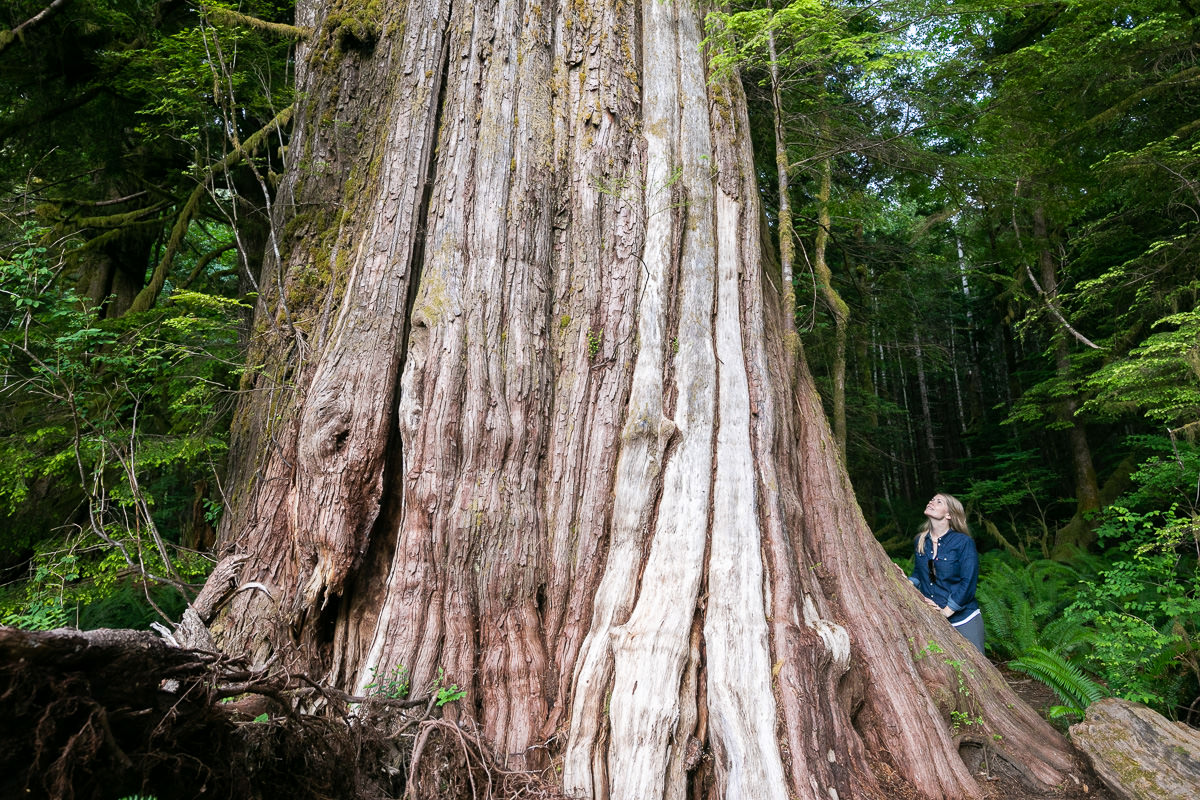
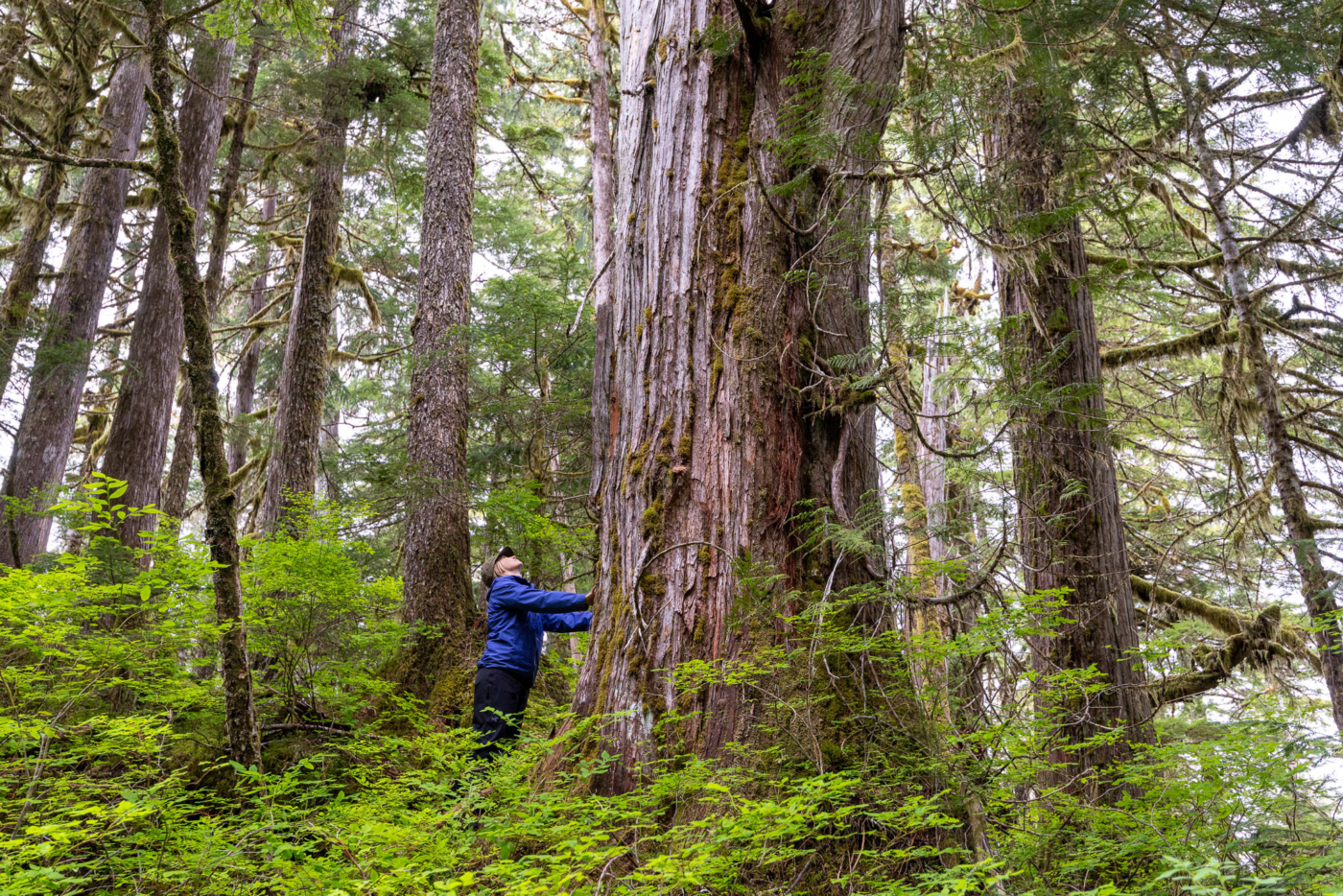
Endangered Ecosystems Alliance’s Executive Director Ken Wu beside a giant old-growth cedar tree in the unprotected Eden Grove near Port Renfrew in Pacheedaht territory.
Here are some of the policy gaps and key recommendations for old-growth protection and sustainable forestry jobs, as identified by the EEA and AFA:
1. Secure Remaining Old-Growth Deferrals in Most At-Risk Stands by Providing “Solutions Space” Funding
So far, only about half of the most at-risk old-growth stands with the biggest and oldest trees identified by the Technical Advisory Panel (TAP), about 1.2 million hectares, have been deferred from logging out of 2.6 million hectares, with another 1.2 million hectares of more marginal stands also deferred. The “War in the Woods” primarily hinges on the remaining 1.4 million hectares of undeferred most at-risk old-growth stands.
To secure these areas, deferral or “solutions space” funding for First Nations is needed for their lost forestry revenues in deferral areas – otherwise, it’s asking First Nations to go 2 years or more without what is often their largest revenue source. BC Nature Agreement funds are a potential source and can be applied going forward for new deferrals (i.e. the other 1.4 million hectares) and extensions of existing deferrals.
2. Develop the “GPS of Protection” – Ecosystem-Based Targets and a BC Protected Areas Strategy
In BC, protection is skewed towards alpine and marginal timber to minimize the impacts on the available timber supply (i.e. “save the small trees, log the big trees”). At the same time, the BC government has not created a proactive mandate to pursue protected areas – instead, the civil service is waiting on First Nations with IPCA proposals to approach them, despite the fact that many First Nations communities lack the capacity, the technical insights (in part due to a lack of proactive information flow from the BC government), and the economic ability without alternative financial support to protect the big-tree old-growth forests in their territories which many are dependent upon for forestry jobs and revenues.
If the BC government is serious about preventing a re-flare up of the War in the Woods, it must develop a mandate to proactively pursue the protection of the most endangered, least represented ecosystems, including the big-treed old-growth stands.
This mandate can be created via the development of “ecosystem-based targets” by a Chief Ecologist and independent Science/Traditional Ecological Knowledge committees housed under a BC Protected Areas Strategy. These initiatives can all arise from the forthcoming Biodiversity and Ecosystem Health (BEH) Framework. A science-based approach is needed that ensures protection targets for all ecosystems that are “fine filter” enough to include forest productivity distinctions (*this is critical) to distinguish between sites with small versus big trees. These ecosystem-based targets must not be limited to guiding the establishment of conservation reserves like OGMAs and WHAs under FRPA (as is currently in the works) but must also guide the establishment of parks and conservancies.
In addition, a provincial Protected Areas Strategy like that of the BC NDP government in the 1990s is vital to proactively identify candidate areas for potential protection based on ecosystem-based targets with plans and budgets, contingent on proactively engaging and undertaking shared decision-making with local First Nations, and that guides the expenditure of BC Nature Agreement conservation financing funds based on these objectives.
3. Close the logging loopholes in conservation reserves (e.g. OGMAs and WHAs)
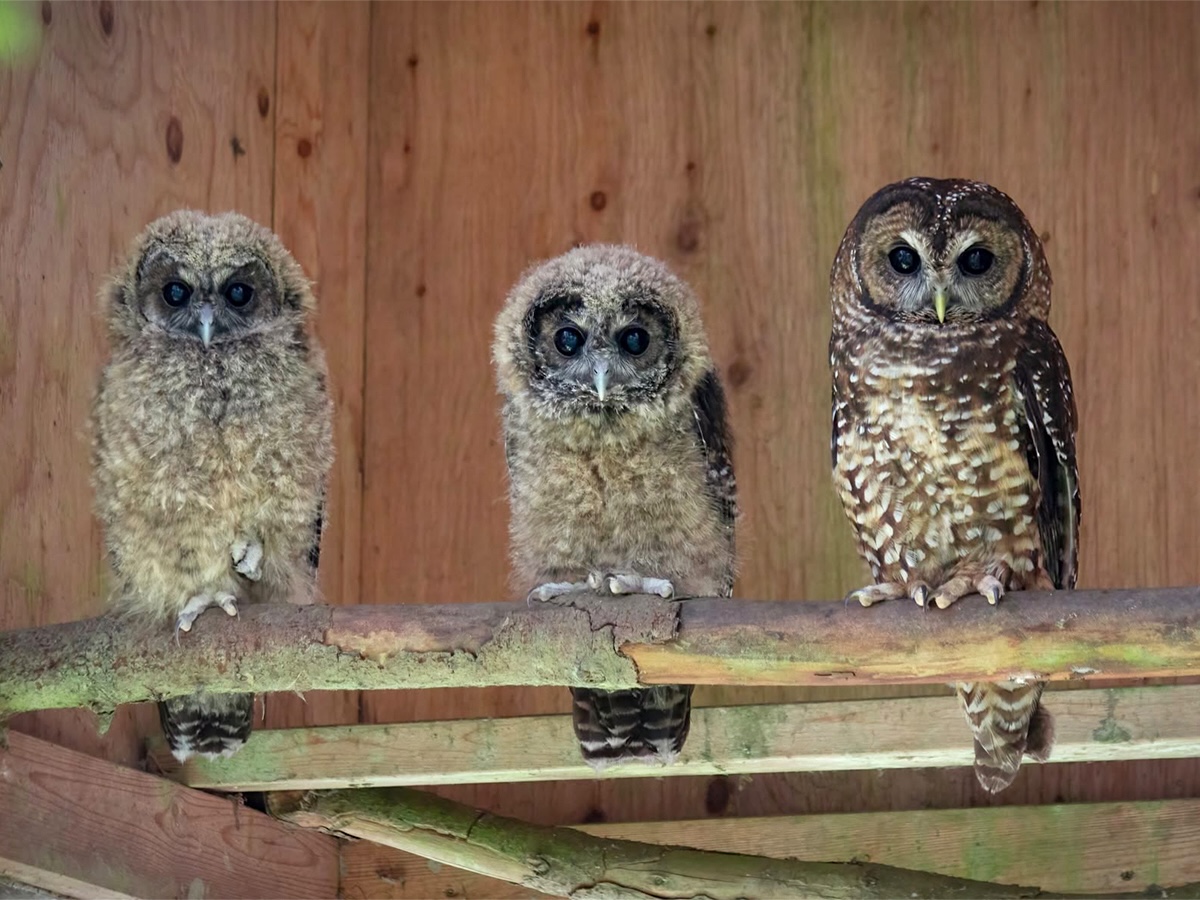
Currently, Old Growth Management Areas can be moved and swapped for lower-value timber, while many Wildlife Habitat Areas still allow commercial logging within their boundaries (including in some spotted owl, northern goshawk and mountain caribou reserves and buffers). OGMAs should not be moveable for logging interests (wildfires and natural disturbances are different), and logging should not occur in the WHAs of sensitive old-growth species. Until then, these areas must not be included in BC’s accounting towards its 30% by 2030 goal (i.e. BC has not protected 19.5% but rather 15 to 16%).
4. Build a Modernized, Smart Forest Industry and a BC Conservation Economy Strategy
The BC government should expand a major second-growth, value-added “smart forest industry” incentive program, where log export “fees in lieu” rebates, PST relief, and provincial property tax relief can be used as incentives to greatly scale up the transition to smaller diameter, value-added, second-growth engineered wood products. Log export restrictions should also be undertaken, along with a concerted effort to facilitate eco-forestry practices to create higher-value logs (longer rotations, removing lower limbs to create higher-value saw logs) and commercial thinning.
A BC Conservation Economy Strategy is also needed, particularly in regions where the major expansion of protected areas is occurring. Provincially-supported business development hubs can provide rebates, loans and various financial incentives; in-kind business development support; facilitation of labour services, including supporting staff housing and accommodation (e.g. supporting rental zoning bylaw adjustments); and other strategies to spur tourism, recreation, real estate, high-tech, non-timber forest products, carbon-offset and clean tech development. Such a strategy can make BC a powerhouse to fuel a sustainable economic resurgence in BC combined with the protection of old-growth and endangered ecosystems.
Ancient Forest Alliance campaigner & photographer TJ Watt stands beside an ancient western redcedar approximately 9 feet (3 meters) wide before and after it was cut down by BC Timber Sales in the Nahmint Valley near Port Alberni in Hupačasath, Tseshaht, and Yuułuʔiłʔatḥ First Nations territory.
Victoria News: Advocate makes desperate plea for Island’s old-growth at Victoria TEDx talk
/in News CoverageDec. 12, 2024
Victoria News
By Rick Stiebel
See the original article here.
TJ Watt compares old-growth logging on Vancouver Island forests to grinding up castles in Europe into gravel to make highways
To say TJ Watt embraced the opportunity to share his quest to protect B.C.’s old-growth forests to an international audience doesn’t paint a clear-cut picture of how the issue has impacted his life.
Watt is a renowned Ancient Forest Alliance (AFA) photographer, big-tree hunter, National Geographic explorer, and Royal Canadian Geographical Society explorer who has dedicated his life to capturing the beauty of old-growth forests in B.C. His viral ‘before and after’ photos were instrumental in exposing the shocking scale of devastation of old-growth logging in B.C.
Among Watt’s efforts is the landmark victory of protecting Avatar Grove near Port Renfrew in Pacheedaht territory, and helping to secure major conservation financing to support the creation of new protected areas across B.C.
Watt took his the stage recently at TEDxVictoria 2024 to deliver One Last Shot to Protect Old-Growth Forests in British Columbia, an urgent, passionate plea that fuses elements of his award-winning photography with nearly two decades of experience advocating for the permanent protection of endangered old-growth forests and irreplaceable ecosystems.
“I’m honoured to have been a TEDxVictoria speaker and to have the opportunity to share my life’s mission to protect endangered old-growth forests in B.C. with the world,” said Watt, who was born in Metchosin and co-founded the AFA 15 years ago. “These forests are among the most majestic, vital, and imperilled ecosystems on Earth and without protection, they are at risk of being lost forever. From uncovering groves of ancient giants to trudging up steep mountainsides or slogging through soaked clear-cuts, it’s been a beautiful and, many times, heartbreaking journey documenting these forests.”
Watt estimates that more than 80 per cent of the productive old-growth forests have already been logged on Vancouver Island, including more than 90 per cent of the valley bottoms where the biggest trees grow and the richest biodiversity resides.
“Old-growth forests are extraordinary – some of the ancient trees are as wide as a living room, as tall as a downtown skyscraper, and have lived to be more than a thousand years old,” Watt noted. “Yet, in British Columbia, their destruction from industrial logging continues at an alarming rate. Cutting down thousand-year-old trees and turning them into 2x4s and toilet paper is like grinding up castles in Europe into gravel to make highways. It’s unethical and unnecessary, (especially considering) most of the world is now logging second, third, and fourth-growth forests.
“We must ensure a swift transition to a truly sustainable, value-added, second-growth forestry industry in B.C.” Watt stressed. “By investing in technology that makes higher-value wood products from smaller-diameter trees, we can protect old-growth forests and forestry jobs at the same time. We have a global responsibility to do the right thing.”
Watt said he hopes his talk will raise widespread awareness of this issue and inspire people to stand together and help protect these irreplaceable ecosystems for this generation and those still to come.
In a follow-up interview with the Sooke News Mirror, Watt said he’s pleased that talks with the provincial government and various stakeholder groups about reopening Avatar Grove to the public will resume in the near future after a two-year hiatus.
The AFA is a registered charitable organization working to protect endangered old-growth forests and ensure a sustainable, second-growth forest industry in B.C. that has launched a social media campaign this month featuring Watt’s TEDxVictoria Talk to amplify his message and reach thousands of new viewers.
“With a newly elected government in place and the fate of many endangered old-growth forests still hanging in the balance, Watt’s call to action comes at a pivotal moment for the future of ancient forests in B.C.,” the AFA said in a statement. “Namely, there is still a need for the B.C. government to take a proactive, science-based approach to ensuring the most at-risk old-growth forests are targeted for protection and to deliver “solutions space” funding to help First Nations offset lost logging revenues when being asked to accept logging deferrals in their unceded territories.”
Check out www.youtube.com/watch?v= enF8Zf4EPNg to view Watt’s TEDxVictoria presentation.
Bald Eagles
/in Creature Feature, EducationalWhen visiting a temperate rainforest in British Columbia, look for the bald eagle, a frequent old-growth visitor.
While not bald, the name comes from an older variation of the word, meaning “white-headed.” These majestic creatures can be found searching for their next meal in salmon-spawning rivers, along the ocean shoreline, or nesting high up in the canopies of ancient giants. Bald eagles build the largest nest of any bird in North America. Their nests can reach up to 8 feet (2.5 metres) across and weigh a metric ton! Since they are territorial birds, they will typically return to that same nest year after year for up to decades.
In addition to their enormous wingspans of 6 to 8 feet (1.8 to 2.3 metres), bald eagles are known for their superpower eyesight. They have a 340-degree field of vision, can spot fish under the water’s surface, and can even see into the ultraviolet range. An eagle’s visual acuity is estimated to be 4 to 8 times greater than that of humans. This means that an eagle can see from a distance of 1.6 kilometers what a human with perfect vision can see from only 200 meters away. They also have binocular and monocular vision, allowing them to spot prey from great distances and navigate their environment with remarkable precision.
Along the Chehalis and Harrison Rivers near Agassiz, BC, in the territory of Sts’ailes First Nation, as many as 10,000 bald eagles have been known to congregate in November and December to feed on spawning salmon, making the area home to one of the largest bald eagle concentrations on Earth. It’s an incredible place to view wildlife this time of year! Nearby, at Echo Lake, one of their night-roosting sites, roughly half of the old-growth forests were protected in 2013 as a result of Ancient Forest Alliance’s campaign efforts. The rest of the forests there must now also be preserved.
How does your eyesight compare to an eagle? How many do you think are in this photo from the Harisson-Chehalis River estuary?? Find the answer at the bottom of this page.
Be sure to check out Hancock Wildlife’s live eagle cams and enjoy some of our favourite eagle photos below!
Answer: About 145 eagles can be found in the photo! Wild!