https://ancientforestalliance.org/wp-content/uploads/2026/04/2025-Activity-Report-Financials-scaled.png
1440
2560
TJ Watt
https://staging.ancientforestalliance.org/wp-content/uploads/2014/10/cropped-AFA-Logo-1000px.png
TJ Watt2026-04-30 16:32:192026-04-30 16:32:192025 Activity Report & FinancialsRelated Posts
https://ancientforestalliance.org/wp-content/uploads/2026/04/2025-Activity-Report-Financials-scaled.png
1440
2560
TJ Watt
https://staging.ancientforestalliance.org/wp-content/uploads/2014/10/cropped-AFA-Logo-1000px.png
TJ Watt2026-04-30 16:32:192026-04-30 16:32:192025 Activity Report & Financials
The Tyee: BC ‘Going Backwards’ on Ecosystem Protections
Advocates, the BC Greens, and a former cabinet minister take aim at the NDP’s stalled efforts to protect ecosystems, such as old-growth forests.

The Tyee: BC Must Stop Blaming First Nations for Old-Growth Logging
BC is increasing logging while lagging on old-growth protection. Experts say the province should fund First Nations to conserve forests instead.

Western Coralroot
Meet one of the rainforest’s loveliest yet strangest flowers: the western coralroot!
Take Action
Donate
Support the Ancient Forest Alliance with a one-time or monthly donation.
Send a Message
Send an instant message to key provincial decision-makers.Get in Touch
AFA’s office is located on the territories of the Lekwungen Peoples, also known as the Songhees and Esquimalt Nations.
Copyright © 2026 Ancient Forest Alliance • All Rights Reserved
Earth-Friendly Web Design by Fairwind Creative


Old-Growth Momentum Grows as Businesses, City Councils, and Naturalists Speak Up & Renowned Filmmaker Comes to Port Renfrew
/in Media ReleaseThe Port Renfrew and Sooke Chambers of Commerce, the town councils of Metchosin, Victoria, and Tofino, and the Federation of BC Naturalists (BC Nature) have joined conservation groups in calling on the BC government to protect Vancouver Island’s old-growth forests in the Walbran Valley. In addition, renowned two-time Sundance filmmaker Joe Callander whose documentaries have been featured in the New York Times is on Vancouver Island to do a story about the old-growth forests around Port Renfrew.
Interest and concern for the fate of Vancouver Island’s endangered old-growth forests is on the rise, as a renowned filmmaker and his crew arrived earlier this week from the US to do a piece about the old-growth forests around Port Renfrew. In addition, a growing and diverse base of businesses, municipal councils, and natural history associations have joined the chorus of concerned citizens calling on the province to protect the endangered old-growth forest in the Central Walbran Valley on Vancouver Island near Port Renfrew.
Two-time Sundance filmmaker Joe Callander has been in Port Renfrew, Lake Cowichan, and Duncan this past week with the Ancient Forest Alliance and various forestry workers, business leaders, and scientists to document the endangered old-growth forests and forest industry in the area. Callander’s award-winning documentary work has been shown at over 30 festivals globally, as well as being featured in the New York Time’s Op-docs section on NYTimes.com. The New York Times has the largest circulation of any metropolitan newspaper in the USA, as well as over one million paying digital-only subscribers for its online content.
The Sooke and Port Renfrew Chambers of Commerce, the Metchosin, Tofino, and Victoria councils, and the Federation of BC Naturalists (the umbrella organization representing 53 naturalist clubs, encompassing 6000 members) have all joined the call for the BC government to protect the endangered old-growth forests of the Central Walbran Valley. The Metchosin council resolution calls on the BC government to amend the 1994 Vancouver Island Land Use Plan to protect the remaining old-growth forests across Vancouver Island, which would include the Walbran Valley.
Near Port Renfrew, the 500 hectare Central Walbran Ancient Forest is part of the 13,000 hectare Walbran Valley, of which about 5500 hectares of the valley is protected within the Carmanah-Walbran Provincial Park and 7500 hectares of the watershed lies outside of the park. About 2600 hectares lies in a “Special Management Zone” (including the 500 hectare Central Walbran), where the size of clearcuts is smaller but which still allows for most of the old-growth forests to be logged. The Central Walbran is the last, largely intact portion of the valley outside of the park, while much of the rest has been highly fragmented and tattered by clearcuts to different degrees. Teal-Jones has 8 cutblocks planned for the Central Walbran Valley, of which one, Cutblock 4424, has been granted a cutting permit by the Ministry of Forests, Lands, and Natural Resource Operations. The company recently stated that they will defer logging plans in the Central Walbran Valley for now, a welcome step forward. The company is actively logging in other parts of the Special Management Zone at this time and protesters have sporadically been blockading their logging operations in recent months. The Walbran Valley is in the unceded territory of the Pacheedaht band in Tree Farm Licences 44 and 46 on Crown lands.
Port Renfrew, formerly a logging town, has been transformed in recent years into a big tree tourism destination as hundreds of thousands of tourists have come from around the world to visit some of Canada’s largest trees in the nearby Avatar Grove, the Red Creek Fir (the world’s largest Douglas-fir tree), Big Lonely Doug (Canada’s 2nd largest Douglas-fir tree), San Juan Spruce (until recently Canada’s largest Sitka spruce tree – its top broke off in a recent storm unfortunately), the Harris Creek spruce (one of the largest Sitka spruce trees in Canada), and the Central Walbran Valley.
• See spectacular photos of the Walbran.
• See the Port Renfrew Chamber of Commerce’s statement for the Walbran here.
• See the Sooke Chamber of Commerce’s Walbran statement here.
• See the Victoria city council motion for the Walbran here.
• See a recent Youtube clip using drone footage over the Central Walbran.
“The publicity about the old-growth forests near Port Renfrew in recent years has brought in a flood of visitors from Europe, the USA, Canada, and diverse countries to visit Port Renfrew. This has especially been true since the protection of the Avatar Grove in 2012. Big tree tourism has increased the total flow of dollars spent in Port Renfrew, in our rental accommodations, restaurants, grocery stores, and businesses in general. Along with sport fishing, old-growth forest tourism has become a staple of our local economy,” states Dan Hager, president of the Port Renfrew Chamber of Commerce. “Recently, increasing numbers of visitors are heading through town to visit the Central Walbran Valley to see its old-growth forest. If the Central Walbran were to be protected, it would be a great addition to our town’s repertoire of big tree attractions.”
“The Central Walbran is one of the most magnificent places that anyone could visit. With its gargantuan trees, emerald-coloured swimming holes, amazing waterfalls, and perfect camping areas, in all of my experiences the Walbran is virtually unmatched for recreational and scenic grandeur in the world. To riddle the whole area with clearcuts and giant stumps would be the lowest, worse use of a place like this,” states Ken Wu, Ancient Forest Alliance executive director.
“The Central Walbran Valley is truly exceptional in so many ways. It has the most extensive, densely-packed groves of old-growth western redcedars in the country – including some of the near-largest on record, such as the Tolkien and Castle Giants,” stated TJ Watt, Ancient Forest Alliance photographer and campaigner. “Not only are old-growth forests important for the climate, but also for tourism, endangered species, clean water, wild salmon, and many First Nations cultures.”
“The old growth forests of the Walbran Valley are very important biologically for the great variety of plants and animals living there – some of which are at risk such as the Queen Charlotte Goshawk and Marbled Murrelet. The second growth forests which replace the old growth lack much of the biodiversity present in old growth”, stated Eric Marshall, president of Cowichan Valley Naturalists.
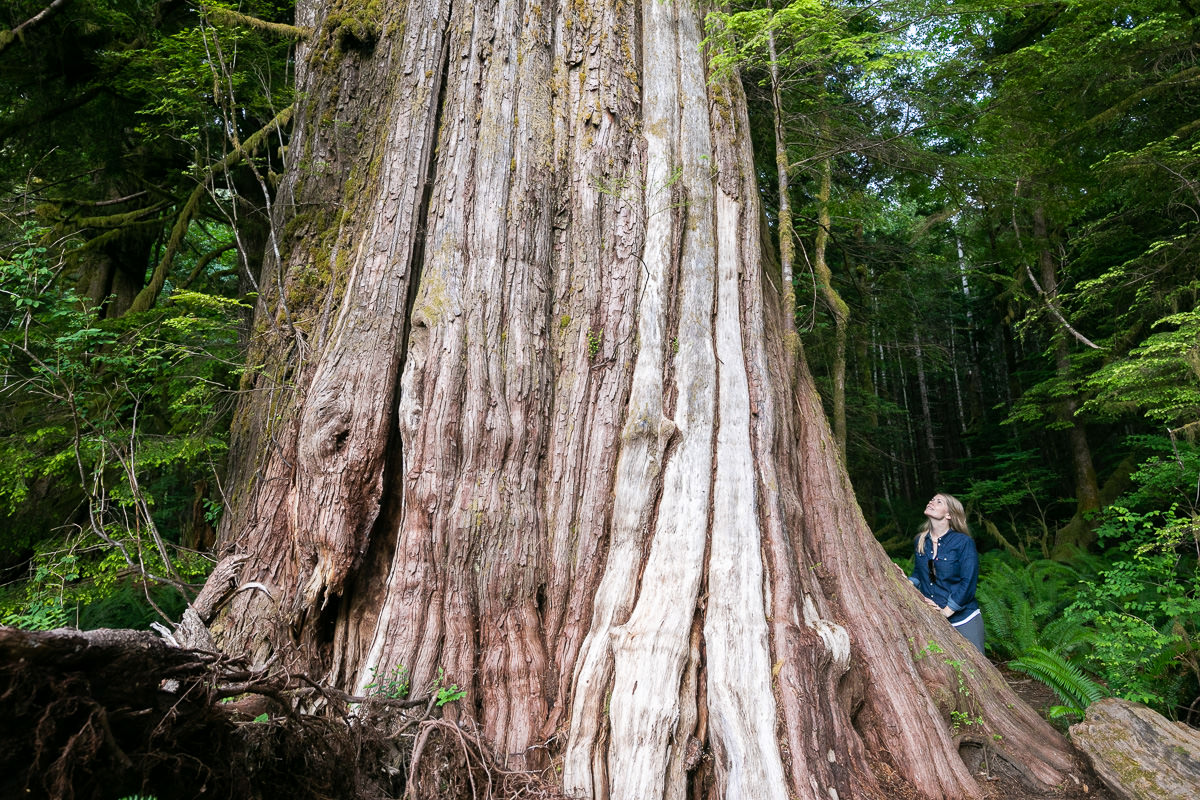
Ancient Forest Alliance campaigners recently located and measured two huge western redcedar trees, one of which makes it into the top 10 widest redcedars in BC according to the BC Big Tree Registry, in the Central Walbran Valley – the 4.6 metre (15 feet) wide “Tolkien Giant” and the “Karst Giant”. See: www.ancientforestalliance.org/news-item.php?ID=944
The recent agreement in BC’s northern coastal rainforest, the Great Bear Rainforest, where 85% of the old-growth forests will be protected in a combination of legislated parks, conservancies, and forest reserves (through Ecosystem-Based Management), sets a science-based precedent to increase protection now for BC’s southern rainforest – on Vancouver Island and the southern Mainland Coast, where only 8% of the original, productive old-growth forests are protected in parks and conservancies (6%) and Old-Growth Management Areas (2%).
The Ancient Forest Alliance is calling on the province to protect its endangered old-growth forests, ensure a sustainable second-growth forest industry, and end the export of raw, unprocessed logs to foreign mills in order to support BC forestry jobs. An Old-Growth Protection Act has been developed by the University of Victoria’s Environmental Law Centre for the Ancient Forest Alliance. See: https://www.elc.uvic.ca/wordpress/wp-content/uploads/2015/01/An-Old-Growth-Protection-Act-for-BC_2013Apr.pdf
On BC’s southern coast (Vancouver Island and the southwest mainland), 75% of the original, productive old-growth forests have already been logged, including over 90% of the valley bottoms where the largest trees grow. 3.3 million hectares of productive old-growth forests once stood on the southern coast, and today 860,000 hectares remain, while only 260,000 hectares are protected in parks and Old-Growth Management Areas. www.ancientforestalliance.org/old-growth-maps.php
Federation of BC Naturalists (BC Nature) join call to protect Central Walbran Valley
/in AnnouncementsThanks to the Federation of BC Naturalists (BC Nature), who have joined multiple Chambers of Commerce and municipal councils calling for the protection of the endangered Central Walbran Valley. The federation consists of 53 naturalist clubs representing 6000 members in British Columbia, including biologists, ecologists, and various natural history enthusiasts. The federation has sent a letter of support for the Cowichan Valley Naturalists in their call to the province requesting protection of the Central Walbran Ancient Forest. The 500 hectare Central Walbran Valley is threatened with potential logging by Teal-Jones, and is the most intact part of a 2600 hectare Special Management Zone. The Ancient Forest Alliance is working with diverse partners calling for the region's protection, along with legislation to protect endangered old-growth forests across BC and new policies to ensure a sustainable, value-added second-growth forest industry.
See the Federation of BC Naturalists (BC Nature) online at: www.bcnature.ca
Tall trees turning Port Renfrew into tourist hot spot
/in News CoverageThe discovery of a grove of massive and unusual cedar trees six years ago has slowly been attracting more and more tourists from around the world to the tiny community of Port Renfrew.
And now the business community says it’s better for the local economy to move on from logging, and set its sights instead on ecotourism.
Port Renfrew is a two hour drive from Victoria, along Vancouver Island’s west coast.
“To be able to drive somewhere, and to be able to immerse themselves in an environment that looks the same, is the same, the way it was perhaps 1000 years ago, is a wonderful experience,” said Dan Hager, President of the Port Renfrew Chamber of Commerce.
A short drive from the centre of Port Renfrew brings you to Avatar Grove.
TJ Watt discovered the unusual and massive cedars while exploring the area with a friend in 2009.
“We found these incredible gigantic trees that are covered in these amazing burls,” said Watts.
Watt’s group the Ancient Forest Alliance along with the Port Renfrew Chamber of Commerce campaigned to have the area saved and in 2012 the provincial government declared Avatar Grove a protected area and word of it’s unique beauty started to spread.
“Avatar started to bring a lot of people, and they started coming and every year they came more and more and more,” said Hager.
In the peak of summer, it’s estimated up to 200 people will visit the “gnarly” trees each day, many from Europe, and the United States.
“There’s been a massive influx of tall tree tourism and the town has re-branded itself as the Tall Tree Capital of Canada,” said Ken Wu with the Ancient Forest Alliance.
But the Tall Tree Capital was actually built on falling trees and signs of the forest industry dot the hills all around.
“Logging really has the origins of Port Renfrew, the reason the road is there because of logging, but we can bring more people and more revenue into Renfrew through tourism than from logging, taking the trees out,” said Hager.
Hager says you can see the impact ecotourism is having on the tiny community of 250 as developers build cabins and cottages for people from around the world who want a closer view of Vancouver Island’s raw beauty.
One of the most iconic tall trees in the Port Renfrew area is affectionately known as “Big Lonely Doug”.
The second largest douglas fir in Canada, it is nearly four meters wide and 67 meters tall, and estimated to be roughly 1000 years old.
It was saved as a wildlife tree when the area was logged a few years ago.
And it is just one more reason local business and environmental groups say the remaining ancient forests in the region need to be protected.
“Giant douglas firs, big red cedars, these are primeval forests, sort of Jurassic Park type landscapes that really deserve protection there’s so little left,” said Wu.
But for many in the area the tall trees remaining are a sign of transformation, for a town ready to cut ties with its logging roots and plant a new seed for a future in tourism.