Ancient Forest Alliance
  • Home
  • About Us
        • The six AFA team members stand beside each other in front of an old-growth Douglas-fir tree.
        • Our Mission & Team
        • History & Successes
        • Work With Us
        • Contact Us
  • Our Work
    • Campaigns
    • Building Alliances
    • Activity Reports
  • Ancient Forests
    • Hiking Guides
    • Old-Growth 101
    • Old-Growth Forests in BC: FAQs
    • Before & After Old-Growth Maps
    • Myths & Facts
    • Directions to Avatar Grove
    • Port Renfrew Big Trees Map
  • Recent News
    • Recent News
    • Media Releases
    • Research & Reports
    • Publications
    • Educational
  • Photos & Media
        • Map of Gallery Locations
        • Themes
          • Biggest Trees
          • Biggest Stumps
          • Low Productivity Old-Growth
        • Videos
        • Vancouver Island North
          • East Creek Rainforest
          • Klaskish Inlet
          • Quatsino
            • Grove of Giant Cedars Clearcut in Quatsino Sound
            • Quatsino Old-Growth Under Threat 2023
            • Mahatta River Logging
          • Spruce Bay
          • Tsitika Valley
          • White River Provincial Park
        • Vancouver Island Central
          • Barkley Sound
            • Vernon Bay
          • Clayoquot Sound
            • Canada’s Most Impressive Tree – Flores Island
            • Flores Island
            • Meares Island
            • Sydney River Valley
          • Cortes Island
            • Children’s Forest
            • Squirrel Cove Ancient Forest
          • Nootka Island
          • Port Alberni
            • Cameron Valley Firebreak
            • Cathedral Grove Canyon
            • Juniper Ridge
            • Katlum Creek
            • Nahmint Valley
            • Nahmint Logging 2024
            • McLaughlin Ridge
            • Mount Horne
            • Taylor River Valley
          • Tahsis
            • McKelvie Valley
            • Tahsis: Endangered Old-Growth Above Town
        • Vancouver Island South
          • Carmanah
            • Climbing the Largest Spruce in Carmanah
            • Carmanah Research Climb
          • Caycuse Watershed
            • Before & After Logging – Caycuse Watershed
            • Before and After Logging Caycuse 2022
            • Caycuse Logging From Above
            • Lower Caycuse River
            • Massive Trees Cut Down
          • Klanawa Valley
          • Koksilah
          • Mossy Maples
            • Mossy Maple Gallery
            • Mossy Maple Grove
          • Port Renfrew
            • Avatar Boardwalk
            • Avatar Grove
            • Big Lonely Doug and Clearcut
            • Bugaboo Ridge Ancient Forest
            • Eden Grove
            • Exploring & Climbing Ancient Giants
            • Fairy Creek Headwaters
            • Granite Creek Logging
            • Jurassic Grove
            • Loup Creek
            • Mossome Grove
            • Mossome Grove Tree Climb
          • Walbran Valley
            • Castle Grove
            • Central Walbran Ancient Forest
            • Hadikin Lake
            • Walbran Headwaters At Risk
            • Walbran Overview
            • Walbran Logging
        • Haida Gwaii
          • Haida Gwaii 2013
          • Yakoun Lake Old-Growth
          • Yakoun River Old-Growth Forests
        • Sunshine Coast
          • Day Road Forest
          • Mt. Elphinstone Proposed Park Expansion
          • Powell River
            • Eldred River Valley
            • Mt. Freda Ancient Forests
          • Roberts Creek Headwaters
          • Stillwater Bluffs
        • Inland Rainforest
          • Ancient Forest/ Chun T’oh Whudujut Provincial Park
          • Parthenon Grove
        • Mainland
          • Echo Lake
          • Kanaka Bar IPCA Proposal
  • Take Action
    • Send A Message to the BC Government
    • Sign a Resolution
  • Store
  • Donate
  • Click to open the search input field Click to open the search input field Search
  • Menu Menu
  • Store
  • Donate

Blog Archive Layout

Climbers scale Big Lonely Doug in Pacheedaht territory against a bluebird sky.

Financial Review: Why we should embrace tall-tree tourism

Jun 6 2024/in News Coverage

June 4, 2024
By Ute Junker
Australian Financial Review

Original article here.

Only 34 per cent of the world’s surviving forests are old-growth ones, and many are under threat. If California’s Redwood National Park is anything to go by, there is hope, however.

This is a tree that demands attention. Thrusting 70 metres into the sky – about the height of a 20-storey building – the towering Douglas fir has a diameter of almost four metres. That sort of girth doesn’t develop overnight: this specimen has been sinking its roots into the rich earth of Canada’s Vancouver Island for around 1000 years.

There is another reason this tree stands out. It stands alone.

Once sheltered by the old-growth forest that enveloped it on all sides, its sheer verticality is cast into stark relief by the stump-studded scrublands that surround it. Fourteen years ago loggers razed the entire forest save for this one survivor, dubbed Big Lonely Doug. Doug owes his survival to a logging company surveyor who – for reasons unknown – wrapped a ribbon around its massive trunk on which were written the words “Leave tree”.

“Big Lonely Doug represents both incredible beauty and incredible destruction,” says conservation photographer TJ Watt. Describing himself as a “big-tree hunter”, Watt spends much of his time exploring remote parts of Vancouver Island in search of the region’s last arboreal giants.

TJ stands in the forefront wearing a black hoodie. Behind him stands a number of old-growth cedars and other ancient trees.

Photographer and co-founder of the Ancient Forest Alliance, TJ Watt. © TJ Watt

As co-founder of the Ancient Forest Alliance, he has worked for years to protect the region’s oldest trees from logging. Stands of tall trees such as Avatar Grove – identified by activists in 2009 and placed under government protection three years later after a protracted campaign – have become tourist attractions in their own right. Nearby Port Renfrew, formerly a quiet fishing village, now markets itself as the Tall Trees Capital of Canada.

The battle between tourism and logging is not a new one, but the Canadian province of British Columbia is a critical frontline. The temperate rainforests that blanket the province’s Pacific Coast are places of incredible beauty, where soft light filters through the high tree canopy, loamy scents of rich soil rise with every footfall, and the mosses and lichens that blanket most surfaces soften every sound.

They are a vital environment for grizzly and black bears.

These forests, which comprise more than 60 per cent of the province, also play a vital role in combating climate change. Studies have shown the tall trees in old-growth forests are especially effective at sequestering large amounts of carbon. Rainforests are oxygen-rich environments: they cover less than 10 per cent of the world’s land surface yet produce nearly a third of our oxygen.

Only around 30 per cent of the world’s surviving forests are old-growth ones, however, and many are under threat. Across the world, communities are turning to tourism as a way to protect these precious landscapes. The success of these projects is not only vital for local communities – in British Columbia’s case, predominantly First Nations people – but also for the health of our planet.

British Columbia’s government recognises that its forests draw tourists. Tall trees feature prominently on the province’s tourism website, along with the slogan “Super, Natural British Columbia”. But Watt says a bigger commitment is needed.

“If the B.C. government got on board and improved the signage and roads, and did some more promotion, you would see such an incredible boom. We could be like the redwoods of Canada – that’s a dream of mine.”

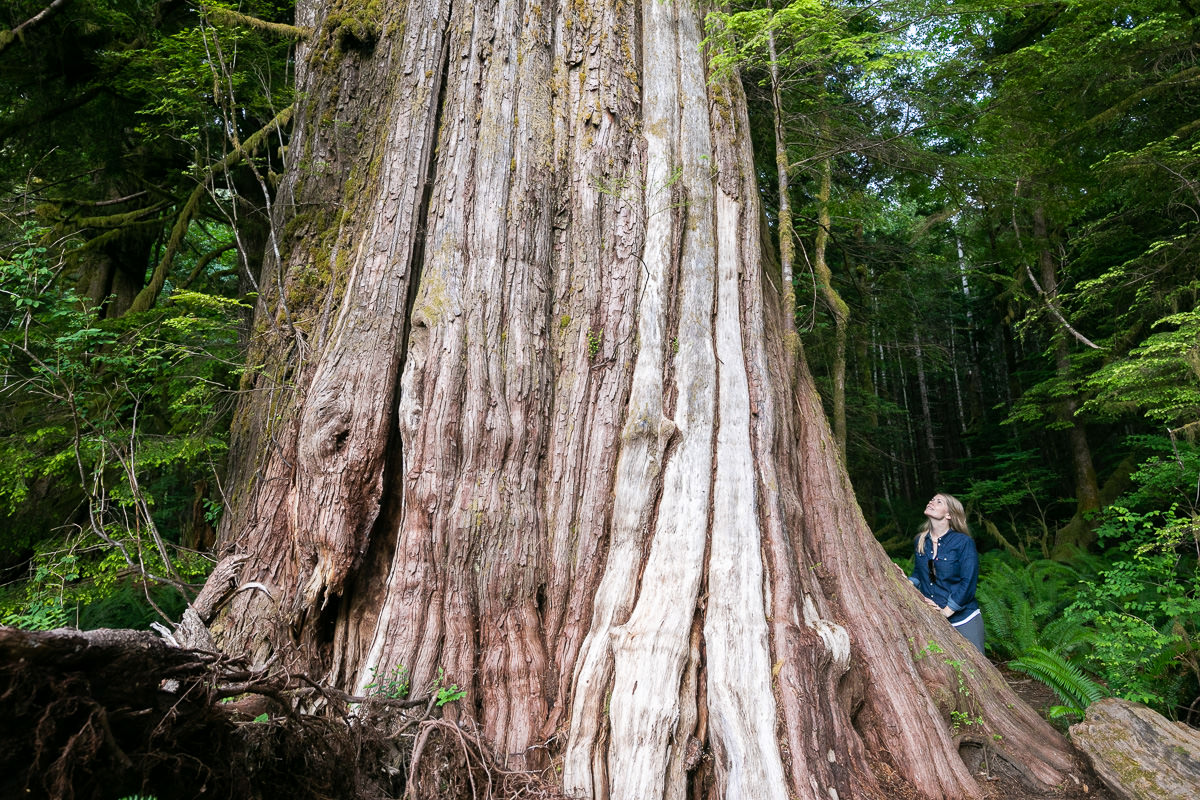
A woman in a blue jacket stands on a boardwalk looking up at an amazing ancient western redcedar. She is surrounded by lush green old-growth forest.

A hiker admires an ancient red cedar tree in the unprotected Eden Grove near Port Renfrew, BC. © TJ Watt

South of the border with British Columbia, the redwood forests of northern California are home to sequoias and Douglas firs that stand up to 100 metres tall. They are proven money-spinners. The US National Parks Service reports that in 2022, 458,400 visitors to Redwood National Park spent around $US31 million and sustained more than 400 jobs.

Different countries take different approaches to marketing their old-growth forests. In Waipoua on New Zealand’s North Island, the emphasis is on particularly mighty specimens such as Tāne Mahuta, the king of the forest. The largest kauri tree in the country, Tāne Mahuta stands over 51 metres tall, with a girth of almost 14 metres.

On the Kii Peninsula on Japan’s Honshu island, where pilgrims have followed the Kumano Kodo trail through shady forests for more than a thousand years, the experience is as much about communing with culture as it is about marvelling at nature.

A hiker looks up to the lofty tree tops in the Milkshake Hills Forest Reserve in Tasmania’s Tarkine Rainforest.

A hiker looks up to the lofty tree tops in the Milkshake Hills Forest Reserve in Tasmania’s Tarkine Rainforest. Alice Hansen

An increasing attraction for some visitors are the wellness benefits associated with spending time among tall trees. Study after study has indicated that immersion in nature can improve everything from heart health to emotional wellbeing, and help stave off cognitive decline.

“There are so many physical and mental health benefits from going to these ancient natural places, embedding a little natural code in people who are usually living in busy urban environments,” says Mark Olsen, chief executive of Tourism Tropical North Queensland.

Olsen is intimately involved with Australia’s most successful tall-tree tourist destination, the Daintree Rainforest. One of the oldest rainforests in the world, listed as a World Heritage site since 1988, the Daintree’s flora is as remarkable as the region’s cassowaries and tree kangaroos.

Twelve of the planet’s 19 families of primitive flowering plants are found here, including 50 species rarely seen anywhere else. The Daintree is also home to the world’s tallest conifer, the bull kauri, which can grow up to 50 metres in height.

Since 2019, the park has been jointly managed by the Jabalbina Yalanji Aboriginal Corporation and the Queensland Parks and Wildlife Service, and the cultural knowledge of the Eastern Juku Yulanji people is now a key part of the tourist offering.

Being introduced to the landscape by an Indigenous guide changes your perspective, says Olsen. “You no longer see a wall of green. You see a cultural landscape.”

Just as in British Columbia, Australian Indigenous communities are benefiting from tourism. “They get to look after Country, to stay on Country, to teach the language connected to that landscape. It’s about the inseparability of story and place,” Olsen says.

An overhead view of the Daintree Forest in Tasmania.

The Daintree Rainforest is a precious resource. Jason South

The Daintree may be a success story but elsewhere in Australia, “irreplaceable” tall-tree forests remain at risk, says Amelia Young, the Wilderness Society’s director of national campaigns. “Because of our evolutionary history, these forests are unlike those found anywhere else on Earth. There are so few left, [yet] they are incredibly significant for biological and cultural reasons.”

These forests include the jarrah trees in Western Australia’s southwest, which are “still subject to deforestation, principally for bauxite mining”; the mountain ash forests of Victoria’s Central Highlands region; and, of course, Tasmania’s old-growth forests.

An edited image depicting the before and after the effects of mining on the left, and the old jarrah forest on the right.

Alcoa bauxite mining operations in an area that was once jarrah forest in Western Australia. Getty/Nine News

Last year The Wilderness Society released its Big Tree State report showcasing eight potential sites for tall-tree tourism in the Huon, Styx and Tyenna valleys. It estimated that an initial investment of $745,000 would generate 139,000 visitor days and $20.2 million in revenue for regional communities.

Tasmania’s government has since promised to introduce new protections for tall trees, but Young says this is only part of the solution. “We also need to protect younger forests so they can become old forests.”

Of course, forest tourism brings its own challenges. In California’s Redwood National Park two years ago, the National Parks Service was forced to close off an area around Hyperion, spruiked as the tallest tree in the world. Trespassers face a $US5000 fine ($7500) and six months in prison.

Even though the National Park Service had kept quiet about the exact location of the soaring redwood – at 115 metres, it is taller than the Statue of Liberty – so many people had found their way there that the ground around its base had eroded, potentially endangering its roots.

Wilderness areas require particular protections, says Dr Susanne Etti, the global environmental impact manager for Intrepid Travel. The company hosts multi-day treks in Tasmania’s Tarkine Rainforest, and has implemented protective measures there ranging from waste-removal processes to managing contaminants.

“Our leaders are very clear about the dangers of contamination from pathogens,” she says. “Cleaning your boots at the start of a trip must be second nature.”

Three lodges with canvass roofs sit at the edge of the forest looking out onto a very still Clayoquot Sound at Clayoquot Wilderness Lodge.

Clayoquot Wilderness Lodge is literally embraced by the forest.

Luxury tourism operators are also finding ways to ‘immerse’ their guests in landscapes that remain relatively untouched. At Clayoquot Wilderness Resort, an exclusive wilderness camp on Vancouver Island’s wild west coast, room rates start at $CA2900 ($3190) a night.

General manager Sarah Cruise says she sees a physical change in travellers during their stay: “You watch your guests come in drained, and see them filling up on green.” The effect of being surrounded by these towering trees fulfils our deepest needs as a species, she adds.

Gesturing to the forest outside her office, Cruise says: “This is our home, this is where we belong – we just don’t know it.”

https://ancientforestalliance.org/wp-content/uploads/2024/06/Big-Lonely-Doug-Climb-75_original.jpg 1200 1800 TJ Watt https://staging.ancientforestalliance.org/wp-content/uploads/2014/10/cropped-AFA-Logo-1000px.png TJ Watt2024-06-06 12:59:122024-07-15 17:19:39Financial Review: Why we should embrace tall-tree tourism
Six of the many images that are depicted on AFA's greeting cards, including Big Lonely Doug, an old-growth sunset, waterfall, the San Juan Spruce, Cheewhat Giant, and Avatar Grove

AFA Greeting Cards are on sale for 20% off until August 31st!

Jun 3 2024/in Announcements

Have a special occasion coming up? Pick up your next set of greeting cards from Ancient Forest Alliance while they’re 20% off and help protect old-growth forests in BC!

Choose one of our specially curated sets of six cards for $20 or get a deal and choose two sets for $35!

Taken by AFA photographer TJ Watt, these photos feature big trees, birds, bears, flowers and fungi from locations such as Echo Lake, Meares Island, Carmanah Valley, Flores Island, and Brooks Peninsula, each card captures the beauty of the West Coast.

All cards are 5×7, blank inside and printed on 100% PCW recycled paper using vegetable-based inks. The educational descriptions on the back of the cards help to inspire others to share your love of old-growth forests.

All proceeds support the campaign to protect endangered old-growth forests in BC and ensure a sustainable second-growth industry. Offer ends August 31st or while supplies last.

Grab yours today!

12 images of the AFA greeting cards, including old-growth sunset, Big Lonely Doug, Mossy Maple Grove, Roosevelt elk, Avatar Grove, San Juan Spruce, an aerial image of Flores Island, and many more!

All cards are 20% off! Here are some of the images you can get on your cards.

https://ancientforestalliance.org/wp-content/uploads/2016/12/6-Pack-Cards-AFA.jpg 907 1300 TJ Watt https://staging.ancientforestalliance.org/wp-content/uploads/2014/10/cropped-AFA-Logo-1000px.png TJ Watt2024-06-03 08:09:342024-10-10 10:40:30AFA Greeting Cards are on sale for 20% off until August 31st!
AFA's TJ Watt stands in a brutal cutblock that used to be an Old-Growth Management Area.

Times Colonist: Canada’s logging industry is seeking a wildfire ‘hero’ narrative

May 30 2024/in News Coverage

May 26, 2024
By Stefan Labbe
The Times Colonist

Original article here.

BC and Canadian forestry associations aim to tell a story that places them as the ‘hero’ in a fight against wildfires. One critic says the strategy is ‘mendacious and dangerous.’

On a rainy Friday in April, industry executives and government officials were sitting on the fourth floor of a Vancouver casino hotel. From the stage, a pitch for the future of forestry was on repeat: what if logging companies could be the heroes who saved British Columbia from wildfires?

Many of the speakers at the annual BC Council of Forest Industries (COFI) convention focused on how the sector could return to higher levels of harvest or slow the pace of government regulations. Then the conversation turned to wildfires.

David Coletto, head of the market research firm Abacus Data, presented the results from a poll he designed with COFI. After Canada’s most destructive wildfire season on record, the results suggested the BC public was ready to accept a narrative that the forestry industry could act as a saviour.

As Coletto put it, everybody in this province agrees who is the villain: it’s the fire.

“And so now you have a place to be a hero in that story,” he said, speaking to members of the logging industry in the room. “That’s a complete paradigm shift to where you were a few years ago, where you were often seen as the villain.”

Leaning on the data, COFI president and CEO Linda Coady said BC needs a “compelling story” that attracts investors, one that describes a convergence between fixing wildfires and increasing the supply of wood fibre.

Jamie Stephen, the managing director of the energy and resources consulting firm TorchLight Bioresources, put it another way.

“Counterintuitively, if governments and the public want forestry to contribute to climate mitigation in Canada, we have to harvest more, not less,” he said.

Does logging more prevent wildfires?

The call to re-frame forestry as the solution to wildfire comes less than a year after the most destructive season in Canada’s recorded history burned an area roughly half the size of Italy.

Experts interviewed for this story agreed the best solution to a growing wildfire crisis is to reduce the amount of forest fuels that have built up for more than a century — the result of unbridled wildfire suppression and logging practices that have left forests primed to burn. But just who should decide how to do that has divided many in industry, government and science.

On one side, the timber sector says it should drive the solution; on the other, critics say it’s dangerous to allow an industry that helped spawn the problem direct its solution through their version of “forest management.”

​“It appears to be that they’re asking government and Canadians to write a blank check… It’s disaster capitalism — where industry takes advantage of a crisis to make money,” said Julee Boan, the Canada program project manager for the National Resource Defense Council.

Boan said the record 2023 wildfires “really scared people” and left many looking for answers to a “wicked and complex problem” too big for any single sector to deal with.

“This is really complicated,” said Boan, who also has a PhD in forestry science. “They need to be part of this discussion on what to do. But they can’t be leading it.” ​

A plume of smoke erupts from a square piece of land during the Donnie Creek Fire in 2023.

The 2023 Donnie Creek wildfire north of Fort St. John, BC, was the province’s largest ever in terms of area burned. BC Wildfire Service

​The disagreement hinges on what appears to be a simple question: does logging more reduce wildfires? Glacier Media asked seven experts in wildfires and forest ecology to help answer that question.

Karen Price, an old-growth ecologist who served as a technical advisor on BC’s Old Growth Strategic Review, said she now frequently hears the argument for logging to solve wildfires from people inside the Ministry of Forests.

She described the argument put forward at the COFI conference as “mendacious and dangerous” and that she has “seen no evidence to support logging to reduce wildfire risk in most of BC’s ecosystems.”

Price said thinning — removing small trees, leaving big ones and then burning understories — can reduce fire risk in some fire-dominated ecosystems. But in the thin-barked ecosystems that make up most of BC, those practices would burn big trees.

“And even worse, where people have thinned in the name of ‘fuel reduction,’ they’ve taken the big trees and left small ones, removing old-growth values with no decrease in wildfire risk…” said Price.

‘Forest management’ far more nuanced than ‘logging’

Price pointed to evidence from BC, collected in May 2023, when BC Forest Service ecologist Paula Bartemucci carried out a field visit in a forest at Deception Lake outside the town of Smithers. The forest had earlier been deemed to have a “sufficiently high fuel hazard to warrant treatment.” A contractor was brought in to thin the forest and remove 15 tons of surface fuels per hectare, according to her report.

The forest there has spruce up to 200 years old and is classified as “big-treed old forests.” But after it was thinned, the forest “no longer had large, standing dead trees, large downed wood, large live trees, or abundant regeneration of various sizes,” wrote Bartemucci.

“The treated forest has lost old forest structure and function.”

Bartemucci later added that “the thinning treatment will likely make the site vulnerable to fire” — a result of increased drying, stronger winds, and lower relative humidity than before.

Price said that report is part of a body of evidence suggesting only fire-dominated forests of interior BC should be thinned and burned with low-intensity fires.

Pink and purple fireweed blooms in a meadow of burnt snags from a forest fire. The air is hazy and the outline of a rounded mountain is in the distance.

Fireweed grows among forest fire tree snags in BC’s Kootenay National Park. James Gabbert / iStock / Getty Images Plus

Most of the forest ecologists interviewed for this story agreed that limiting wildfires would require a combination of leaving moist forests unharvested, leaving burned forests unsalvaged, and encouraging the re-growth of more fire-resistant deciduous trees.

​​Lori Daniels, a professor in the University of British Columbia’s Faculty of Forestry, said the forestry industry would need to go through a transformative change if it wants to be part of the solution to wildfires.

“While it is true that fuels need to be reduced and reconfigured across many landscapes of interior BC, forestry as it is currently practiced in BC contributes to the wildfire problem. So more of the same is deeply problematic,” said Daniels in an email.

Mathieu Bourbonnais, an assistant professor at UBC Okanagan’s Department of Earth, Environmental and Geographic Sciences, said that if logging to reduce wildfires means more cutblocks and more conifer tree plantations of a single species “then it won’t help at all.”

Bourbonnais said mechanical thinning may use some of the same equipment as logging but generally involves removing fibre that is not profitable, such as small trees and saplings.

“They aren’t wrong in that we need to figure out ways to remove large amounts of hazardous fibre from many of our forests, but how to do that is far more nuanced than ‘logging.’ I hear this a lot but conflating logging with fuel treatments is a problem,” said Bourbonnais.

Evidence from U.S. show limits of ‘forest management’

Forest ecologist Rachel Holt, who also served on BC’s Old Growth Technical Advisory Panel, said that for forest management to actually reduce wildfires, it needs to focus on feeding value-added mills with small bits of wood — not chipping logs to feed the pellet industry and not exporting barely processed timber.

When Holt hears the words “forest management” she says it’s never clear what vision is actually being talked about. Rarely, she said, is there a recognition that to be successful, forest management will require cutting fewer trees.

“I hear the same words, but they don’t mean the same thing,” she said. “They are talking about sanitizing the forest of its biodiversity values — i.e. its old trees, its dead trees. They are talking about creating an agricultural forest.”

One 2022 study looking at thinning practices across the American West found “active management” led to widespread logging of fire-resistant live trees and snags. Degradation of wildlife habitat was “functionally equivalent to clear-cutting the forest understorey” in many cases leading to “weed-infested woodlands or savannahs that look nothing like the original forest.”

High-severity wildfire, found the study, is “substantially underestimated in thinned areas.”

A firefighter for the BC Wildfire Service prepares to cut down trees to reduce potential fire fuel. He wears read and stands among many trees and logs, and much greenery.

A firefighter from the BC Wildfire Service’s Rhino Unit Crew prepares to cut down trees to reduce potential fuel on the south edge of the Stoddard Creek wildfire. The 2023 wildfire season was BC’s most destructive ever. BC Wildfire Service

Dominick DellaSala, who led the study as the chief scientist at Oregon’s Wild Heritage, said he is now working on studies across southeast Australia, the western U.S. and Canada that suggest previously harvested young forests “prime the fire pump” and burn hotter than old forests. In each region, he said logging has replaced old forests with slash and densely packed trees grown on a plantation model.

“And everyone knows when you start a fire, you start with kindling, small material, not the gigantic trees that you get in an old-growth forest,” he said.

DellaSala, who has been testifying about the effects of logging before the U.S. Congress since the 1990s, said in recent years, the U.S. timber industry has ramped up a lobbying campaign that frames wildfire as a solution only they can fix. The evidence suggests the “complete opposite” of what the timber industry is saying, with “messaging is akin to tobacco-cancer denialism and climate change denialism.”

“Right out of those playbooks,” DellaSala said.

A 2020 joint investigation involving the Oregon Public Broadcasting, The Oregonian/Oregon Live, and ProPublica uncovered documents that showed the timber industry aimed “to frame logging as the alternative to catastrophic wildfires through advertising, legislative lobbying and attempts to undermine research that has shown forests burn more severely under industrial management.”

In one 2019 presentation to the Oregon House Committee On Natural Resources, Chris Edwards of the Oregon Forest Industries Council showed a slide of a timber-framed building next to a young child with an oxygen mask.

“Where would you rather store carbon?” it reads. “Here? Or here?”

A national campaign to show ‘Canadian Forestry Can Save the World’

In Canada, using wildfires to influence public opinion appears to only just be taking off. Holt, who attended the COFI conference, said it was the first time she heard BC’s forest industry explicitly planning to frame itself as heroes ready to solve wildfires. She said she was shocked by the open conversation on how to influence public opinion and government.

But a closer look at forestry industry groups across Canada shows BC is not the only province where such a public narrative is taking shape.

Many of the largest forestry companies operating in Canada count themselves as members of multiple industry groups. Paper Excellence, West Fraser and Weyerhaeuser are all members of both the BC-based COFI and the Forests Products Association of Canada (FPAC).

According to Meta’s Ad Library, FPAC has spent thousands of dollars and reached millions of people on its “Forestry for the Future” campaign. The ads frame industry as players reducing wildfire risk as early as 2022. In one advertisement shared across Facebook and Instagram, the national industry group tells people to “take action” by emailing “your MP to support the policies that will improve forest conditions and keep communities safe.”

It goes on: “We can help mitigate wildfire risk through responsible forestry.”

On June 8, 2023, near the height of the 2023 wildfire season, FPAC’s president and CEO Derek Nighbor presented a blueprint for the campaign in a presentation to the Maritime Lumber Bureau in Saint John, N.B.

“Persuasion and opinion change are not something that happen overnight. Retention of information requires multi-platform saturation, memorable executions, and consistency of message to seed the underlying facts,” reads one slide.

The presentation, first reported by the Halifax Examiner, then lists a number of campaign activities — on transit shelters, at airports, through a “Capturing Carbon” documentary and through its “Canadian Forestry Can Save the World” podcast.

Other activities include TikTok and Instagram influencer partnerships, Indigenous partnerships and cross-platform digital advertising. By June 2023, the public influencing campaign had already reached 13.1 million Canadians — more than a quarter of the country’s population.

The presentation ends with a three- to five-year plan in which FPAC looks to expand its reach and appeal “to drive policy change and the sector’s place as a critical part of a growing, green economy.”

Glacier Media asked David Coletto what role Abacus Data had in shaping FPAC’s Forestry for the Future campaign, and who came up with the idea for COFI to use wildfire as a way to turn the forest industry into the ‘hero.’

Coletto declined to comment.

Familiar tactics from the same PR firms

Melissa Aronczyk has spent years tracking the PR strategies corporations and politicians use to reshape the narrative around environmental problems. A professor of media studies at Rutgers University, Aronczyk said FPAC and COFI’s public messaging are all well-known tactics.

“They are sometimes used in crisis situations, but more often these tactics are part of a long-term strategy to change the narrative around the industry to appear less environmentally destructive. This is a common playbook that gets opened up time and time again,” she said.

What’s remarkable about the playbook, Aronczyk said, is that it’s been around since at least the 1990s, an indication they are effective in influencing both the public and politicians.

Like COFI, documents show FPAC has also leaned on market research from Abacus Data to frame its Forestry for the Future campaign. Founded in 2010, the market research firm was formally chaired by Bruce Anderson, who worked alongside Coletto while leading accounts for the Canadian Association of Petroleum Producers and the Canadian Energy Pipelines Association, among others, according the website of his current PR firm spark*advocacy.

Anderson was also the founding partner of the Earnscliffe Strategy Group back in the 1990s, a firm that more recently has carried out lobbying for Pathways Alliance, a coalition of six fossil fuel companies that together account for 95 per cent of Canada’s oil sands production.

Aronczyk learned of the connections in a recent peer-reviewed study she carried out with two colleagues from Carleton University and the University of Ottawa. The research, published earlier this month, found the coalition had engaged in several examples of greenwashing — including producing non-credible claims to the public and selectively disclosing and omitting information.

Aronczyk said public relations firms are “notorious for their coordination and communication across industry sectors,” and often share resources and strategies through industry coalitions.

She said Abacus’s latest work for Canada’s forestry industry appears to be carrying on that tradition.

https://ancientforestalliance.org/wp-content/uploads/2024/05/Stewart-Lake-Rec-Site.jpg 1365 2048 TJ Watt https://staging.ancientforestalliance.org/wp-content/uploads/2014/10/cropped-AFA-Logo-1000px.png TJ Watt2024-05-30 16:05:032024-05-30 16:05:03Times Colonist: Canada’s logging industry is seeking a wildfire ‘hero’ narrative
Page 34 of 534«‹3233343536›»

Pages

  • ACTION ALERT: Tell the NDP government FRPA amendments must protect old-growth forests
  • AFA Policy Recommendations – 2026
  • Ancient Forests
  • BC Protected Areas Strategy (PAS)
  • Before & After Logging – Caycuse Watershed
  • Before and After Logging Caycuse 2022
  • Biggest Trees
  • BLOG ARCHIVE TEMPLATE
  • Bugaboo Ridge Ancient Forest
  • Call Premier Horgan to demand funding for old-growth protection in Budget 2022
  • Call the BC government
  • Cameron Firebreak
  • Canada’s Most Impressive Tree – Flores Island
  • Cast Your Vote for Ancient Forest Protection!
  • Caycuse Logging From Above
  • Central Walbran Valley
  • Climbing the Largest Spruce in Carmanah
  • Conservation Financing
  • Contact
  • Donate Stocks, Securities, and Mutual Funds
  • Echo Lake
  • Economic Valuation of Old-Growth Forests on Vancouver Island
  • Ecosystem-Based Targets
  • Edinburgh Mountain Ancient Forest
  • Eldred River Valley
  • Exploring & Climbing Ancient Giants
  • Fairy Creek Headwaters
  • Granite Creek Logging
  • Grove of Giant Cedars Clearcut in Quatsino Sound
  • Have your say on the BC government’s Old-Growth Strategy
  • Hiking Guides
  • Home
  • Join the Growing Number of BC Businesses Calling for Old-Growth Forest Protection
  • Juniper Ridge
  • Kanaka Bar Indigenous Protected and Conserved Area
  • Kanaka Bar IPCA Proposal
  • Katlum Creek
  • Katlum Creek
  • Klaskish Inlet
  • Loup Creek
  • Lower Caycuse River
  • Mahatta River Logging
  • Massive Trees Cut Down
  • McKelvie Valley
  • McLaughlin Ridge
  • Mossy Maple Rainforest
  • Mount Horne
  • Mt. Freda Ancient Forests
  • Nahmint Logging 2024
  • Nahmint Valley
  • Nahmint Valley
  • Old Growth Strategic Review Questionnaire Guide
  • Old-Growth 101 – The Facts on Ancient Forests in BC
  • Old-Growth Campaigns
  • Old-Growth Forest Hikes Near Port Renfrew
  • Old-Growth Forest Hikes Near Victoria BC
  • Our Mission & Team
  • Our Work
  • Petition
  • Photographer TJ Watt
  • Photos & Media
  • Policy recommendations to support sustainable, value-added, second-growth forestry jobs in BC
  • Pop for Parks Report
  • Privacy Policy
  • Protect Old-Growth Forests & Endangered Ecosystems in BC
  • Provincial Biodiversity and Ecosystem Health Framework
  • Provincial Land Acquisition Fund
  • Quatsino Old-Growth Under Threat 2023
  • Recent News
  • Salmon Parks Initiative
  • Send a Message
  • Send a Message
  • Send a Message
  • Spruce Bay Old Growth Trail – Port Alice
  • Sydney River Valley
  • Taylor River Valley
  • Thank you for speaking up for ancient forests!
  • Thank you for speaking up for BC’s last remaining ancient forests!
  • Thank you for speaking up for BC’s last remaining ancient forests!
  • Thank you for speaking up for endangered ecosystems!
  • Thank You for Speaking Up for Old-Growth Forests!
  • Thank you for taking action for ancient forests, your call will begin shortly!
  • Thank you for taking action for old-growth
  • Thank you for taking action for old-growth
  • Vernon Bay
  • Videos
  • Walbran Headwaters At Risk
  • Ways to Take Action
  • White River Provincial Park
  • Work With Us
  • Yakoun Lake Old-Growth
  • Yakoun River Old-Growth Forests
  • z__Archive Footer – DO NOT EDIT
  • z__Pre-Footer – DO NOT EDIT
  • z__Single Post Footer – DO NOT EDIT
  • z__Take Action row – DO NOT EDIT
  • z_Send a Message – Call for Ecosystem Based Targets
  • Activity Reports
  • Ancient Forest / Chun T’oh Whudujut Provincial Park
  • Before & After Old-Growth Maps
  • 2018 Activity Report & Financials
  • History & Successes
  • Old-Growth Forests in BC: Frequently Asked Questions
  • Parthenon Grove
  • 2017 Activity Report & Financials
  • Directions to Avatar Grove
  • Upper Tsitika Valley
  • 2016 Activity Report & Financials
  • Avatar Boardwalk
  • Building Alliances
  • 2015 Activity Report & Financials
  • Avatar Grove
  • Myths & Facts
  • Big Lonely Doug and Clearcut
  • Policy Recommendations
  • Biggest Stumps
  • Port Renfrew Big Trees Map
  • Publications
  • Cameron Valley Firebreak
  • Research & Reports
  • Carmanah Research Climb
  • Castle Grove
  • Cathedral Grove Canyon
  • Central Walbran Ancient Forest
  • Children’s Forest
  • Day Road Forest
  • East Creek Rainforest
  • Echo Lake
  • Eden Grove
  • Flores Island
  • Hadikin Lake
  • Haida Gwaii
  • Jurassic Grove
  • Klanawa Valley
  • Koksilah
  • Low Productivity Old-Growth
  • McKelvie Valley
  • McLaughlin Ridge
  • Meares Island
  • Mossome Grove
  • Mossome Grove Tree Climb
  • Mossy Maple Gallery
  • Mossy Maple Grove
  • Mount Horne
  • Mt. Elphinstone Proposed Park Expansion
  • Nootka Island
  • Roberts Creek Headwaters
  • Squirrel Cove Ancient Forest
  • Stillwater Bluffs
  • Tahsis: Endangered Old-Growth Above Town
  • Tree Climb 2014
  • Tree Climb 2016
  • Walbran Logging
  • Walbran Overview

Categories

  • Announcements
  • Creature Feature
  • Educational
  • Employment
  • Events
  • Media Release
  • News Coverage
  • Notes From The Field
  • Photo Gallery
  • Take Action
  • Thank You
  • Video

Archive

  • March 2026
  • February 2026
  • January 2026
  • December 2025
  • November 2025
  • October 2025
  • September 2025
  • August 2025
  • July 2025
  • June 2025
  • May 2025
  • April 2025
  • March 2025
  • February 2025
  • January 2025
  • December 2024
  • November 2024
  • October 2024
  • September 2024
  • August 2024
  • July 2024
  • June 2024
  • May 2024
  • April 2024
  • March 2024
  • February 2024
  • January 2024
  • December 2023
  • November 2023
  • October 2023
  • September 2023
  • August 2023
  • July 2023
  • June 2023
  • May 2023
  • April 2023
  • March 2023
  • February 2023
  • January 2023
  • December 2022
  • November 2022
  • October 2022
  • September 2022
  • August 2022
  • July 2022
  • June 2022
  • May 2022
  • April 2022
  • March 2022
  • February 2022
  • January 2022
  • December 2021
  • November 2021
  • October 2021
  • September 2021
  • August 2021
  • July 2021
  • June 2021
  • May 2021
  • April 2021
  • March 2021
  • February 2021
  • January 2021
  • December 2020
  • November 2020
  • October 2020
  • September 2020
  • August 2020
  • July 2020
  • June 2020
  • May 2020
  • April 2020
  • March 2020
  • February 2020
  • January 2020
  • December 2019
  • November 2019
  • October 2019
  • September 2019
  • August 2019
  • July 2019
  • June 2019
  • May 2019
  • April 2019
  • March 2019
  • February 2019
  • January 2019
  • December 2018
  • November 2018
  • October 2018
  • September 2018
  • August 2018
  • July 2018
  • June 2018
  • May 2018
  • February 2018
  • January 2018
  • December 2017
  • November 2017
  • October 2017
  • September 2017
  • August 2017
  • July 2017
  • May 2017
  • April 2017
  • March 2017
  • February 2017
  • December 2016
  • November 2016
  • October 2016
  • September 2016
  • August 2016
  • July 2016
  • June 2016
  • May 2016
  • April 2016
  • March 2016
  • February 2016
  • January 2016
  • December 2015
  • November 2015
  • October 2015
  • September 2015
  • August 2015
  • July 2015
  • June 2015
  • May 2015
  • April 2015
  • March 2015
  • February 2015
  • January 2015
  • December 2014
  • November 2014
  • October 2014
  • September 2014
  • August 2014
  • July 2014
  • June 2014
  • May 2014
  • April 2014
  • March 2014
  • February 2014
  • January 2014
  • December 2013
  • November 2013
  • October 2013
  • September 2013
  • August 2013
  • July 2013
  • June 2013
  • May 2013
  • April 2013
  • March 2013
  • February 2013
  • January 2013
  • December 2012
  • November 2012
  • October 2012
  • September 2012
  • August 2012
  • July 2012
  • June 2012
  • May 2012
  • April 2012
  • March 2012
  • February 2012
  • January 2012
  • December 2011
  • November 2011
  • October 2011
  • September 2011
  • August 2011
  • July 2011
  • June 2011
  • May 2011
  • April 2011
  • March 2011
  • February 2011
  • January 2011
  • December 2010
  • November 2010
  • October 2010
  • September 2010
  • August 2010
  • July 2010
  • June 2010
  • May 2010
  • April 2010
  • March 2010
  • February 2010
  • January 2010

Related Posts

NOW HIRING: Forest Campaigner

Mar 3 2026
The Ancient Forest Alliance (AFA) is hiring a passionate Forest Campaigner to join our team and help protect old-growth forests in BC!
Read more
Employment
https://ancientforestalliance.org/wp-content/uploads/2026/02/Keith-River-Old-Growth-BC-333.jpg 1365 2048 TJ Watt https://staging.ancientforestalliance.org/wp-content/uploads/2014/10/cropped-AFA-Logo-1000px.png TJ Watt2026-03-03 09:07:112026-03-04 14:36:34NOW HIRING: Forest Campaigner

It’s AFA’s 16th Birthday!

Feb 26 2026
On Tuesday, February 24th, we’re celebrating 16 years of working together with you, our community, to ensure the permanent protection of old-growth forests in BC. To mark the date, will you chip in $16 or more to support our work?
Read more
Announcements
https://ancientforestalliance.org/wp-content/uploads/2026/02/2026-02-AFA-16-Birthday.jpg 1080 1920 TJ Watt https://staging.ancientforestalliance.org/wp-content/uploads/2014/10/cropped-AFA-Logo-1000px.png TJ Watt2026-02-26 11:49:362026-02-26 11:49:36It’s AFA’s 16th Birthday!

Budget 2026 Shortchanges Nature Protection and Sustainable Forestry Transition At a Critical Time for British Columbia

Feb 20 2026
BC’s Budget 2026 fails to provide the funding needed to secure lasting protection for endangered ecosystems and at-risk old-growth forests in the province.
Read more
Media Release
https://ancientforestalliance.org/wp-content/uploads/2026/02/Caycuse-Logging-Split-View.jpg 1365 2048 TJ Watt https://staging.ancientforestalliance.org/wp-content/uploads/2014/10/cropped-AFA-Logo-1000px.png TJ Watt2026-02-20 16:43:192026-02-20 16:45:09Budget 2026 Shortchanges Nature Protection and Sustainable Forestry Transition At a Critical Time for British Columbia

Welcome, Zeinab, our new Vancouver Canvass Director!

Feb 20 2026
We're excited to welcome Zeinab Salenhiankia, our new Vancouver Canvass Director, to the Ancient Forest Alliance team!
Read more
Announcements
https://ancientforestalliance.org/wp-content/uploads/2026/02/Zeinab-Horizontal-Web.jpg 1000 1500 TJ Watt https://staging.ancientforestalliance.org/wp-content/uploads/2014/10/cropped-AFA-Logo-1000px.png TJ Watt2026-02-20 11:35:152026-02-20 13:08:24Welcome, Zeinab, our new Vancouver Canvass Director!
See All Posts

Take Action

 Donate

Support the Ancient Forest Alliance with a one-time or monthly donation.
How to Give

 Send a Message

Send an instant message to key provincial decision-makers.
Take Action

Get in Touch

Phone

(250) 896-4007 (Mon-Fri 9am-5pm)

Address

205-620 View Street
Victoria, B.C. V8W 1J6

Privacy Policy

  • Link to Facebook
  • Link to Instagram
  • Link to Youtube
  • Link to TikTok
  • Link to Bluesky
  • Link to Reddit

Resources

  • Recent News
  • Old-Growth 101
  • Photos & Media
  • Videos
  • Hiking Guides
  • Research & Reports

Who We Are

  • Our Mission & Team
  • History & Successes
  • Activity Reports
  • Contact
Ancient Forest Alliance

The Ancient Forest Alliance (AFA) is a registered charitable organization working to protect BC’s endangered old-growth forests and to ensure a sustainable, value-added, second-growth forest industry.

AFA’s office is located on the territories of the Lekwungen Peoples, also known as the Songhees and Esquimalt Nations.
Copyright © 2026 Ancient Forest Alliance • All Rights Reserved
Earth-Friendly Web Design by Fairwind Creative
Scroll to top
Ancient Forest AllianceLogo Header Menu
  • Home
  • About Us
    • Our Mission & Team
    • History & Successes
    • Work With Us
    • Contact Us
  • Our Work
    • Our Work
    • Activity Reports
    • Building Alliances
    • Campaigns
  • Ancient Forests
    • Hiking Guides
    • Old-Growth 101
    • Old-Growth Forests in BC: FAQs
    • Before & After Old-Growth Maps
    • Myths & Facts
    • Directions to Avatar Grove
    • Port Renfrew Big Trees Map
  • Recent News
    • Recent News
    • Research & Reports
    • Media Releases
    • Publications
    • Educational
  • Photos & Media
    • Map of Gallery Regions
    • Themes
      • Biggest Trees
      • Biggest Stumps
      • Low Productivity Old-Growth
    • Videos
    • Inland Rainforest
      • Ancient Forest/ Chun T’oh Whudujut Provincial Park
      • Parthenon Grove
    • Mainland
      • Echo Lake
      • Kanaka Bar IPCA Proposal
    • Haida Gwaii
      • Yakoun River Old-Growth
    • Sunshine Coast
      • Day Road Forest
      • Mt. Elphinstone Proposed Park Expansion
      • Roberts Creek Headwaters
      • Stillwater Bluffs
    • Sunshine Coast: Powell River
      • Eldred River Valley
      • Mt. Freda Ancient Forests
    • Vancouver Island South
      • Climbing the Largest Spruce in Carmanah
      • Carmanah Research Climb
      • Klanawa Valley
      • Koksilah
    • VI South: Caycuse Watershed
      • Before & After Logging – Caycuse Watershed
      • Before and After Logging Caycuse 2022
      • Caycuse Logging From Above
      • Lower Caycuse River
      • Massive Trees Cut Down
    • VI South: Mossy Maples
      • Mossy Maple Gallery
      • Mossy Maple Grove
    • VI South: Port Renfrew
      • Avatar Boardwalk
      • Avatar Grove
      • Big Lonely Doug and Clearcut
      • Bugaboo Ridge Ancient Forest
      • Eden Grove
      • Exploring & Climbing Ancient Giants
      • Fairy Creek Headwaters
      • Granite Creek Logging
      • Jurassic Grove
      • Loup Creek
      • Mossome Grove
      • Mossome Grove Tree Climb
    • VI South: Port Alberni
      • Cameron Valley Firebreak
      • Cathedral Grove Canyon
      • Juniper Ridge
      • Katlum Creek
      • Nahmint Valley
      • Nahmint Logging 2024
      • McLaughlin Ridge
      • Mount Horne
      • Taylor River Valley
    • VI South: Walbran Valley
      • Castle Grove
      • Central Walbran Ancient Forest
      • Hadikin Lake
      • Walbran Headwaters At Risk
      • Walbran Overview
      • Walbran Logging
    • Vancouver Island Central
      • Barkley Sound: Vernon Bay
      • Nootka Island
    • VI Central: Clayoquot Sound
      • Canada’s Most Impressive Tree – Flores Island
      • Flores Island
      • Meares Island
      • Sydney River Valley
    • VI Central: Cortes Island
      • Children’s Forest
      • Squirrel Cove Ancient Forest
    • VI Central: Tahsis
      • McKelvie Valley
      • Tahsis: Endangered Old-Growth Above Town
    • Vancouver Island North
      • East Creek Rainforest
      • Klaskish Inlet
      • Mahatta River Logging
      • Quatsino
      • Spruce Bay
      • Tsitika Valley
      • White River Provincial Park
  • Take Action
    • Send a Message
    • Sign Petition
    • Sign a Resolution
  • Store
  • Donate