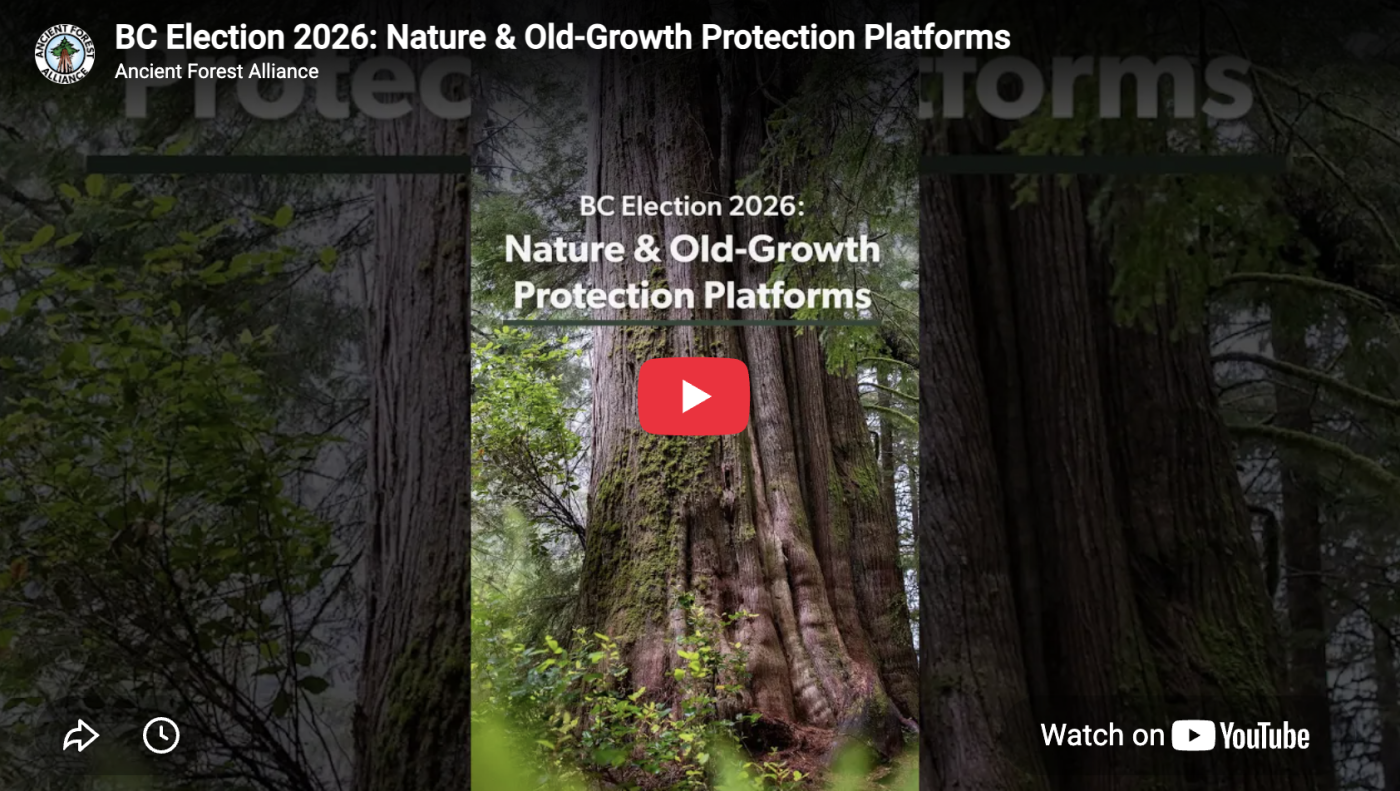
 https://ancientforestalliance.org/wp-content/uploads/2026/10/Screenshot-2026-10-22-at-4.54.32-PM.png
952
1684
TJ Watt
https://ancientforestalliance.org/wp-content/uploads/2026/05/Ancient-Forest-Alliance-logo.svg
TJ Watt2026-10-22 16:54:062026-10-22 16:59:41NEW Video: BC Election 2026: Nature & Old-Growth Protection
https://ancientforestalliance.org/wp-content/uploads/2026/10/Screenshot-2026-10-22-at-4.54.32-PM.png
952
1684
TJ Watt
https://ancientforestalliance.org/wp-content/uploads/2026/05/Ancient-Forest-Alliance-logo.svg
TJ Watt2026-10-22 16:54:062026-10-22 16:59:41NEW Video: BC Election 2026: Nature & Old-Growth ProtectionRelated Posts
https://ancientforestalliance.org/wp-content/uploads/2026/10/Screenshot-2026-10-22-at-4.54.32-PM.png
952
1684
TJ Watt
https://ancientforestalliance.org/wp-content/uploads/2026/05/Ancient-Forest-Alliance-logo.svg
TJ Watt2026-10-22 16:54:062026-10-22 16:59:41NEW Video: BC Election 2026: Nature & Old-Growth Protection https://ancientforestalliance.org/wp-content/uploads/2026/10/Before-After-Caycuse-TJ-Watt-4-scaled.jpg
1915
2560
TJ Watt
https://ancientforestalliance.org/wp-content/uploads/2026/05/Ancient-Forest-Alliance-logo.svg
TJ Watt2026-10-16 17:36:002026-10-21 13:40:23BC Election 2026: Where do Parties Stand on Nature & Old-Growth?
https://ancientforestalliance.org/wp-content/uploads/2026/10/Before-After-Caycuse-TJ-Watt-4-scaled.jpg
1915
2560
TJ Watt
https://ancientforestalliance.org/wp-content/uploads/2026/05/Ancient-Forest-Alliance-logo.svg
TJ Watt2026-10-16 17:36:002026-10-21 13:40:23BC Election 2026: Where do Parties Stand on Nature & Old-Growth? https://ancientforestalliance.org/wp-content/uploads/2026/10/BC-Election-2026-Banner-1-1-scaled.jpg
1439
2560
TJ Watt
https://ancientforestalliance.org/wp-content/uploads/2026/05/Ancient-Forest-Alliance-logo.svg
TJ Watt2026-10-09 18:16:372026-10-16 17:44:41Where do BC’s Major Political Parties Stand on Nature Protection?
https://ancientforestalliance.org/wp-content/uploads/2026/10/BC-Election-2026-Banner-1-1-scaled.jpg
1439
2560
TJ Watt
https://ancientforestalliance.org/wp-content/uploads/2026/05/Ancient-Forest-Alliance-logo.svg
TJ Watt2026-10-09 18:16:372026-10-16 17:44:41Where do BC’s Major Political Parties Stand on Nature Protection? https://ancientforestalliance.org/wp-content/uploads/2026/10/Nat-Geo-Travel-Flores-Cedar.jpg
1357
2048
TJ Watt
https://ancientforestalliance.org/wp-content/uploads/2026/05/Ancient-Forest-Alliance-logo.svg
TJ Watt2026-10-02 13:38:152026-10-02 13:38:15Nat Geo Travel Features TJ Watt’s Photo of Flores Cedar
https://ancientforestalliance.org/wp-content/uploads/2026/10/Nat-Geo-Travel-Flores-Cedar.jpg
1357
2048
TJ Watt
https://ancientforestalliance.org/wp-content/uploads/2026/05/Ancient-Forest-Alliance-logo.svg
TJ Watt2026-10-02 13:38:152026-10-02 13:38:15Nat Geo Travel Features TJ Watt’s Photo of Flores CedarTake Action
 Donate
Support the Ancient Forest Alliance with a one-time or monthly donation. Send a Message
Send an instant message to key provincial decision-makers.
Campaign Launched to Protect Rare Lowland Old-Growth Rainforest and Internationally Significant Eagle Roosting Area east of Vancouver
/in Media ReleaseFor Immediate Release
October 11, 2012
Campaign Launched to Protect Rare Lowland Old-Growth Rainforest and Internationally Significant Eagle Roosting Area east of Vancouver
Between Mission and Agassiz, Echo Lake’s old-growth Douglas fir and redcedars are home to hundreds of roosting bald eagles during the fall salmon run. A new BC government proposal would protect some of the area but is still missing key old-growth groves, with public input ending on Nov.5
See SPECTACULAR photos of Echo Lake’s ancient forest at: https://ancientforestalliance.org/photos-media/echo-lake/
Conservationists with the Ancient Forest Alliance (AFA) have launched a new campaign to fully protect one the last endangered lowland old-growth forests left in the Lower Mainland at Echo Lake east of Mission, as part of the organization’s larger campaign to lobby the BC government for a new Provincial Old-Growth Strategy to save endangered old-growth forests across the province. The campaign to protect the Echo Lake Ancient Forest coincides with the onset of a 60 day public input period launched last month by the Ministry of Forests, ending on November 5, in regards to proposed new Old-Growth Management Areas in the Chilliwack Forest District.
The Echo Lake Ancient Forest is a spectacular, monumental stand of enormous mossy redcedars and extremely rare old-growth Douglas firs (99% of which have already been logged on BC’s coast) found on the shores and lower slopes around the lake. The area is within the traditional, unceded territory of the Sts’ailes First Nations band (formerly the Chehalis Indian Band). The BC government’s newly proposed Old-Growth Management Area (OGMA) for Echo Lake excludes some of the area’s finest old-growth trees.
“This is really an extremely rare gem of lowland ancient rainforest in a sea of second-growth forests, clearcuts, and high altitude old-growth patches. It’s like a little slice of the Carmanah-Walbran, but in the Lower Mainland. To still have an unprotected lowland ancient forest like this left near Vancouver is like finding a Sasquatch. But on top of that, during the fall salmon run the region is home to one of the largest concentrations of raptors on Earth – that is, thousands of fishing and roosting bald eagles,” stated Ken Wu, executive director of the Ancient Forest Alliance. “The BC government’s proposed new Old-Growth Management Area for Echo Lake excludes some of its most spectacular old-growth trees. It’s sort of like serving a burger without the patty, or a lobster without the tail meat. All of the old-growth forests around Echo Lake must be protected.”
In September, the BC Ministry of Forests, Lands, and Natural Resource Operations launched a 60 day public review ending on Nov.5 of proposed Old-Growth Management Areas that prohibit logging as part of the process to complete the land use planning process in the Chilliwack Forest District. See:[Original article no longer available]
Echo Lake is found within the Hatzic Landscape Unit, one of 6 landscape units under review in the plan. Unfortunately, while the boundaries of a proposed Old-Growth Management Area (OGMA) for Echo Lake encompasses the old-growth forests on the south side of the lake, some of the finest old-growth redcedars and Douglas firs on the west and north sides of the lake are still excluded from the proposed boundaries, as are mature forests that buffer these groves and provide scenery and additional wildlife habitat.
The Harrison and Chehalis Rivers area is home to one of the largest concentrations of bald eagles on Earth. Thousands of eagles come in the fall to eat spawning salmon in the rivers and hundreds roost in the old-growth trees at night around Echo Lake. It is also home to a large array of biodiversity including bears, cougars, bobcats, deer, mountain goats, and osprey, and until recent times would have been populated by the critically endangered northern spotted owl.
Virtually all low elevation old-growth forests in the region have been now been logged, with most remaining old-growth stands consisting of smaller mountain hemlocks, amabilis firs, and yellow cedars at higher altitudes on steep slopes.
The vigilance of local landowners on the east side of Echo Lake, whose private lands restrict public access to the old-growth forests on the Crown lands on the west side of the lake, have held-off industrial logging from the lake’s old-growth forests for decades. Across the southern coast of BC, about 80% of the original, productive old-growth forests have already been logged.
“A professor from Oxford University did a study in the 1980’s on the eagles that roost every fall in the old growth trees surrounding Echo Lake. He said that this small valley has offered sanctuary to these majestic birds for over eight thousand years. When you see them come in at sunset by the hundreds, you quickly realize this valley should be theirs in perpetuity,” stated Stephen Ben-Oliel, the landowner whose private property at Echo Lake abuts the Crown lands covered in old-growth forests.
“Considering the exceptional importance of Echo Lake for bald eagles and the scarcity of these lowland ancient forests in the Lower Mainland, it really should be a no-brainer that all of the old-growth and mature forests around the lake should be protected,” stated TJ Watt, campaigner and photographer with the Ancient Forest Alliance. “But that also goes for all of the remaining endangered old-growth forests now throughout the Lower Mainland, Vancouver Island, and elsewhere in BC where logging has greatly depleted these ancient ecosystems.”
Local conservationists are also interested in stronger conservation measures for the massive bald eagle population in the area, including stronger protections for salmon habitat, water quality, and forests. The protection of the Echo Lake Ancient Forest where the eagles roost at night would be a vital part of such a plan. For example, near Squamish at another major eagle congregating region, the Brackendale Eagles Provincial Park protects over 700 hectares of forests on the west side of the Squamish River. The local Sts’ailes First Nations band have a particular interest in protecting the salmon habitat and water quality in the region that supports the eagles.
While the Ancient Forest Alliance is calling for the full protection of Echo Lake’s forests, the organization is primarily calling for a larger provincial plan to protect the remaining endangered old-growth forests across BC while ensuring sustainable second-growth forestry jobs. In particular, some of the key policy shifts the organization is calling for include:
“How many jurisdictions on Earth still have trees that grow as wide as living rooms and as tall as downtown skyscrapers? And how many jurisdictions still consider it okay to turn such trees in giant stumps and tree plantations? What we have here in BC is something exceptional, the likes of which won’t be seen again for a long, long time if they are logged,” stated Wu. “More than ever we need the BC government to have the wisdom and courage to move ahead with a provincial plan that will protect our endangered old-growth forests, ensures the sustainable logging of second-growth forests, and ends the export of raw logs to foreign mills”.
Group aims to protect eagles’ night roost
/in News CoverageLink to Globe and Mail online article
A small grove of timber in the Fraser Valley used as a night roost by flocks of eagles has long been a secret known only to a few people in British Columbia.
But now an environmental group, the Ancient Forest Alliance, and a landowner who has property adjacent to the roosting trees are working together to publicize the area, in the hopes of saving it from logging.
“I would say between 25 and 50 hectares has to be protected – which is not a huge amount to save what is a natural wonder of the world,” said Stephen Ben-Oliel, who first learned of the eagle roost when he bought land at Echo Lake 17 years ago.
In the late fall, thousands of eagles gather along the nearby Harrison and Chehalis rivers to feast on spawning salmon, a major ecotourism draw and focus of the annual Fraser Valley Bald Eagle Festival, which this year is held Nov. 17 and 18.
But while boat and hiking tours have long allowed people to see the eagles feeding along the rivers, few knew where the birds went when darkness fell.
Mr. Ben-Oliel says they come by the hundreds, just at dusk, to settle in the big trees cupped in the small valley that holds Echo Lake, east of Mission.
“They are like a secret and that little valley is like a secret,” he said. “People living in the Fraser Valley often don’t know there’s a lake there because it’s surrounded by mountains. It’s a hidden valley, with this secret of the eagles.”
Mr. Ben-Oliel said a Ministry of Forests land use plan under study for the Fraser Valley sets aside part of the old-growth timber around Echo Lake, but would allow a swath of trees that the eagles perch in at night to be logged.
“The outside of this valley has all been hammered by logging. Why not save this little place.…Why not leave this as the place they sleep?” he asked.
Mr. Ben-Oliel said the birds don’t come in large numbers every year, but when they do it is a major wildlife event.
“Some years it’s like you are in the middle of a National Geographic shot and then, for reasons I don’t understand, in other years there aren’t many,” he said. “They come in singly just at dusk, from the end of November through December and into January. There are certain points, about an hour before the sun sets, when the sky is not empty of them. Sometimes they are circling one of the two small mountains, in groups of 15 to 20, but then they start to stack up in the trees. It’s not something that is easily photographed because it’s twilight, but you see their white heads sticking up like golf balls around the lake.”
Ken Wu, executive director of the Ancient Forest Alliance, said the provincial land use plan sets aside trees on one shore of Echo Lake, but not the other. “It all needs to be saved,” he said, arguing the government needs to double its plan to save 45 hectares.
Mr. Wu said his organization, which searches for the last remaining patches of old growth around the province, then lobbies to save them, became aware of Echo Lake in 2007, when the area was first slated for logging.
Protests at that time persuaded the government to hold off, he said, but now a detailed land use plan for the Fraser Valley is being finalized, which would allow a portion of the Echo Lake timber to be cut. Mr. Wu said he has been unable to find any comparable old growth anywhere in the Lower Mainland. The trees are 300 to 600 years old.
“I mean, it is exceedingly scarce. It’s like coming across a Sasquatch these days, to find valley bottom, low elevation old growth in the Lower Mainland.”
In an e-mail, Vivian Thomas, a spokeswoman for the Ministry of Forests, said the government is now accepting public comment on Fraser Valley land use plans, and concerns about Echo Lake will be considered in that process. She also said the government is looking at a proposal to designate 1,500 hectares in the Harrison and Chehalis area for wildlife management, which could protect winter feeding areas for eagles.
Saturday: Cortes Youth Champion Bill M211; The Species At Risk Protection Act
/in AnnouncementsYouth from Cortes Island, BC are hosting an educational rally on the legislative grounds in Victoria this coming Saturday, October 13 from 11 am – 4 pm.
Cortes youth are championing Bill M211, the Species At Risk Protection Act that has been proposed by the NDP, achieved first reading and is presently tabled.
Forest lands on Cortes Island threatened by industrial logging prompted the youth to research out what protection, if any, was afforded the numerous species at risk making these forest lands their home.
The youth discovered that BC has no species at risk protection legislation in place; together with Alberta, the only 2 Canadian provinces without legal protection for species at risk.
The youth further learned that polls show 85% of British Columbians are in favour of protection for the 1900 species at risk in BC.
So… they made the decision to champion Bill M211!!!!!!!!!
Over the past 6 months Cortes youth and their friends in Victoria have created original artwork depicting 8 of the species at risk occurring in the forest lands threatened on Cortes Island.
They have had buttons made from this artwork and will be handing these out to the public in downtown Victoria (by donation) in conjunction with their educational rally on the front steps of the legislature.
Their strategy is that buttons travel far on public lapels and disseminate the information widely!!!!!!!
Fairahn Reid and Eira-Shay Barker Hart have taken the lead in this youth initiative, with the support of fellow Cortes students and new friends made while attending school in Victoria. Show them your support on Saturday if you are in Victoria or sign on to the petition to bring in legal protection for species at risk in BC at www.protectbiodiversity.ca/action
Kudos to our youth for speaking out for the protection of species at risk!!