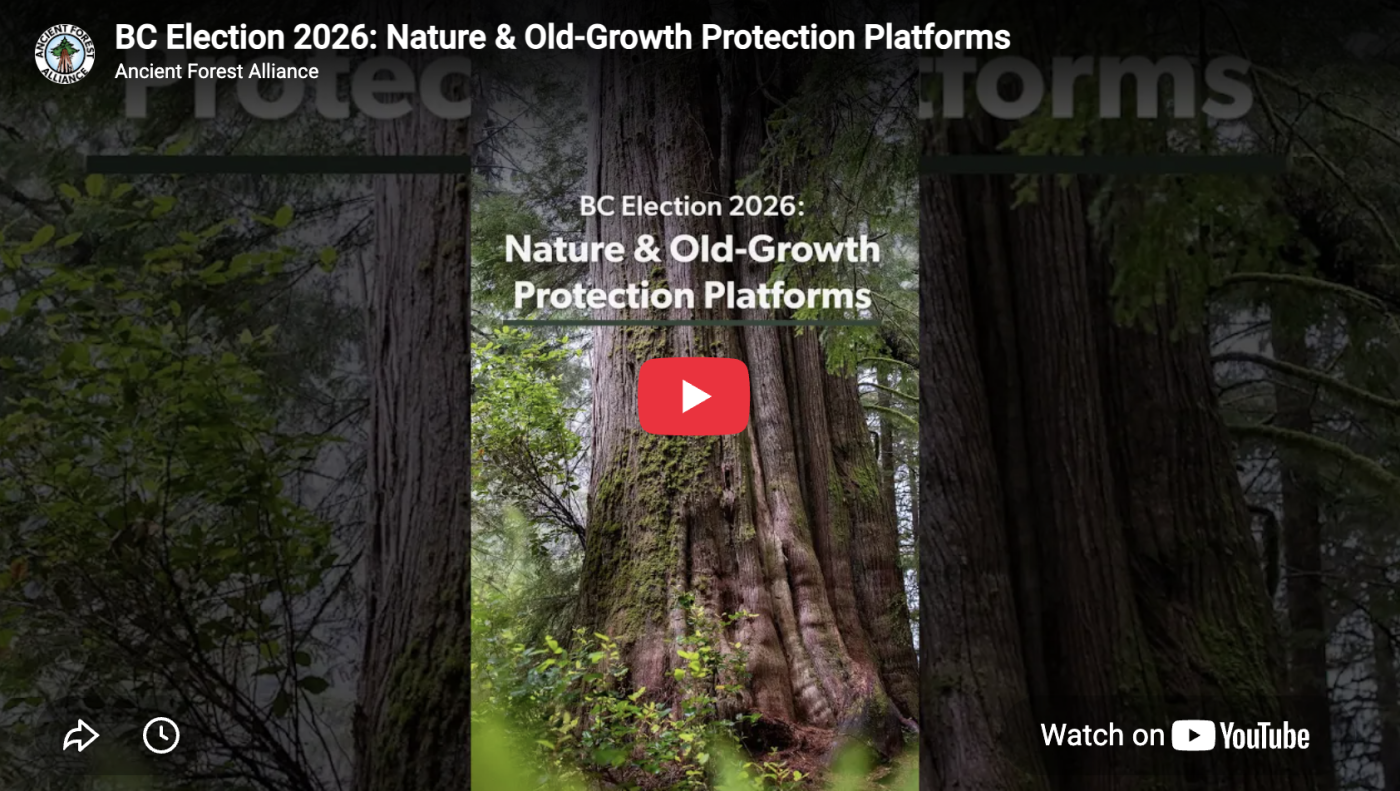
 https://ancientforestalliance.org/wp-content/uploads/2026/10/Screenshot-2026-10-22-at-4.54.32-PM.png
952
1684
TJ Watt
https://ancientforestalliance.org/wp-content/uploads/2026/05/Ancient-Forest-Alliance-logo.svg
TJ Watt2026-10-22 16:54:062026-10-22 16:59:41NEW Video: BC Election 2026: Nature & Old-Growth Protection
https://ancientforestalliance.org/wp-content/uploads/2026/10/Screenshot-2026-10-22-at-4.54.32-PM.png
952
1684
TJ Watt
https://ancientforestalliance.org/wp-content/uploads/2026/05/Ancient-Forest-Alliance-logo.svg
TJ Watt2026-10-22 16:54:062026-10-22 16:59:41NEW Video: BC Election 2026: Nature & Old-Growth ProtectionRelated Posts
https://ancientforestalliance.org/wp-content/uploads/2026/10/Screenshot-2026-10-22-at-4.54.32-PM.png
952
1684
TJ Watt
https://ancientforestalliance.org/wp-content/uploads/2026/05/Ancient-Forest-Alliance-logo.svg
TJ Watt2026-10-22 16:54:062026-10-22 16:59:41NEW Video: BC Election 2026: Nature & Old-Growth Protection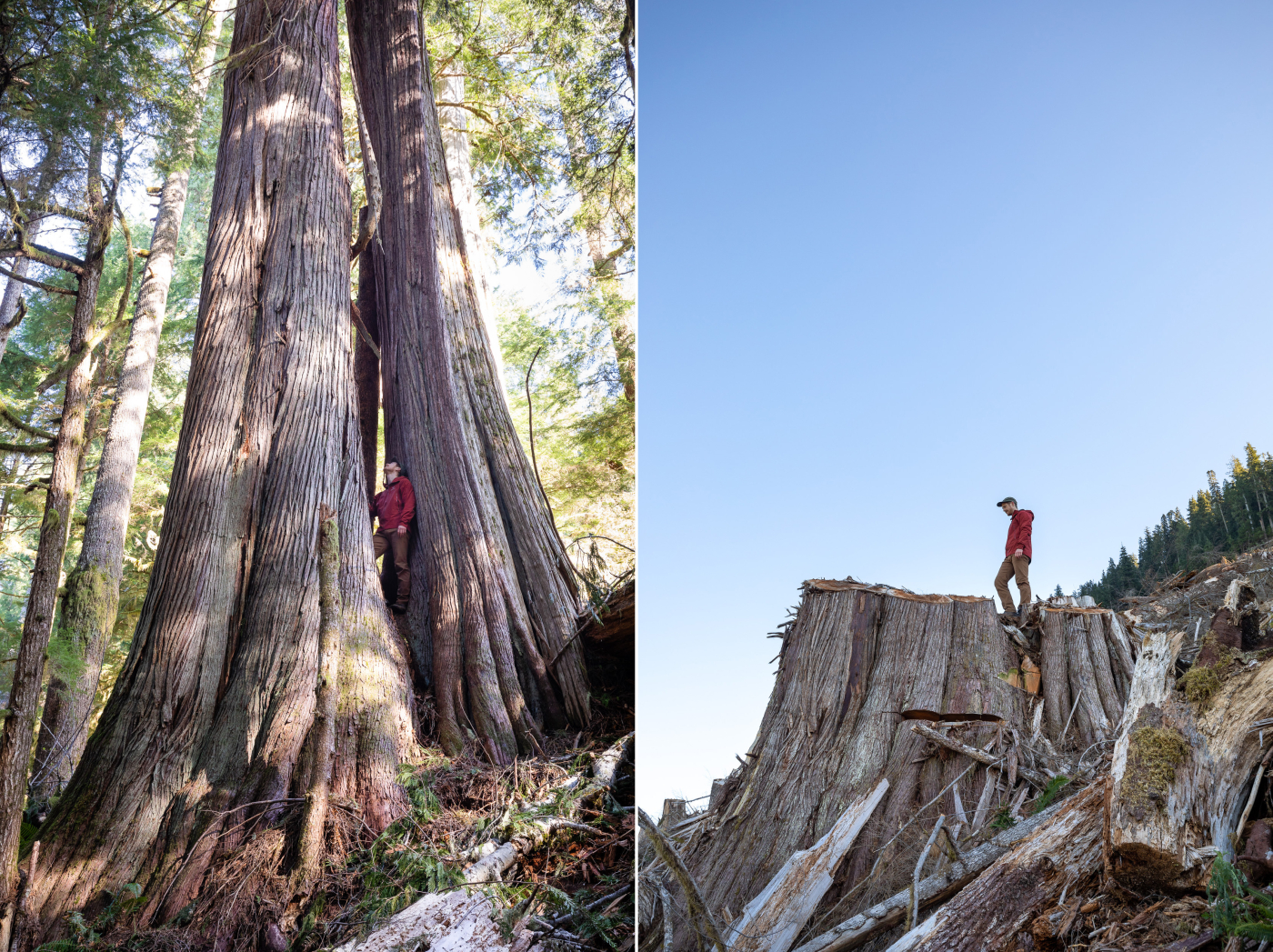 https://ancientforestalliance.org/wp-content/uploads/2026/10/Before-After-Caycuse-TJ-Watt-4-scaled.jpg
1915
2560
TJ Watt
https://ancientforestalliance.org/wp-content/uploads/2026/05/Ancient-Forest-Alliance-logo.svg
TJ Watt2026-10-16 17:36:002026-10-21 13:40:23BC Election 2026: Where do Parties Stand on Nature & Old-Growth?
https://ancientforestalliance.org/wp-content/uploads/2026/10/Before-After-Caycuse-TJ-Watt-4-scaled.jpg
1915
2560
TJ Watt
https://ancientforestalliance.org/wp-content/uploads/2026/05/Ancient-Forest-Alliance-logo.svg
TJ Watt2026-10-16 17:36:002026-10-21 13:40:23BC Election 2026: Where do Parties Stand on Nature & Old-Growth? https://ancientforestalliance.org/wp-content/uploads/2026/10/BC-Election-2026-Banner-1-1-scaled.jpg
1439
2560
TJ Watt
https://ancientforestalliance.org/wp-content/uploads/2026/05/Ancient-Forest-Alliance-logo.svg
TJ Watt2026-10-09 18:16:372026-10-16 17:44:41Where do BC’s Major Political Parties Stand on Nature Protection?
https://ancientforestalliance.org/wp-content/uploads/2026/10/BC-Election-2026-Banner-1-1-scaled.jpg
1439
2560
TJ Watt
https://ancientforestalliance.org/wp-content/uploads/2026/05/Ancient-Forest-Alliance-logo.svg
TJ Watt2026-10-09 18:16:372026-10-16 17:44:41Where do BC’s Major Political Parties Stand on Nature Protection?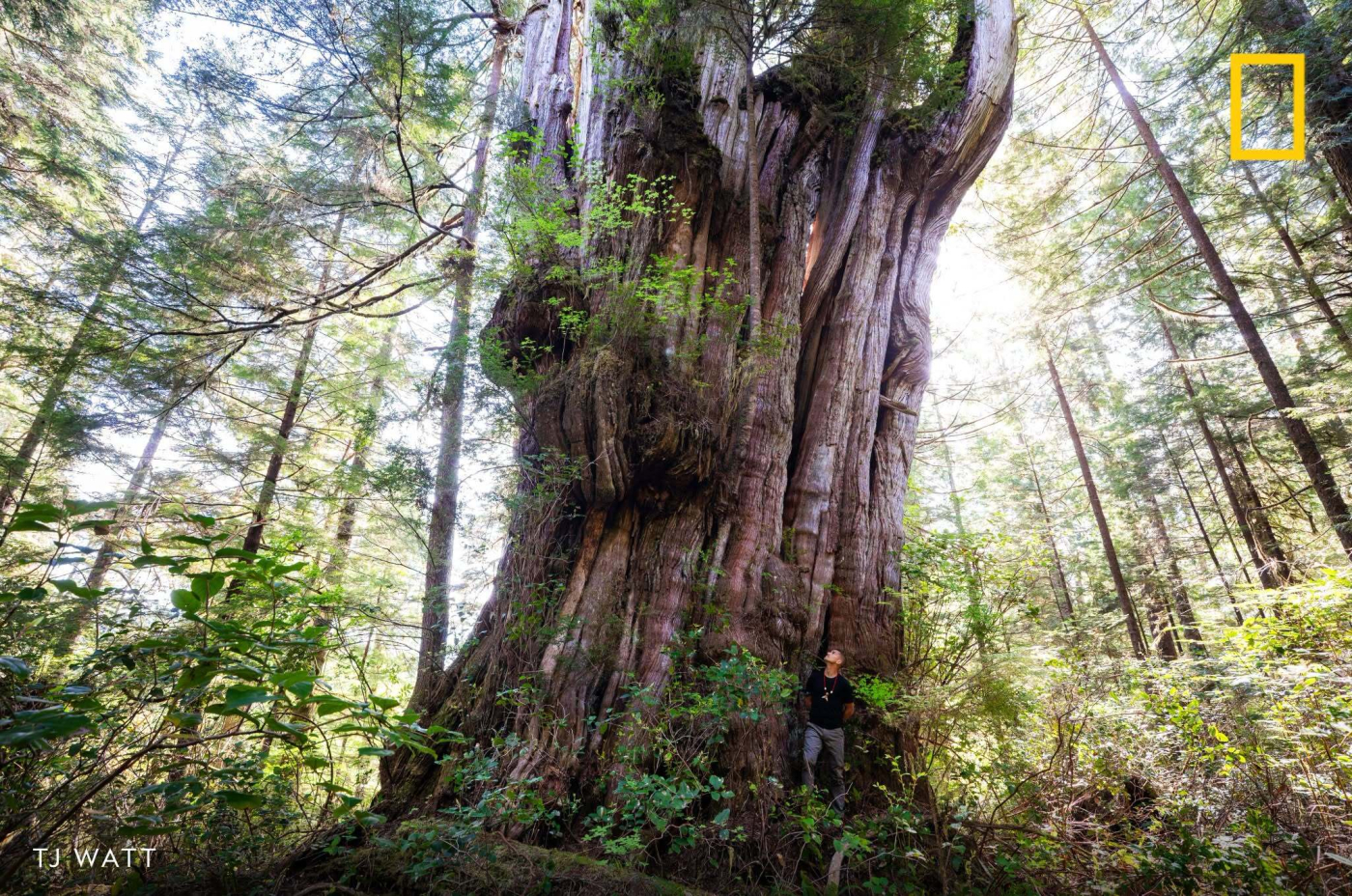 https://ancientforestalliance.org/wp-content/uploads/2026/10/Nat-Geo-Travel-Flores-Cedar.jpg
1357
2048
TJ Watt
https://ancientforestalliance.org/wp-content/uploads/2026/05/Ancient-Forest-Alliance-logo.svg
TJ Watt2026-10-02 13:38:152026-10-02 13:38:15Nat Geo Travel Features TJ Watt’s Photo of Flores Cedar
https://ancientforestalliance.org/wp-content/uploads/2026/10/Nat-Geo-Travel-Flores-Cedar.jpg
1357
2048
TJ Watt
https://ancientforestalliance.org/wp-content/uploads/2026/05/Ancient-Forest-Alliance-logo.svg
TJ Watt2026-10-02 13:38:152026-10-02 13:38:15Nat Geo Travel Features TJ Watt’s Photo of Flores CedarTake Action
 Donate
Support the Ancient Forest Alliance with a one-time or monthly donation. Send a Message
Send an instant message to key provincial decision-makers.
Province to ease logging restrictions in Fraser region
/in News CoverageThe B.C. government plans to relax logging restrictions on about 9,500 hectares of Crown land, including the well-loved getaway of Harrison Lake.
Areas slated for reduced protection within the Fraser timber supply area include upper Stave Lake and Chehalis Lake, as well as upper Harrison Lake. They had been partly protected previously because of their natural beauty.
The planned changes result from an industry-requested review of Crown lands managed under “visual quality objectives” of the Forest and Range Practices Act. The objectives are used to protect all or part of scenic areas and travel corridors for the benefit of communities and tourism. In some cases, logging must follow natural landscape contours, employ selective cutting, or utilize helicopters without road construction.
Lloyd Davies, a visual resource management specialist with the Ministry of Forests, Lands and Natural Resource Operations, said in an interview that industry argued that the upper end of Harrison Lake received fewer visitors than the south end, near the tourist destination of Harrison Hot Springs. They also noted a major landslide had severely damaged three campgrounds and restricted public access at Chehalis Lake in December 2007.
Logging restrictions in upper Stave Lake will be relaxed to bring the level of protection for viewscapes into line with the rest of the lake.
The Vancouver Sun received details of the changes following a freedom-of-information request.
The relaxations in logging of scenic areas is a concern for tourism operators dependent on wilderness viewscapes.
Fraser River Safari in Mission con-ducts scenic boat tours of Stave Lake and would like to see less logging to benefit tourism in the area.
“It is a concern,” said company co-owner Jo-Anne Chadwick, noting the situation is compounded by reckless public use of Crown land, including rampant littering. “We are working hard to get people to understand, to connect with nature.”
The province plans to make logging less restrictive across 9,453 hectares and more restrictive across 1,200 hectares, mainly to preserve views-capes at Alouette Lake. The difference is 8,253 hectares – an area about 20 times the size of Stanley Park.
Management will not change across another 35,867 hectares.
“We’ve looked at it and tried to make balances,” Davies said.
He noted the province rejected a relaxation of logging requirements in other scenic areas such as along the Coquihalla Highway and Pitt River.
An order allowing the changes is expected to take place as soon as June 29.
Dan Gerak, owner of Pitt River Lodge, said he can support logging that respects the importance of maintaining “visual quality” for tourism operators – something that major clearcuts do not.
“We have seen areas in the Pitt where the company is able to take timber out and leave strips, and from the ground it is hard to see that any-thing is gone. That we are okay with, but not big clearcuts in visually sensitive areas.”
Gerak added that face-to-face dialogue is important because the detailed maps provided by forestry are “very hard to understand for the average person that isn’t in forestry.”
Leave Old Growth Alone Says Union
/in News CoverageA major forest sector union is coming out against proposals from the British Columbia government that could see protected areas opened to logging.
“It’s just short term gain for probably long term pain,” said Arnold Bercov, the forest resource officer for the Pulp, Paper and Woodworkers of Canada, which represents some 2,000 workers in the sector in the province. “As I tell the guys, [if we] cut them all down tomorrow we’re screwed and we don’t cut any down.”
The B.C. Legislature has a committee touring Interior communities this week asking the public where timber supply should come from as cut levels are reduced in the wake of the mountain pine beetle epidemic.
A cabinet document leaked in April outlined several possibilities, including logging at an unsustainable rate, cutting down more old growth and wildlife habitat, and allowing cabinet to make decisions instead of the chief forester. Premier Christy Clark confirmed at the time the document reflected the discussion cabinet was having and that the B.C. public needed to have.
Bob Matters, the chair of the wood council for the United Steelworkers Union, which represents the most forest sector workers in the province, in April told The Tyee that his union generally supported the government’s direction.
USW members include those who worked at the Babine Forest Products sawmill in Burns Lake before it burned after a January explosion. The difficulty finding a timber supply for Hampton Affiliates Ltd. to justify rebuilding the mill led to the production of the cabinet document and the appointment of the legislature’s committee.
No jobs without trees
“I’m not trashing any other union,” said the PPWC’s Bercov. “They can come to whatever conclusion they want.”
He said he’s sympathetic to the Steelworkers, to people who are out of work and to the mill owners. “Nobody’s going to rebuild the mill unless they have fibre supply.”
At 62 years old, Bercov has worked in the industry since he was a teenager. When he started, he said, he didn’t think about where the trees came from and didn’t care, but over time that changed. “I think, where does it end?”
If every tree is protected, there are no jobs, he said. But if everything is logged there are no jobs either, he said. “All I’m saying is we have to find that balance.”
For six years, some of it as co-chair, Bercov was on the board of the Forest Stewardship Council of Canada, the certification and labelling organization that promotes responsible forest management. Through that experience he saw the value of hearing and respecting the perspectives of environmentalists, First Nations, the industry and others, he said.
And today he and the PPWC made a joint a statement with the conservationist group Ancient Forest Alliance on the proposal to log protected areas. Bercov, by the way, said he respects AFA executive director Ken Wu and “I value what he tells me.”
Working with Wu
Wu is of course against logging in protected areas, which he compares to burning your house for firewood.
“This is precedent-setting,” he said, noting the industry in other parts of the province says it faces timber shortages. “There’s no way we’re going to let them do that.”
The legislative committee will hear from stakeholders in Vancouver for three days, but Wu said the committee should add opportunities for the public also to voice their concerns in Victoria and Vancouver.
The committee needs to hear that there is strong opposition to taking trees from areas set aside for old growth, wildlife habitat and views. “It’s rewarding unsustainable behaviour with more unsustainable behaviour,” he said. “You don’t reward the unsustainable activity of the industry with more unsustainable activities.”
There are various reasons the forest industry is facing reduced cuts, he said. They include the expansion of the mountain pine beetle from years of forest fire suppression and climate change and from the industry’s over cutting, he said.
Wu said conservationists are watching the positions the province’s political parties take on logging protected areas and are prepared to make it an election issue.
Bercov said it’s not in his union’s interest to reignite a war between the industry and environmentalists. “Just to go in and renew the battles with environmentalists is a loser for the province,” he said. “I don’t think our union’s interested in refighting them. I’d rather work with environmental groups than against them.”
The province needs to look at ways to get more value from the trees the industry cuts, he said. That means reducing log exports and getting the highest value possible out of each log. It also means more intensive tree planting and silviculture, he said.
And it means managing the reduction in timber in the interior and other areas, rather than desperately seeking more, he said. “Cutting down reserves and angering people isn’t a solution. It’s short term.”
A better managed forest would lead to more jobs, he said. “We want to create employment, not at any cost, but I think you’d create more employment if you did thing right,” he said. “To me it’s about jobs. We want to create as many jobs as we can out of every tree that’s cut here.”
It’s entirely possible to protect the forest, look after the needs of wildlife and still have enough timber supply to provide jobs, he said. “Balance always works best.”
Campaign for a $40 million per year BC Park Acquisition Fund Launched
/in AnnouncementsThis week the Ancient Forest Alliance has launched a campaign, including a new petition at www.BCParkFund.com, the distribution of 50,000 new brochures (see https://www.bcparkfund.com/newsletter/June-2012-Parks-Acquisition.pdf) into key communities, and outreach to other conservation and recreation groups, calling on the BC Liberal government to establish a dedicated “BC Park Acquisition Fund” of at least $40 million per year. The fund would raise $400 million over 10 years, enabling the timely purchase of significant tracts of endangered private lands of high conservation, scenic, and recreation value to add to BC’s parks and protected areas system.
“While private land trusts are vital for conservation, they simply don’t have the capacity to quickly raise the tens of millions of dollars needed each year to protect enough endangered lands within the short time spans many areas have left to exist – only governments have such funds,” stated Ken Wu, executive director of the Victoria-based Ancient Forest Alliance (www.ancientforestalliance.org).
In years past, the BC government has designated funds for new park acquisition in the provincial budget; however, the funds have been inconsistent and simply too small.
“While $40 million might sound like a lot, let’s remember that it is only 1/1000th or 0.1% of the $40 billion provincial budget. Surely we can afford to invest 0.1% of the provincial budget to protect our endangered species and invest in BC’s scenic and recreational assets?” Wu asked.
Across British Columbia many of the most endangered ecosystems are found on private lands. These include the Coastal Douglas-fir and Dry Maritime forests on Vancouver Island and the Sunshine Coast, with their Mediterranean-like climates, twisted arbutus trees on rocky outcrops, and extremely scarce ancient groves; dry ecosystems of BC’s southern interior, including the fragrant Ponderosa Pine forests, sage-filled grasslands, and semi-arid “pocket desert”; waterfowl-filled wetlands and rich deciduous forests in the Fraser Valley and along our largest rivers; and other magnificent but endangered ecosystems threatened with encroaching developments.
These private lands are jam-packed with endangered species. They are also usually found closest to BC’s main population centers, making them highly accessible locations for environmental education and nature tourism. As such, they are potentially the highest-value additions to BC’s world-class parks and protected areas system.
Several of the most endangered old-growth forests on Vancouver Island and the Sunshine Coast survive on the hundreds of thousands of hectares of private corporate lands owned by Island Timberlands and until recently, TimberWest, who sold their BC lands in 2011 to two public sector pension funds managed by the BC Investment Corporation (BCIMC) and the federal Public Sector Investment Management Board (PSIMB). Old-growth forests are vital for supporting endangered species, tourism, the climate, clean water and salmon, and many First Nations cultures.
Island Timberlands in particular in 2012 is aggressively moving to log many of its lands with the highest conservation and recreational values. Conservationists are calling on the company to back off from such plans, while at the same time calling on the BC government to help purchase the companies’ contentious private lands.
Earlier this week a meeting between Cortes Island residents and Island Timberlands representatives resulted in a deadlock in negotiations due to fundamental disagreements about the company’s logging plans that might start as soon as this September. See: https://www.vancouverobserver.com/blogs/earthmatters/no-negotiation-progress-island-timberlands%E2%80%99-plans-log-cortes-island-forests
Contentious old-growth and mature forests (see spectacular PHOTOS in each link) that are threatened by Island Timberlands on their private lands include:
Contentious forests on former TimberWest lands, now owned by the BCIMC and the PSIMB, include:
Park acquisition funds already exist on a smaller scale in several Regional Districts in BC, including the Capital Regional District (CRD) in the Greater Victoria region which has a Land Acquisition Fund of about $3.5 million each year. The CRD has spent over $34 million dollars since the year 2000 to purchase over 4500 hectares, including lands at Jordan River, the Sooke Hills, the Sooke Potholes, Thetis Lake, Mount Work, and Mount Maxwell on Salt Spring Island, to expand their system of Regional Parks.
“Studies have shown that for every $1 spent by the BC government on our parks system, another $9 in tourism revenues is generated in the provincial economy,” stated TJ Watt, campaigner and photographer with the AFA. “What better investment can we make than to spend a very modest sum each year to protect Beautiful British Columbia? A BC Park Acquisition Fund would be a win-win for everyone.”