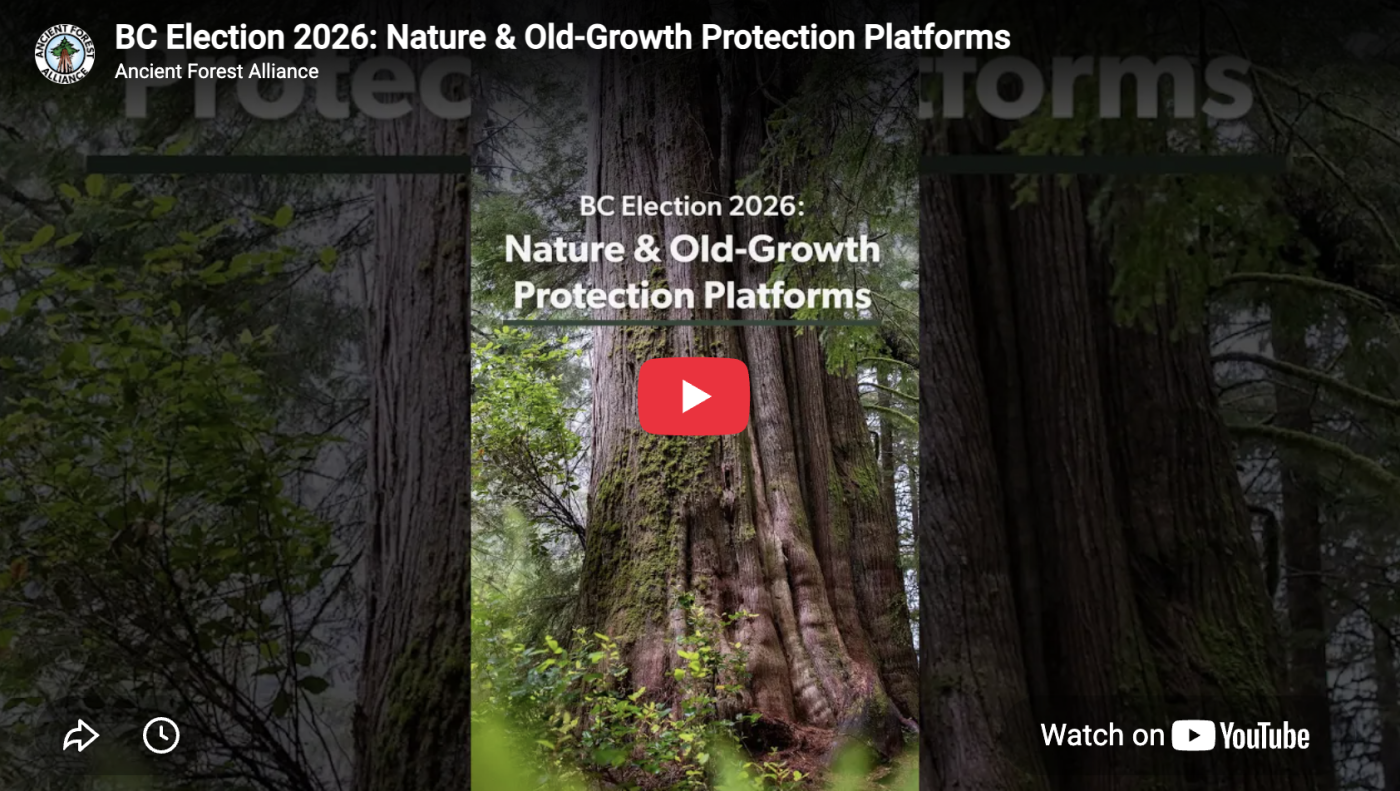
 https://ancientforestalliance.org/wp-content/uploads/2026/10/Screenshot-2026-10-22-at-4.54.32-PM.png
952
1684
TJ Watt
https://ancientforestalliance.org/wp-content/uploads/2026/05/Ancient-Forest-Alliance-logo.svg
TJ Watt2026-10-22 16:54:062026-10-22 16:59:41NEW Video: BC Election 2026: Nature & Old-Growth Protection
https://ancientforestalliance.org/wp-content/uploads/2026/10/Screenshot-2026-10-22-at-4.54.32-PM.png
952
1684
TJ Watt
https://ancientforestalliance.org/wp-content/uploads/2026/05/Ancient-Forest-Alliance-logo.svg
TJ Watt2026-10-22 16:54:062026-10-22 16:59:41NEW Video: BC Election 2026: Nature & Old-Growth ProtectionRelated Posts
https://ancientforestalliance.org/wp-content/uploads/2026/10/Screenshot-2026-10-22-at-4.54.32-PM.png
952
1684
TJ Watt
https://ancientforestalliance.org/wp-content/uploads/2026/05/Ancient-Forest-Alliance-logo.svg
TJ Watt2026-10-22 16:54:062026-10-22 16:59:41NEW Video: BC Election 2026: Nature & Old-Growth Protection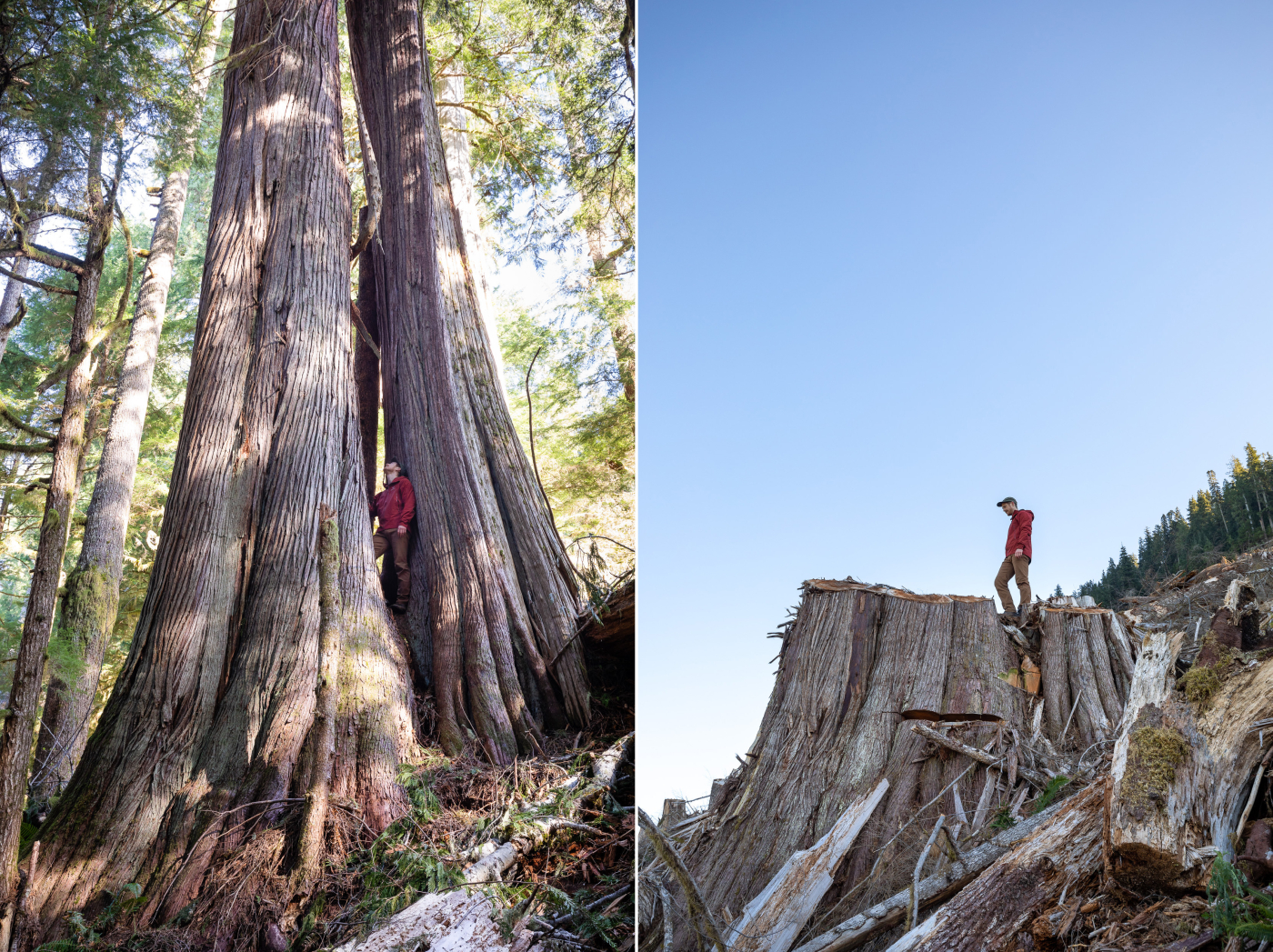 https://ancientforestalliance.org/wp-content/uploads/2026/10/Before-After-Caycuse-TJ-Watt-4-scaled.jpg
1915
2560
TJ Watt
https://ancientforestalliance.org/wp-content/uploads/2026/05/Ancient-Forest-Alliance-logo.svg
TJ Watt2026-10-16 17:36:002026-10-21 13:40:23BC Election 2026: Where do Parties Stand on Nature & Old-Growth?
https://ancientforestalliance.org/wp-content/uploads/2026/10/Before-After-Caycuse-TJ-Watt-4-scaled.jpg
1915
2560
TJ Watt
https://ancientforestalliance.org/wp-content/uploads/2026/05/Ancient-Forest-Alliance-logo.svg
TJ Watt2026-10-16 17:36:002026-10-21 13:40:23BC Election 2026: Where do Parties Stand on Nature & Old-Growth? https://ancientforestalliance.org/wp-content/uploads/2026/10/BC-Election-2026-Banner-1-1-scaled.jpg
1439
2560
TJ Watt
https://ancientforestalliance.org/wp-content/uploads/2026/05/Ancient-Forest-Alliance-logo.svg
TJ Watt2026-10-09 18:16:372026-10-16 17:44:41Where do BC’s Major Political Parties Stand on Nature Protection?
https://ancientforestalliance.org/wp-content/uploads/2026/10/BC-Election-2026-Banner-1-1-scaled.jpg
1439
2560
TJ Watt
https://ancientforestalliance.org/wp-content/uploads/2026/05/Ancient-Forest-Alliance-logo.svg
TJ Watt2026-10-09 18:16:372026-10-16 17:44:41Where do BC’s Major Political Parties Stand on Nature Protection?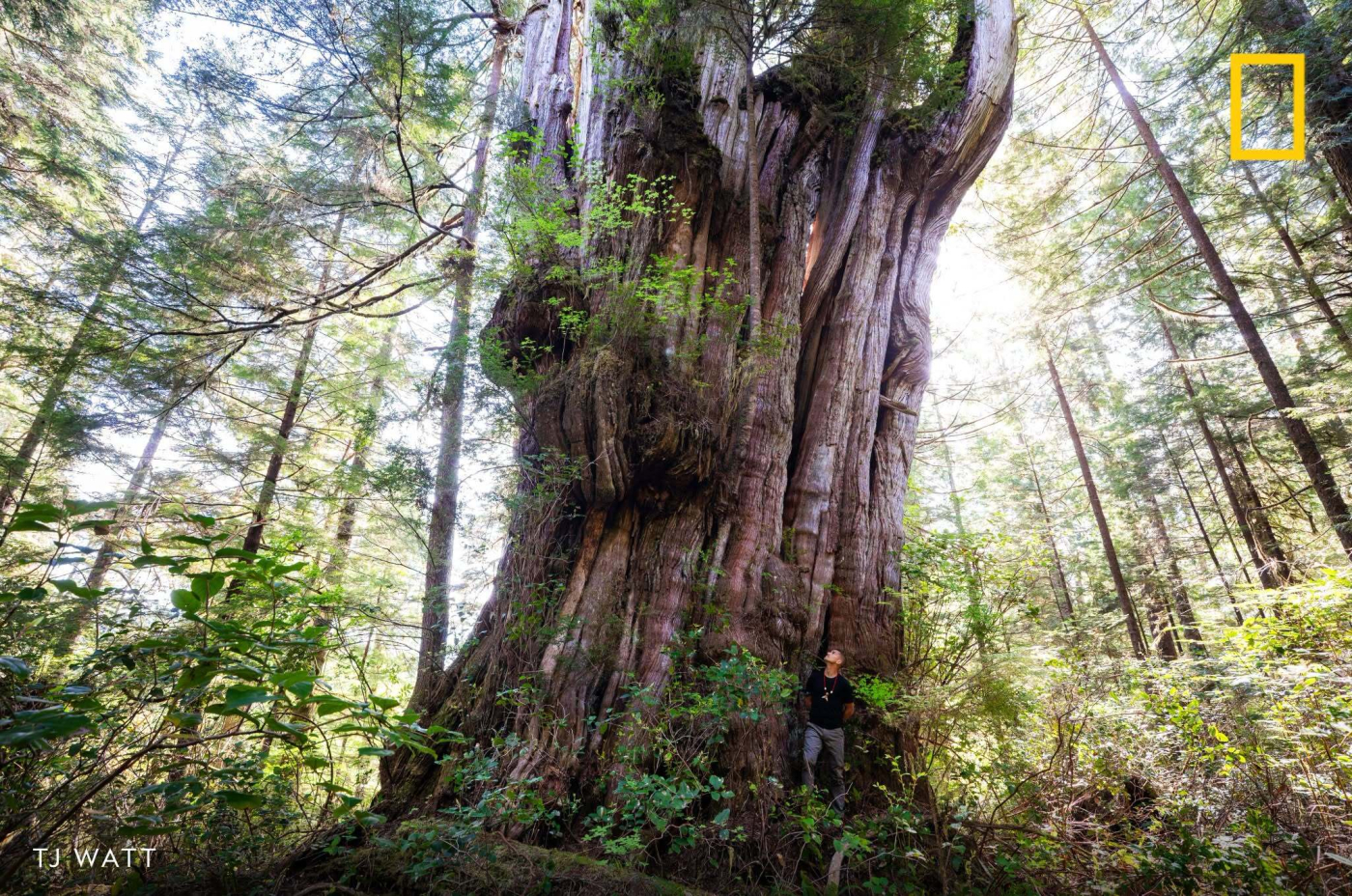 https://ancientforestalliance.org/wp-content/uploads/2026/10/Nat-Geo-Travel-Flores-Cedar.jpg
1357
2048
TJ Watt
https://ancientforestalliance.org/wp-content/uploads/2026/05/Ancient-Forest-Alliance-logo.svg
TJ Watt2026-10-02 13:38:152026-10-02 13:38:15Nat Geo Travel Features TJ Watt’s Photo of Flores Cedar
https://ancientforestalliance.org/wp-content/uploads/2026/10/Nat-Geo-Travel-Flores-Cedar.jpg
1357
2048
TJ Watt
https://ancientforestalliance.org/wp-content/uploads/2026/05/Ancient-Forest-Alliance-logo.svg
TJ Watt2026-10-02 13:38:152026-10-02 13:38:15Nat Geo Travel Features TJ Watt’s Photo of Flores CedarTake Action
 Donate
Support the Ancient Forest Alliance with a one-time or monthly donation. Send a Message
Send an instant message to key provincial decision-makers.
Liberals ignoring committee on raw log exports: Dix
/in News CoverageThe B.C. Liberal government has, since December, been exporting raw logs that its own advisory committee has been saying should be going to producers in B.C.
On Tuesday, New Democratic Party leader Adrian Dix said the Timber Export Advisory Committee (TEAC) deter-mined last December that logs from Quatsino Sound on Vancouver Island should be sold to Teal-Jones of Surrey instead of being shipped overseas.
But Minister of Forests, Lands and Natural Resource Operations Steve Thomson overruled that recommendation, Dix said, allowing the logs to be sold into foreign markets.
“The minister owes people an explanation for his decision,” Dix said during question period Tuesday.
“The committee made the determination that keeping those logs in British Columbia was better for our economy than exporting them, and the minister overruled them.”
Thomson said his ministry rejected the recommendation because TEAC had changed the way it was evaluating whether or not logs should be sold to foreign buyers.
“Without just taking their advice directly, in this case because we knew there was policy implications that needed to be considered, we administered the policy the way that it had always been administered and the way they had previously been providing advice to us,” Thomson said Tuesday, adding the committee has no regulatory function, and is an advisory body only.
“It’s not a process of overruling TEAC,” he continued, “it’s a process of a shift in policy advice being received from the advisory committee.”
Ministry staff said the issue stretches beyond Teal-Jones, and has affected about 150 applications since December, comprising about 116,000 cubic metres of timber.
The ministry said that staff overturned TEAC recommendations on 86 applications in December and January, covering 70,145 cubic metres.
In February, the ministry stopped referring anything to the committee from the west coast of Vancouver Island, as they expected the decisions would be overturned. There were 47 offers in February, comprising 35,532 cubic metres.
In March, TEAC requested it be allowed to review cases again, and government agreed. The committee has so far reviewed 18 offers for 10,168 cubic metres, staff said.
Thomson said he has met with members of the committee and is reviewing the change they made in December to deter-mine if it’s something government is willing to adopt.
“We’re continuing to review that with [TEAC] and we’ve committed to get back to them,” he said, adding he will have an answer before the committee’s next meeting in April.
“But because there was a change in determination and a change in policy in terms of their advice we know we needed to look at this and have a discussion around the implications of the policy.”
At issue in the matter is the way TEAC judges fair market value for logs.
As of December, the commit-tee began looking at domestic offers for coastal logs that did not include the costs to ship the logs to the buyer. This represents a change from before, where the offer made for the logs had to include the cost of freight.
It means domestic offers can potentially be more competitive than before.
On Tuesday, NDP forest critic Norm Macdonald said the issue goes beyond the details of how to calculate market value, adding the key is all about jobs.
“You have manufacturers that are ready. You have Teal-Jones that has gone through the pro-cess. This is a company that produces jobs,” said Macdonald. “You have a host of companies that are ready, and these are the crumbs we’re talking about that go through this advisory committee. These are the crumbs, and even them – this minister will deny those mills.”
In 2011, British Columbia exported 5.87 million cubic metres of coastal raw logs. That was up from the 3.86 million cubic metres that were exported from the coast in 2010.
Read more: https://www.vancouversun.com/Liberals+ignoring+committee+exports/6298779/story.html#ixzz1p7mGGyHA
Minister costing logging jobs, critics say
/in News CoverageB.C. Forests Minister Steve Thomson has overruled recommendations from his own advisory board on log exports dozens of times in the past three months, electing to send millions of dollars worth of raw logs to Asia rather than local mills.
The minister’s decisions effectively put logging profits ahead of jobs in B.C. mills, says a forestry executive whose bid for coastal logs was approved by the minister’s Timber Export Advisory Committee but quashed by the minister.
Mr. Thomson said he has rejected his committee’s advice, citing an arcane policy debate about freight costs. But the result is that workers at a Teal-Jones Group sawmill in Surrey are facing down time this week because of a shortage of fibre, while buyers in China, Japan and South Korea are purchasing B.C. logs in record volumes at premium prices that B.C. mills can’t afford.
“There is room for exports, but I think the significant increase in exports is going to ensure nobody can put up another mill in B.C.,” said Hanif Karmally, chief financial officer for the Teal-Jones Group.
Teal-Jones, which owns a string of forestry operations across the province, found that the committee started approving its domestic timber bids in December – after a year that saw a 50-per-cent increase in the volume of logs being shipped overseas.
But the minister’s office disagreed with the committee’s new-found reluctance to declare as “surplus” those logs that were being sought by local mills. Throughout December and January, the ministry spiked 86 recommendations by the advisory board that would have kept roughly 70,000 cubic metres of wood in B.C. mills. By February, the ministry simply stopped sending the applications to the committee at all, directly rejecting another 47 local offers for 35,000 cubic metres of wood.
The wood is being sold to Asian mills at about double the domestic price.
The minister’s decisions were raised in the legislature on Tuesday, just hours after Premier Christy Clark held a press conference to tout the success of her jobs plan.
NDP Opposition Leader Adrian Dix blasted her government for putting mill jobs at risk. “They specifically intervened to stop jobs from being created in British Columbia,” Mr. Dix later told reporters.
Ms. Clark was not in the legislature on Tuesday. Instead, she attended an event at Seaspan Shipyards to mark the six-month anniversary of her jobs plan.
“That’s the problem when you have a communications exercise dressed up as a jobs plan,” Mr. Dix said. “That’s the reason, ultimately, that the government is in such trouble.”
Mr. Thomson told reporters he rejected the advice of his committee because his government is in the midst of a policy review on raw log exports and the committee appeared to be changing policy on its own by pushing more wood to local mills.
“They are an advisory committee … but given the fact that there was a shift in policy advice, we administered the policy as it had previously been administered.”
He said his government needs to find the “appropriate balance” to ensure harvesting jobs are maintained as well as processing jobs. He is set to visit the Teal-Jones operations next week. “The Teal-Jones boys know we are looking at this policy, what we are telling them is that it is under review.”
He said the question of surplus timber is wrapped up in the larger review of raw-log exports that is under way.
In January, Ms. Clark promised a conference of truck loggers that the review would not shut the door on raw-log exports. “I can assure you that on log exports, my government is taking a common-sense approach,” the Premier said at that time.
Read more in the Globe and Mail: https://www.theglobeandmail.com/news/national/british-columbia/bc-politics/minister-costing-logging-jobs-critics-say/article2368563/
Bluffs receive high-profile focus
/in News CoverageA campaign to protect Stillwater Bluffs south of Powell River received high-profile help from a provincial organization recently.
Jason Addy, of the Friends of Stillwater Bluffs, joined Ken Wu, co-founder of the Ancient Forest Alliance, at a press conference at the Sooke Potholes. The groups were calling on the BC government to form a land acquisition fund dedicated to protecting parkland.
Powell River Regional District’s Parks and Greenspace Plan identifies Stillwater Bluffs as one of the top five sites earmarked as priorities for parks acquisition. The regional district discussed the issue at its Thursday, March 8 committee-of-the-whole meeting, during which Laura Roddan, regional district planner, reported on a meeting with Island Timberlands on March 8.
Stillwater Bluffs is part of the 48-hectare District Lot 3040, owned by Island Timberlands. The company has completed a timber cruise to identify high value timber and logging may start next year or the year after.
Planning work has started and will continue over the coming months. It includes confirming road access, ground-truthing sensitive ecosystems, setting visual management objectives and considering recreational uses and community interests.
Planning work to date has confirmed that mosses and lichens, classified as herbaceous sensitive ecosystems, are on the rocky bluffs, which don’t have a high timber value.
The company’s real estate group handles all negotiations for land acquisitions. Park acquisitions are considered more valid if requested by local governments and there have been no park acquisitions negotiated with community groups.
If negotiations begin with the regional district, a confidentiality agreement would be signed and all planning activities would be suspended. Market value of the land would be determined through a property assessment based on residential use plus timber valuation.
Island Timberlands will not approve a moratorium on logging unless the regional district is in negotiations with the real estate group.
The Friends of Stillwater Bluffs has offered to pay Island Timberlands’ property taxes on the property while negotiations take place.
The committee agreed to refer the issue to the parks and greenspace plan implementation advisory committee.
Colin Palmer, board chair and Electoral Area C director, said there is no money in the system to purchase any land. However, he said the regional district should have some way of raising money for regional parks and suggested a parcel tax across the region, including in the city, should be explored. He also said the board would want to know from the parks and greenspace plan committee what other organizations or groups would be interested in raising money for Stillwater Bluffs.
The regional district has close to $300,000 in a community parks reserve. When asked about the funds, Palmer said it is not money for regional parks, because it came from subdivisions within the rural areas. “You can’t move money from an electoral function, which is where the money is, and put it into regional parks, which is a totally separate service,” he said.
When asked if the money in the community parks reserve could be used as an electoral area contribution toward a regional park, Mac Fraser, regional district chief administrative officer, said not without reviewing the terms in which it was accepted. “I believe we lack specific policy about how to use it,” he said. “In that situation, it would default to what was the statutory intention.”
Fraser said he would research the issue and bring the answer back to the committee.
Read more at: https://www.prpeak.com/articles/2012/03/14/news/doc4f5fe07ade3a4762868102.txt