https://ancientforestalliance.org/wp-content/uploads/2026/02/Keith-River-Old-Growth-BC-333.jpg
1365
2048
TJ Watt
https://staging.ancientforestalliance.org/wp-content/uploads/2014/10/cropped-AFA-Logo-1000px.png
TJ Watt2026-03-03 09:07:112026-03-04 14:36:34NOW HIRING: Forest CampaignerRelated Posts
https://ancientforestalliance.org/wp-content/uploads/2026/02/Keith-River-Old-Growth-BC-333.jpg
1365
2048
TJ Watt
https://staging.ancientforestalliance.org/wp-content/uploads/2014/10/cropped-AFA-Logo-1000px.png
TJ Watt2026-03-03 09:07:112026-03-04 14:36:34NOW HIRING: Forest Campaigner
It’s AFA’s 16th Birthday!
On Tuesday, February 24th, we’re celebrating 16 years of working together with you, our community, to ensure the permanent protection of old-growth forests in BC. To mark the date, will you chip in $16 or more to support our work?

Budget 2026 Shortchanges Nature Protection and Sustainable Forestry Transition At a Critical Time for British Columbia
BC’s Budget 2026 fails to provide the funding needed to secure lasting protection for endangered ecosystems and at-risk old-growth forests in the province.

Welcome, Zeinab, our new Vancouver Canvass Director!
We're excited to welcome Zeinab Salenhiankia, our new Vancouver Canvass Director, to the Ancient Forest Alliance team!
Take Action
Donate
Support the Ancient Forest Alliance with a one-time or monthly donation.
Send a Message
Send an instant message to key provincial decision-makers.Get in Touch
AFA’s office is located on the territories of the Lekwungen Peoples, also known as the Songhees and Esquimalt Nations.
Copyright © 2026 Ancient Forest Alliance • All Rights Reserved
Earth-Friendly Web Design by Fairwind Creative


Losing legacies in the cut block
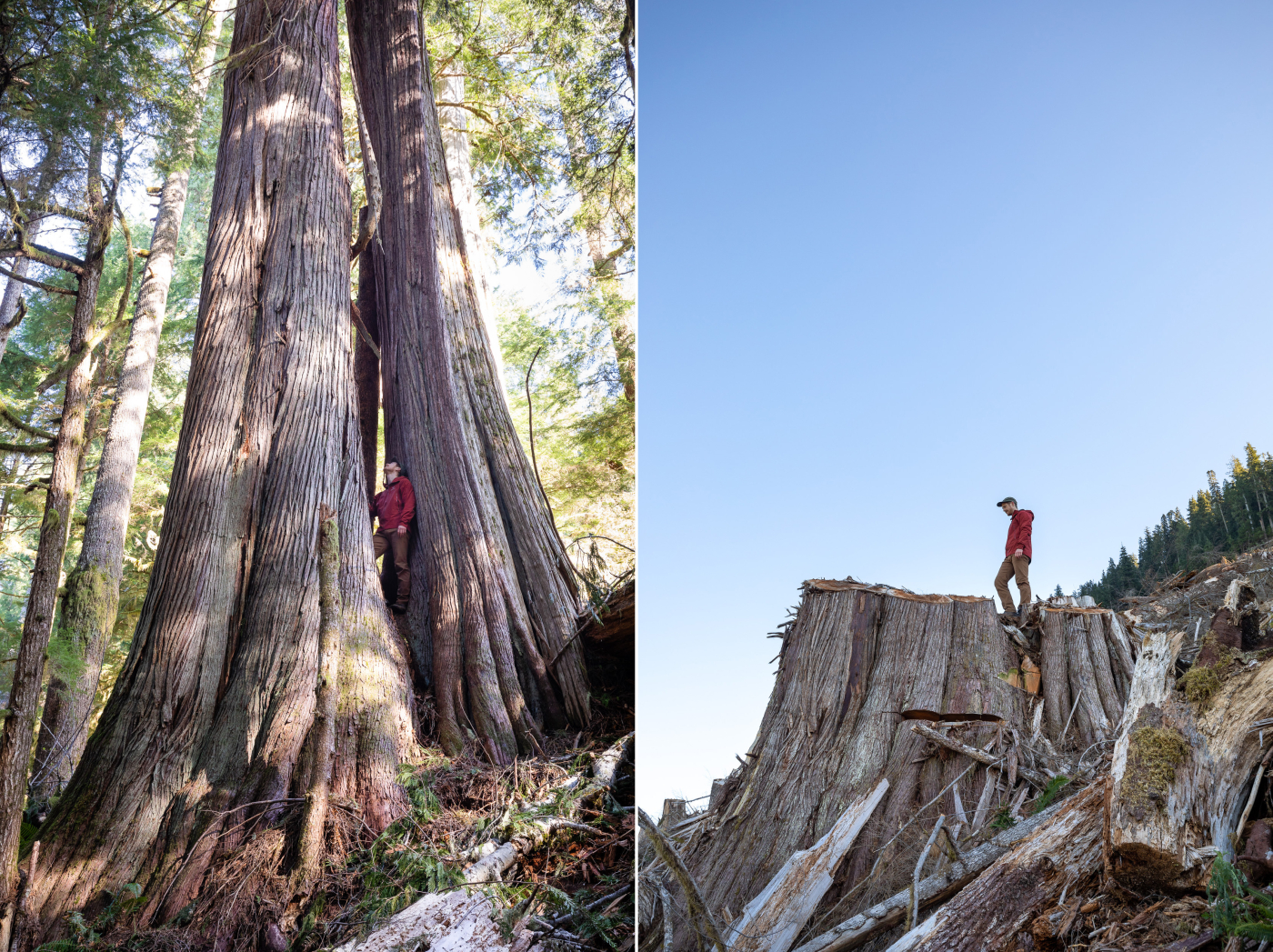
/in News Coverage“They aren’t logging old-growth anymore, are they?” This is one of the most common questions I hear when I talk to people about protecting B.C.’s endangered ancient forests. The sad reality is that here in B.C., we are still cutting down trees that started growing at the time of the Battle of Hastings in 1066 and were already 500 years old when Columbus “discovered” North America. B.C.’s ancient forests — on crown, or public land, and in the most critical ecosystem types and wildlife habitat — are still being devastated by logging. The Ancient Forest Alliance — an organization that supports grassroots activists, including the Ancient Forest Committee here at SFU — has been exploring the back roads of B.C., finding unprotected groves and recently clear-cut valleys in order to raise public awareness about the continued logging of old-growth. Early this year, a fellow old-growth forest campaigner, exploring the Gordon River valley on Vancouver Island, found a valley-bottom cut block full of newly cut stumps, many of which would take over 15 people to surround! A forest that would have been like something out of a fantasy was destroyed in a few weeks, reduced to . . . well, probably matchsticks. This is going on as we speak in B.C.’s “back stage” — something so unthinkable that even when I am standing there talking about protecting old-growth forests, people will ask, “Protecting them from what?”
A delicate balance
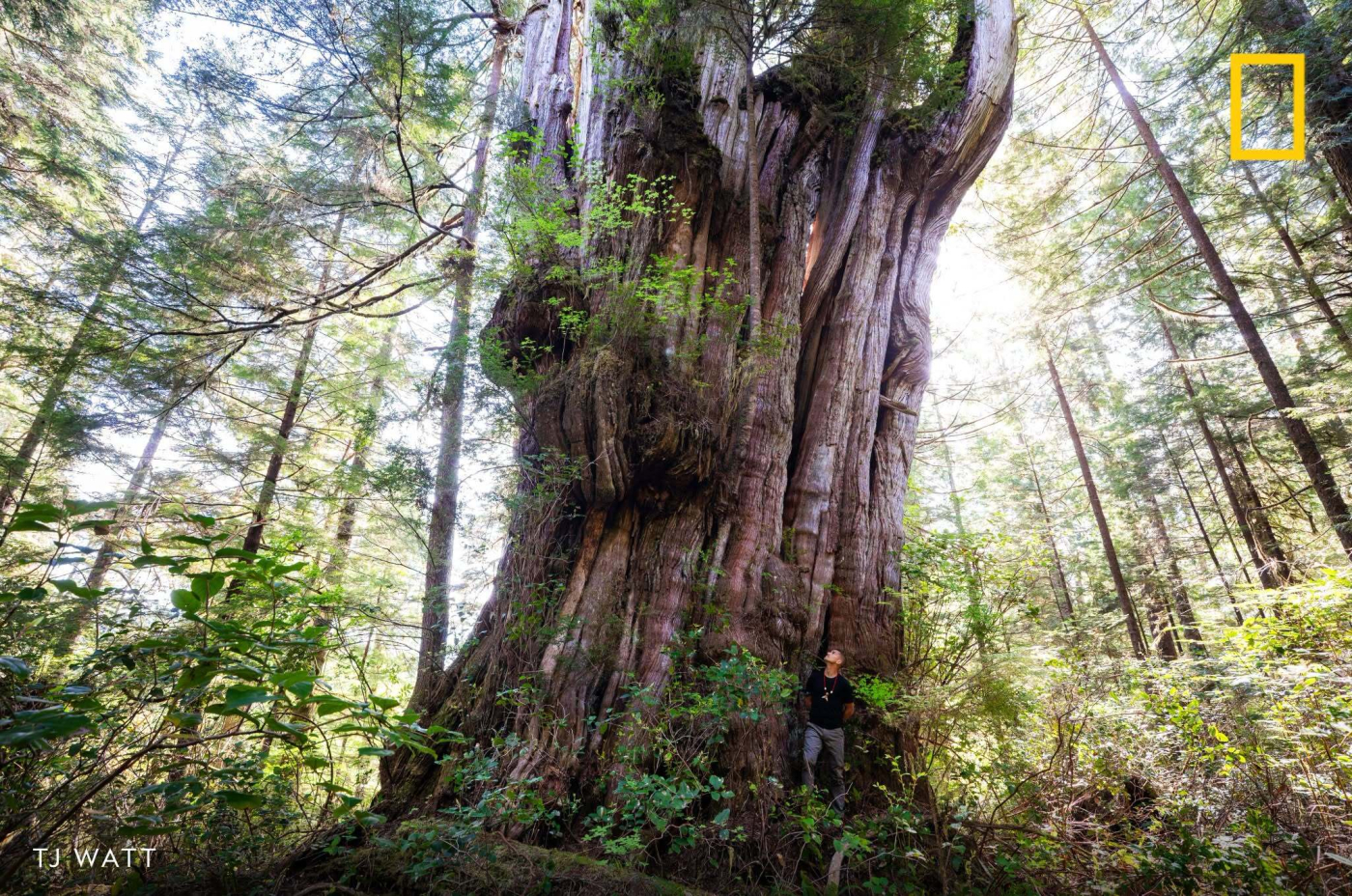
Unlike the younger, second-growth forests that develop from tree plantations, old-growth forests, largely undisturbed by industrial logging, have developed for hundreds of years into complex ecosystems connecting many different forms of life. The trees vary in age and height and grow farther apart, letting sunlight in through the canopy to the forest floor, where a rich understory can grow and provide food and shelter to many species. Big mossy tree limbs provide tree-top nesting platforms for an old-growth dependent seabird, the marbled murrelet. Dead and decaying wood also provides habitat for many species, and mechanisms within the forest act to filter water and store atmospheric carbon, which, if released, would contribute to climate change. Stepping into an old-growth forest feels like walking into a natural cathedral.
The industry digs own grave
The other side to this argument is one we hear all the time: “Old-growth logging is necessary . . . forestry is the backbone of B.C.’s economy.” But although it certainly boosts corporate profit, old-growth logging does little for the forestry workers who depend on the industry’s sustainability for their livelihood. How could using up the last of a resource that takes many hundreds of years to re-grow — if at all — be sustainable? The majority of forestland on Vancouver Island and the southwest coast is second-growth, offering the potential for a sustainable second-growth industry in these areas. Yet the government foolishly adopts the rhetoric that old-growth logging is sustainable, even as they stand by the logging of Vancouver Island’s last 10 per cent of productive valley-bottom old-growth and last one per cent of coastal dry Douglas Fir old-growth. Ironically, the main threats to forestry jobs lie in the industry itself, including the overcutting and elimination of old-growth, especially in lower elevation, more accessible areas. Furthermore, as ancient forests are logged to extinction, most sawmills in B.C., designed for old-growth rather than smaller second-growth logs, are being shut down by the B.C. government rather than being re-tooled to accept smaller logs. This government’s support for exporting logs rather than re-tooling sawmills is basically supporting the exporting of jobs while requiring even more trees to be cut.
Logging of our ancient forests is a luxury that can’t be sustained. Companies are not committed to sustainable jobs or habitats — what they are committed to is short-term corporate profit, and our old-growth forests are the price we are involuntarily paying for that. The B.C. Liberal government is continuing to hand over logging rights to large-scale logging companies — basically, the right to convert our public land to tree farms, to devastate our ecosystems and deplete a crucial and unique resource. We have seen this happen so many times in history . . . the collapse of the Atlantic cod stocks to name just one instance. Will we stand around and watch it happen again?
Tricks with numbers
Pat Bell, minister of forests and range, recently announced that we have more old-growth now that we have had in the past! Should we be reassured that this government is working miracles by growing thousand-year-old trees in mere decades? Or should we wonder if something is fishy about the statistics behind this claim? The government has stated again and again that there is still plenty of old-growth left and that much is still protected. But what they are including in these claims of abundant old-growth and generous protection is low-productivity old-growth — the tiny alpine trees and shore pine bog trees that are old but tiny, and definitely not sought out for logging . . . at least not yet. Of course the government is not logging all of this low-productivity old-growth, and of course they can easily protect it without a thought to industry demands — do they need to be commended for this? Only about 10 per cent of Vancouver Island’s original, productive old-growth is protected, and only about 25 per cent of the original productive old-growth is left (10 per cent if we count only productive valley-bottom old-growth, where we find the biggest trees and most biodiversity). Basically, there is very little left, and much in need of protection!
Legacies in the forest
Coastal First Nations cultures in B.C. have to a large extent co-evolved and co-existed with coastal old-growth forests, and this ecosystem remains central to many First Nations peoples along the coast, for the uses provided by the trees themselves — for canoes and totem poles — and for the support old-growth provides to salmon and other species. While there is interest among some First Nations in logging old-growth forests in certain areas, many support land-use plans calling for increased protection for old-growth. For instance, the Squamish First Nations pushed the B.C. Liberal government to establish new provincial conservancies in their “Wild Spirit Areas” in the Elaho and Sims Valleys, and these areas are now protected through new legislation.
The last of the last
There were times in history when it seemed perfectly acceptable to look out across the land and claim that there was more than we could ever take. We are past that time. We should have learned by now — we have taken too much before, and we are still taking too much. This is not an issue of the environment versus jobs; it is an issue of survival versus corporate profit. Logging endangered old-growth is not sustainable for our jobs, our children’s jobs, our futures, or those of the next generations.
The fact that we are one of the only places on the planet that still has ancient temperate rainforests such as these is both a gift and a responsibility. While appreciating the beauty and ecological importance of these forests, we must also recognize the threats that they face, and the need to act for their protection.
What do we want?
The B.C. Liberal government has recently implemented new protected areas on Vancouver Island, amounting to around 10 per cent of the remaining endangered ancient forests on the island. This is an important first step, and one that should be commended. However, there is so little left in endangered areas such as Vancouver Island that we need to keep demanding that the remaining 90 per cent of the island’s endangered ancient forests be protected, along with sustainable logging of second-growth that makes up much of the rest of forestland on the island. As well, we need to ask for a provincial old-growth strategy that would inventory old-growth in the province and protect it where it is most scarce. Along with these demands we are also asking for a ban on the export of raw logs to make sure that as many jobs as possible are provided for the amount of wood that is cut.
We are not asking for a change overnight, but a guarantee of protection measures in the most critically endangered habitats (Vancouver Island, the Lower Mainland and the southern Interior), which would include specific timelines to allow for transitions in the industry to take place — from immediate protection in the most endangered areas to a few years’ transition time in other endangered areas.
A new campaign
The Ancient Forest Alliance is currently launching a 100,000 Strong for Ancient Forests and B.C. Forestry Jobs campaign, aiming to get 100,000 signatories calling for an end to the logging of B.C.’s endangered ancient forests and a ban on raw log exports. You can help to reach this goal by signing the online petition and downloading copies for others to sign, at ancientforestpetition.com
Tangible solutions
Solutions to issues as complex as this must be reached through a variety of measures. To reach these goals, we engage in actions such as petitions, public outreach events (like hikes or slideshows), rallies, and protests. We also encourage people who support this cause to engage with their political representatives and the general public. Let others know about this campaign. Write letters to your local politician, to Premier Gordon Campbell, and to the Minister of Forests and Range, Pat Bell. Writing letters and asking for change from politicians may seem ineffective, but politicians know that each letter represents hundreds of people who feel the same way yet don’t act. In fact, pressure to get with the program may be easier than expected, especially in certain political ridings around SFU. Two MLAs in Burnaby (MLA Richard Lee in Burnaby-North and Harry Bloy in Burnaby-Lougheed) are in power by only a few hundred votes (548 for Richard Lee and 696 for Harry Bloy). Public voices (especially from SFU students, many of whom are in their ridings) will have much sway on their fragile balance of power, and their readiness to enact such policy changes.
Ancient Forest Alliance seeks support
/in AnnouncementsCo-founders of the newly formed Ancient Forest Alliance Ken Wu and TJ Watt will host an informative and inspiring slideshow featuring spectacular photographs of Canada’s largest trees tonight, Wednesday, Oct. 6.
The presentation by Wu and Watt will include discussion of the stunning ecology and complex politics surrounding B.C.’s old-growth forests and forestry jobs, and slides of the Red Creek Fir, San Juan Spruce, Cheewhat Cedar and the newly discovered and threatened Avatar Grove. It will be held at Central Hall from 7 to 8:30 p.m. on Wednesday, Oct. 6.
Admission is by donation.
“Time is running out for our endangered old-growth forests and B.C.’s coastal forestry jobs,” said AFA campaign director Wu in a press release. “Salt Spring Island is famous as a hub of environmental consciousness — it may very well have the highest density of tree-huggers in North America! It’s a key place for us to build support and expand the campaign to protect our ancient forests, ensure sustainable second-growth forestry, and to ban raw log exports to foreign mills.”
The AFA says that to date, about 75 per cent of Vancouver Island’s productive old growth forest has been logged according to satellite photos, including 90 per cent of the flat valley bottoms, while only six per cent of its original, productive old-growth forests are protected in parks. Meanwhile thousands of forestry jobs are being lost as millions of cubic meters of raw logs are exported each year to foreign mills.
Common Ground: Newsbytes
/in AnnouncementsOn September 16, in a seemingly unlikely event, the Ancient Forest Alliance stood in solidarity with members of the Pulp, Paper and Woodworkers of Canada and the United Steelworkers union in Nanaimo as part of the ongoing fight to ban raw log exports in BC. AFA forest campaigner TJ Watt spoke alongside union officials Nanaimo MLA Leonard Krog and Nanaimo-North Cowichan MLA Doug Routley to the hundreds of workers in attendance, denouncing the export of raw logs and calling for the protection of BC’s threatened forestry jobs.
“Under Gordon Campbell’s BC Liberals we have seen over 60 mills shut down across the province since 2003 while raw log exports have nearly doubled,” said Watt. “It’s time to ban raw log exports in BC, to rejuvenate local mills and to once again provide secure jobs for the thousands upon thousands of forestry workers who have been kicked aside by this backwardspolicy…Exported logs equals exported jobs.”
The AFA believes there can be a solution that works for both our ancient forests and our forestry workers. “The BC Liberal government needs to stimulate investment in the retooling of old-growth sawmills so they can handle second-growth trees. With 90 percent of the most productive lands on Vancouver Island having already been logged, the future of this industry is in sustainable second-growth forestry,” says Brendan Harry, communications director of the Ancient Forest Alliance.”
It is inevitable there will be a transition to logging of only second-growth forests in the not so distant future as the remaining old-growth forests become decreasingly accessible to the coastal logging industry in areas like Vancouver Island and the southern mainland. The Ancient Forest Alliance calls on the BC Liberal government to make this transition happen now, in a planned, rational way, allowing for the protection of what little endangered old-growth ecosystems are left and ensuring a smooth shift to sustainable second-growth logging instead.
“If the industry does not adjust in order to process second-growth trees, what happens down the road when that’s basically all that’s available? Where are the forestry jobs going to be?” Watt wonders. “The rest of most of the world is logging second, third, fourth growth and making it work. We need to be moving up the value chain, not down it. In the end, it’s about the long-term sustainability of a resource and an industry and right now we’re moving in completely the wrong direction.”
From Ancient Forest Alliance, www.ancientforestalliance.org