 https://ancientforestalliance.org/wp-content/uploads/2026/08/Canoe-Creek-Cedar-Tree-262.jpg
800
1200
TJ Watt
https://ancientforestalliance.org/wp-content/uploads/2026/05/Ancient-Forest-Alliance-logo.svg
TJ Watt2026-08-04 17:15:512026-08-04 17:15:51Thank you to our monthly business donors!
https://ancientforestalliance.org/wp-content/uploads/2026/08/Canoe-Creek-Cedar-Tree-262.jpg
800
1200
TJ Watt
https://ancientforestalliance.org/wp-content/uploads/2026/05/Ancient-Forest-Alliance-logo.svg
TJ Watt2026-08-04 17:15:512026-08-04 17:15:51Thank you to our monthly business donors!Related Posts
https://ancientforestalliance.org/wp-content/uploads/2026/08/Canoe-Creek-Cedar-Tree-262.jpg
800
1200
TJ Watt
https://ancientforestalliance.org/wp-content/uploads/2026/05/Ancient-Forest-Alliance-logo.svg
TJ Watt2026-08-04 17:15:512026-08-04 17:15:51Thank you to our monthly business donors! https://ancientforestalliance.org/wp-content/uploads/2026/07/Kaska-Territory.-Credit-Johnny-Mikes-CPAWS-BC-scaled-1.jpg
1707
2560
TJ Watt
https://ancientforestalliance.org/wp-content/uploads/2026/05/Ancient-Forest-Alliance-logo.svg
TJ Watt2026-07-24 15:34:372026-07-28 11:05:22Speak up for Three Major New Protected Areas in Northern BC
https://ancientforestalliance.org/wp-content/uploads/2026/07/Kaska-Territory.-Credit-Johnny-Mikes-CPAWS-BC-scaled-1.jpg
1707
2560
TJ Watt
https://ancientforestalliance.org/wp-content/uploads/2026/05/Ancient-Forest-Alliance-logo.svg
TJ Watt2026-07-24 15:34:372026-07-28 11:05:22Speak up for Three Major New Protected Areas in Northern BC https://ancientforestalliance.org/wp-content/uploads/2026/06/tahsish-river-old-growth-karst-forest-285-1.jpg
1366
2048
TJ Watt
https://ancientforestalliance.org/wp-content/uploads/2026/05/Ancient-Forest-Alliance-logo.svg
TJ Watt2026-07-20 10:46:412026-07-20 12:16:45Victoria Buzz: Old growth advocates call for protection of at-risk Vancouver Island forest
https://ancientforestalliance.org/wp-content/uploads/2026/06/tahsish-river-old-growth-karst-forest-285-1.jpg
1366
2048
TJ Watt
https://ancientforestalliance.org/wp-content/uploads/2026/05/Ancient-Forest-Alliance-logo.svg
TJ Watt2026-07-20 10:46:412026-07-20 12:16:45Victoria Buzz: Old growth advocates call for protection of at-risk Vancouver Island forest https://ancientforestalliance.org/wp-content/uploads/2026/06/tahsish-river-old-growth-karst-forest-136-1.jpg
1365
2048
TJ Watt
https://ancientforestalliance.org/wp-content/uploads/2026/05/Ancient-Forest-Alliance-logo.svg
TJ Watt2026-07-17 11:54:012026-07-17 11:56:51In Photos: Old-Growth Forest on Karst in the Tahsish Valley
https://ancientforestalliance.org/wp-content/uploads/2026/06/tahsish-river-old-growth-karst-forest-136-1.jpg
1365
2048
TJ Watt
https://ancientforestalliance.org/wp-content/uploads/2026/05/Ancient-Forest-Alliance-logo.svg
TJ Watt2026-07-17 11:54:012026-07-17 11:56:51In Photos: Old-Growth Forest on Karst in the Tahsish ValleyTake Action
 Donate
Support the Ancient Forest Alliance with a one-time or monthly donation. Send a Message
Send an instant message to key provincial decision-makers.
Nature photographer discovers ancient ‘freak-of-nature’ tree hiding in plain sight: ‘I’ve never seen a tree as impressive as this one’
/in News CoverageDecember 15, 2023
The Cool Down
By Jeremiah Budin
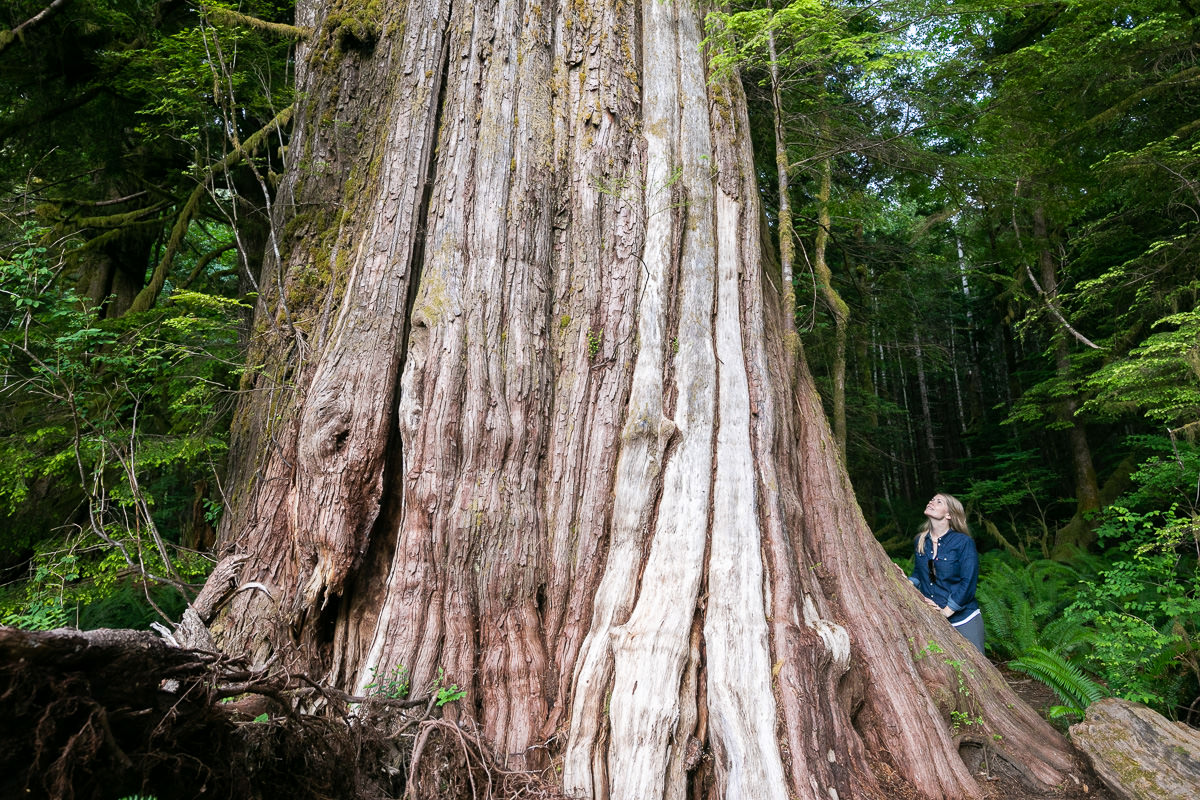
A nature photographer in British Columbia discovered one of the largest old-growth cedars ever documented off the coast of Vancouver Island — and he’s not telling you or anyone else how to find it.
TJ Watt, a co-founder of the Ancient Forest Alliance, a charitable organization that works to protect endangered old-growth forests, waited more than a year after first happening across the massive tree, which he nicknamed “The Wall,” to even tell the world about its existence, according to The Washington Post.
During that time, Watt consulted with members of the Ahousaht First Nation, who have lived in the area for thousands of years.
“It was decided that we should keep the tree’s location a secret because these are sensitive areas, and everything could get pretty trampled if word got out where to find it,” Watt told the Post.
He also took time to thoroughly measure and document The Wall. It is believed that the massive tree is over 1,000 years old, standing 151 feet tall and 17 and a half feet in diameter.
“I’ve found thousands and thousands of trees, and I’ve shot hundreds of thousands of photos of old-growth forests,” Watt told the Post. “But I’ve never seen a tree as impressive as this one.”
“It was incredible to stand before it,” he continued. “I’d describe it as a freak of nature because it actually gets wider as it gets taller. As I looked up at it, I felt a sense of awe and wonder.”
Canada’s largest documented tree, a humongous red cedar known as the Cheewhat Giant, is located in the protected Pacific Rim National Park Reserve and stands 182 feet tall and 19 feet in diameter, per the Post.
Old-growth forests play an essential role in wildlife habitat, species diversity, carbon storage, and other crucial ecological processes. However, like so many parts of the natural world, they are threatened by pollution, the effects of human-caused extreme weather events, and the logging industry.
Although trees such as the Cheewhat Giant are protected, per the Post, 80% of the original old-growth forests on Vancouver Island have already been logged, according to the Ancient Forest Alliance. That’s why it is essential that The Wall stays protected and its location unreleased.
Read the original article.
Thanks for the support at our Year-End Celebration & Fundraiser!
/in Announcements, Events, Thank YouThanks to all who attended and/or supported our Year-End Celebration & Fundraiser!
We’re feeling extremely grateful following our event this past Tuesday evening, where you helped us raise $5,284 for old-growth protection through donations, the silent auction, and merchandise sales! We hope you enjoyed the engaging presentations, food, drinks, and socializing with other old-growth fans.
As always, meeting and having conversations with many of you in person is a great reminder of what a dedicated, passionate, and kind community we have standing with us. We couldn’t have achieved all the latest success without you!
A special shoutout goes to the local businesses and individuals who kindly donated items to our silent auction. Thank you to: Jordan Fritz Art, Botanical Bliss, Fish Hair Salon, Handsome Dans Port Renfrew, Pilgrim Coffee House, Lorelei Green Art, Timothy Colman, Zula Jewelry, The Papery, Smoking Lily Handcrafted Goods, Seaflora Skincare, Spinnacle Yarns, Russell Books, Wild Coast Perfumery, Richard Malacek, Robinson’s Outdoors, Patagonia Victoria, Ecologyst, Bolen Books, and Barbara Brown Art.
Your support this season will make a huge difference and will ensure we’re able to hit the ground running come 2024.
For the forests,
The Ancient Forest Alliance team
The Globe & Mail: ‘Salmon parks’ in traditional First Nations territory aim to save habitats by stopping old-growth logging
/in News CoverageNovember 29, 2023
The Globe and Mail
By Justine Hunter
See the original article.
New plan from the Mowachaht/Muchalaht First Nation, aided by the BC and federal governments, signals a shift in Indigenous-led conservation across the province
Backed by a $15.2-million commitment from the federal government, a First Nations community on the west coast of Vancouver Island intends to buy out forestry tenures to stop old-growth logging in selected watersheds around Nootka Sound.
The Mowachaht/Muchalaht First Nation has declared a string of “salmon parks” in its traditional territories that includes more than 66,000 hectares of watersheds.
The parks are designed to protect critical salmon habitat by maintaining and restoring the land where it intersects with marine ecosystems. Logging can damage the rivers where salmon spawn, and deforestation has been tied to warmer rivers that reduce survival rates for young fish.
Proposed salmon parks on Vancouver and Nootka islands
Red: Proposed salmon parks
Green: Mowachaht/Muchalaht First Nation territory
Yellow: Nuchatlaht First Nation territory
MURAT YÜKSELIR / THE GLOBE AND MAIL SOURCE: BC GOVERNMENT; HA-SHILTH-SA OPENSTREETMAP
The salmon parks of Nootka Sound offer an example of a shift that is coming across the province as a result of the new $1-billion Nature Agreement signed on Nov. 3 between Canada, BC and the First Nations Leadership Council. Significantly more land will be designated for conservation, which in turn will change how and where the province exploits its natural resources.
To meet commitments by the federal and provincial governments, BC will need to set aside more than 10 million hectares of new biologically important areas for protection from development over the next six years. Much of that will be achieved through Indigenous-led conservation projects that are now on a fast track for approval. This includes the Mowachaht/Muchalaht First Nation plan, which will require additional funding to complete.
British Columbia has the greatest diversity of species, ecosystems and habitats of any jurisdiction in Canada, and both the federal and provincial governments have promised to protect 30 per cent of the country’s land and water by 2030.
The provincial government says there are currently 18.5 million hectares of protected and conserved areas, making up 19.6 per cent of BC’s total land.
A number of First Nations in BC have declared Indigenous Protected and Conserved Areas that will be among the first in the queue for consideration by the new tripartite committee, which will decide where the nature agreement funding will go. Federal Environment and Climate Change Minister Steven Guilbeault promised financing for the Mowachaht/Muchalaht salmon parks in late October, providing tacit approval of the First Nation’s IPCAs.
Five species of Pacific salmon run through the traditional territories of the Mowachaht/Muchalaht First Nation, but stocks are in decline. Eric Angel, the project manager for the salmon parks, said the selected areas include some of the last remaining old-growth forest ecosystems in the region.
“What we are bringing to this is a much more creative and nuanced view of what a sustainable economy looks like in rural communities. What we’ve been doing up till now has been liquidating a one-time resource, old-growth forests. What we need to do is find ways to harvest forest products,” he said, “while we also build economies around tourism and conservation and stewardship.”
Celina Starnes from Endangered Ecosystems Alliance looks up at the big-leaf maple grove of the Burman River valley, which lies within the Mowachaht/Muchalaht salmon-park system.
TJ WATT
The village of Gold River, located in the heart of Mowachaht/Muchalaht territory, was built as a forestry community, but the last mill closed in 1999. The salmon-parks strategy will balance economic development with ecology, Mr. Angel said, and some of the funds will help develop those plans. By clearly identifying which lands must be protected, industry will better understand where resource extraction will be allowed, and what kind of activities would be welcomed.
The salmon park is home to black bears like this one near Tahsis.
Based on studies by biologists, the First Nation has determined that 90 per cent of salmon productivity in the region can be protected by setting aside 20 per cent of the watersheds – especially those where glacier-fed rivers offer the greatest climate resiliency.
The provincial government, which awards forestry tenures, has not yet weighed in on the salmon parks. However, Nathan Cullen, BC’s Minister for Land, Water and Resource Stewardship, said that his government needs to endorse IPCAs to reach its conservation targets. “Getting there would be absolutely impossible without willing First Nations partners.”
He believes IPCAs also hold the key to ensuring that this transition can be done without cratering the province’s resource-based economy. Conservation decisions will bring certainty to land that has long been mired in conflict because of unresolved Indigenous claims. First Nations communities have told him, he said, that they will be more open to extraction industries after the areas they have identified for conservation are protected. “The whole point of land-use planning is to lessen the conflict, lessen the legal challenges and increase certainty for investors while protecting more of the province.”
But that process can be expensive. The largest cost associated with the Mowachaht/Muchalaht IPCAs will be the purchase of logging tenures from industry. To implement the plan, the First Nation expects it will need to raise as much as $50-million. “It will cost money because the companies will not just say, ‘Okay, yeah, take our tenure and make a reserve.’ So everyone will need to be compensated,” said Azar Kamran, chief executive officer and administrator for the First Nation.
Western Forest Products, one of those tenure holders in Nootka Sound, is aware of the salmon-parks plan, said Babita Khunkhun, a spokesperson for the company. “While we have not had specific discussions with the Nation since the recent announcement, we work to understand and incorporate the interests of Indigenous communities through open communication and that ongoing commitment will serve to guide us going forward.”
‘We’ve been clear for a number of years now that protecting our old-growth forests is one of our priorities,’ Ms. Dabrusin says.
CHAD HIPOLITO/THE GLOBE AND MAIL
Ottawa has agreed to invest up to $500-million across all projects over the life of the tripartite agreement, with matching funding to come from the province. Philanthropic organizations are also expected to contribute. It took two years to negotiate and now it could take another year to set up the committee.
Julie Dabrusin, parliamentary secretary to Mr. Guilbeault, was one of the brokers. On a recent visit to BC, she visited an old-growth forest where 500-year-old Douglas firs rival the height of the concrete towers of her home riding of Toronto-Danforth.
The trees in Francis/King Regional Park, near Victoria, are already protected, but she said seeing them was a good reminder of the purpose of her assignment, which was to help secure an agreement that would allow the federal Liberal government to achieve its “30 by 30″ commitment.
She acknowledged concerns that BC’s old-growth forests are being logged while the process unfolds. “I think that there is always an urgency to get beyond talking. We’ve been clear for a number of years now that protecting our old-growth forests is one of our priorities.”
Leading Ms. Dabrusin’s old-growth tour was Ken Wu, who heads the Endangered Ecosystems Alliance and has spent decades campaigning for protected areas. Meeting Canada’s conservation targets will be “a monumental undertaking,” he said, but with $1-billion or more, and a framework that puts First Nations in the driver’s seat, the past month has given environmentalists something to celebrate.
“In the coming months and years we’re going to see – I’m certain of it – the biggest protected areas expansion in Canadian history within a province.”
See the original article on the new Salmon Park IPCA here.