 https://ancientforestalliance.org/wp-content/uploads/2026/08/Canoe-Creek-Cedar-Tree-262.jpg
800
1200
TJ Watt
https://ancientforestalliance.org/wp-content/uploads/2026/05/Ancient-Forest-Alliance-logo.svg
TJ Watt2026-08-04 17:15:512026-08-04 17:15:51Thank you to our monthly business donors!
https://ancientforestalliance.org/wp-content/uploads/2026/08/Canoe-Creek-Cedar-Tree-262.jpg
800
1200
TJ Watt
https://ancientforestalliance.org/wp-content/uploads/2026/05/Ancient-Forest-Alliance-logo.svg
TJ Watt2026-08-04 17:15:512026-08-04 17:15:51Thank you to our monthly business donors!Related Posts
https://ancientforestalliance.org/wp-content/uploads/2026/08/Canoe-Creek-Cedar-Tree-262.jpg
800
1200
TJ Watt
https://ancientforestalliance.org/wp-content/uploads/2026/05/Ancient-Forest-Alliance-logo.svg
TJ Watt2026-08-04 17:15:512026-08-04 17:15:51Thank you to our monthly business donors! https://ancientforestalliance.org/wp-content/uploads/2026/07/Kaska-Territory.-Credit-Johnny-Mikes-CPAWS-BC-scaled-1.jpg
1707
2560
TJ Watt
https://ancientforestalliance.org/wp-content/uploads/2026/05/Ancient-Forest-Alliance-logo.svg
TJ Watt2026-07-24 15:34:372026-07-28 11:05:22Speak up for Three Major New Protected Areas in Northern BC
https://ancientforestalliance.org/wp-content/uploads/2026/07/Kaska-Territory.-Credit-Johnny-Mikes-CPAWS-BC-scaled-1.jpg
1707
2560
TJ Watt
https://ancientforestalliance.org/wp-content/uploads/2026/05/Ancient-Forest-Alliance-logo.svg
TJ Watt2026-07-24 15:34:372026-07-28 11:05:22Speak up for Three Major New Protected Areas in Northern BC https://ancientforestalliance.org/wp-content/uploads/2026/06/tahsish-river-old-growth-karst-forest-285-1.jpg
1366
2048
TJ Watt
https://ancientforestalliance.org/wp-content/uploads/2026/05/Ancient-Forest-Alliance-logo.svg
TJ Watt2026-07-20 10:46:412026-07-20 12:16:45Victoria Buzz: Old growth advocates call for protection of at-risk Vancouver Island forest
https://ancientforestalliance.org/wp-content/uploads/2026/06/tahsish-river-old-growth-karst-forest-285-1.jpg
1366
2048
TJ Watt
https://ancientforestalliance.org/wp-content/uploads/2026/05/Ancient-Forest-Alliance-logo.svg
TJ Watt2026-07-20 10:46:412026-07-20 12:16:45Victoria Buzz: Old growth advocates call for protection of at-risk Vancouver Island forest https://ancientforestalliance.org/wp-content/uploads/2026/06/tahsish-river-old-growth-karst-forest-136-1.jpg
1365
2048
TJ Watt
https://ancientforestalliance.org/wp-content/uploads/2026/05/Ancient-Forest-Alliance-logo.svg
TJ Watt2026-07-17 11:54:012026-07-17 11:56:51In Photos: Old-Growth Forest on Karst in the Tahsish Valley
https://ancientforestalliance.org/wp-content/uploads/2026/06/tahsish-river-old-growth-karst-forest-136-1.jpg
1365
2048
TJ Watt
https://ancientforestalliance.org/wp-content/uploads/2026/05/Ancient-Forest-Alliance-logo.svg
TJ Watt2026-07-17 11:54:012026-07-17 11:56:51In Photos: Old-Growth Forest on Karst in the Tahsish ValleyTake Action
 Donate
Support the Ancient Forest Alliance with a one-time or monthly donation. Send a Message
Send an instant message to key provincial decision-makers.
Building a Broad-Based Movement: Thank You to These Non-Traditional Allies!
/in Thank YouBuilding a broad-based movement to protect old-growth forests by engaging non-traditional allies, such as businesses, unions, outdoor recreation groups, chambers of commerce, tourism associations, faith groups, and more, is the hallmark of our work at Ancient Forest Alliance. Of these diverse non-traditional allies, there are a number who’ve recently shown their support with generous gifts to AFA, and we’d like to take this opportunity to thank them!
Thank you to:
Living Forest Campground and Burnaby Central Secondary School’s WISH Club for their generous donations to the old-growth campaign.
Botanical Bliss for their monthly contributions to the AFA since 2022.
Ethos Imagery, who donated for the second time this year in their mission to allocate 1% of all sales to AFA.
And Dirty Freehub podcast, whose donation acted as a thank you to members of AFA and their assistance with Dirty Freehub’s READ & RIDE program for Big Lonely Doug, working to inspire cyclists to get involved with the campaign to protect ancient forests in BC. Check out Dirty Freehub’s podcast featuring episodes with AFA’s TJ Watt and Endangered Ecosystem Alliance’s Ken Wu!
Are you a business owner or a member of an organization and curious about joining this ever-growing movement and taking action for old-growth forests? Check out our Building Alliances page and have your business/organization sign a resolution or contact info@ancientforestalliance.org for more information!
Massive red cedar resembling rock wall discovered in Ahousaht territory
/in News CoverageAugust 3, 2023
Ha-Shilth-Sa
By Karly Blats
Ahousaht, BC
It was like nothing Ahousaht’s Tyson Atleo had ever seen before.
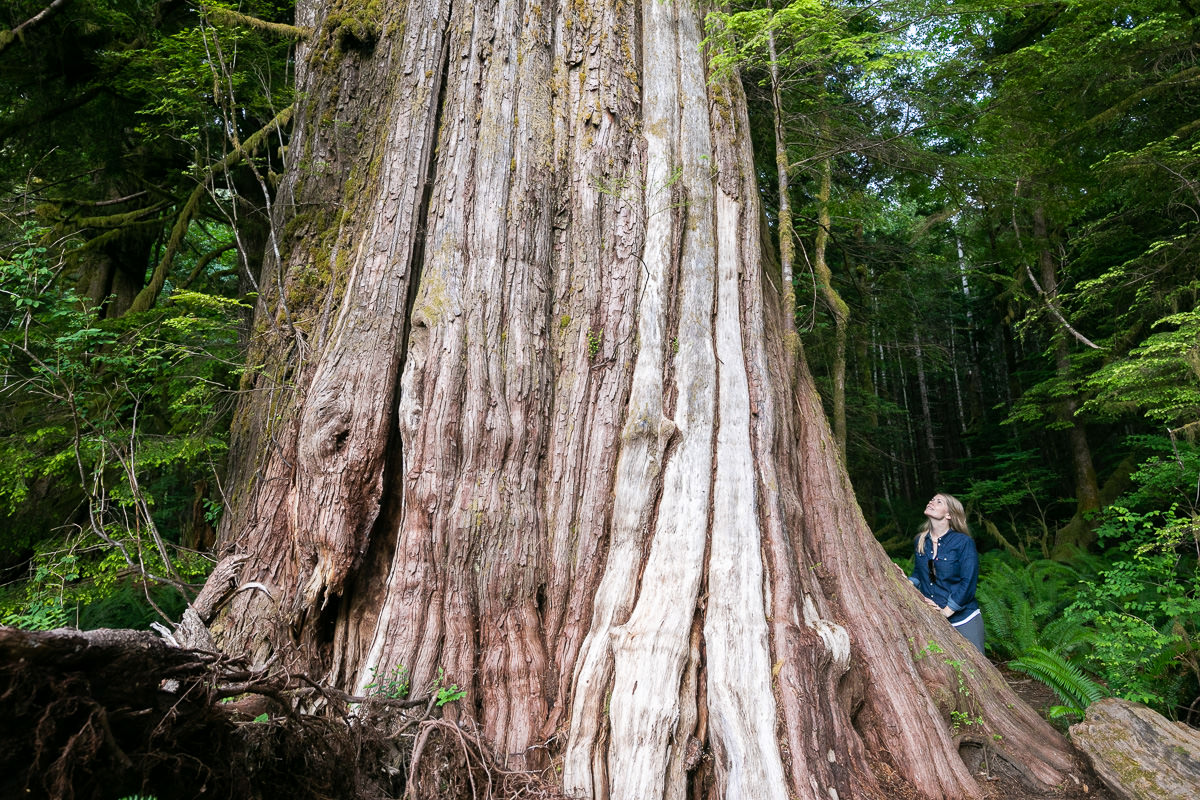
Giving the illusion of a rock wall, a massive western red cedar tree in Ahousaht territory near Tofino in Clayoquot Sound has been named one of Canada’s most impressive trees by conservationists on Vancouver Island.
Ancient Forest Alliance (AFA) photographer and campaigner TJ Watt identified the remotely located tree on Flores Island while exploring with a friend.
The huge tree measures more than 17 feet (five metres) wide near its base, and its trunk gets even wider going upwards more than dozens of meters. According to a press release from the AFA, the tree stands 151 feet (46 metres) tall and is assumed to be well over a thousand years old given its size.
According to the AFA, the tree could have the largest or near largest timber volume of any tree in Canada for about the first 50 feet of its trunk—the part you see and experience from the ground.
“After nearly two decades of photographing, exploring and searching for big trees in old-growth forests across BC, no tree has blown me away more than this one,” said Watt in a press release. “It’s a literal wall of wood. Your brain can’t compute the scale when you stand below it. The first time I arrived, from a distance I thought it had to be two trees because of how wide the trunk and limbs are. It defies words. As an avid big tree hunter, it’s a highlight of my life to find something as spectacular as this.”
According to the BC Big Tree Registry, the tree would currently rank as the sixth largest known red cedar in the country. The registry’s largest red cedar is the Cheewhat Giant, which is located in Ditidaht territory southeast of Nitinat Lake.
The record-sized tree on Flores Island has so far garnered the nickname ‘The Wall’, or ‘ʔiiḥaq ḥumiis’, meaning ‘big red cedar’ in the Nuu-chah-nulth language. It grows on unprotected Crown/public lands in the unceded territory of the Ahousaht First Nation.
No logging plans exist for the area and the Ahousaht First Nation’s Land Use Vision, currently in the late stages of negotiations with the BC government, includes the protection of the forest where this tree is found.
“It was unlike anything I had ever seen before,” said Ahousaht First Nation Hereditary Representative Tyson Atleo. “When TJ first contacted me to go visit the tree, I was assuming it was like many I had experienced across different territories on the Island including in Ahousaht – but this one was obviously quite special. It really does look like a rock wall when you’re hiking up towards it and then you actually realize it’s a tree. It’s just breathtaking.”
Old-growth forests are culturally significant to the Ahousaht people, Atleo said, because they provide the nation with everything they need to survive, from shelter to transportation to clothing.
Aerial view over the ancient forests of Flores Island in Ahousaht territory in Clayoquot Sound, BC.
“The forest provides for every aspect of our wellbeing in addition to being home to our food sources,” Atleo said. “Everything that we need to survive is there, and not only physical survival but it’s a place representative of natural law. So it’s also our place for spirituality, for learning everything we need to know about being good humans on this planet.”
The Ahousaht First Nation’s Land Use Vision calls for the protection of 80 per cent of Ahousaht territory through the creation of new Indigenous Protected and Conserved Areas (IPCAs), encompassing most of the old-growth forests in their territory, to be legislated as Provincial Conservancies by the province.
“The 2017 Land Use Vision that we’re working on implementing builds off thousands of years of stewardship and more recently decade’s worth of efforts by some of our late leaders and current leaders,” Atleo Said. “Efforts that include stopping clear-cut harvesting in Ahousaht territories.”
Atleo said the large red cedar is currently within the boundaries of a tree farm license, and that the objective is to transition that tree farm license into new protected areas and a new forest tenure for Ahousaht.
The Ahousaht First Nation is keeping the location of the tree private at this time, but Atleo said they may take visitors there in the future.
See the original article here.
1,000 year old tree found on Flores Island to be protected
/in News CoverageJuly 28, 2023
CHEK News
By Kori Sidaway
Watch CHEK’s video coverage here.
Nearly two decades into his hunt for B.C.’s biggest trees, it takes a lot to blow away Ancient Forest Alliance campaigner and National Geographic explorer TJ Watt.
A tree on Flores Island has done just that. Five metres (17 feet) wide at its base, even wider as it goes up, reaching more than 150 feet tall, the western red cedar is likely more than 1,000 years old.
“When I first saw it I thought, initially, it was a rock wall,” said Watt.
It’s a sprawling fortress of tree limbs which Watt has dubbed, “Canada’s most impressive tree.”
“It’s just the most mind-blowing thing I’ve seen in nature,” said Watt.
Though currently unprotected, Ahousaht First Nation plans to protect this tree and 80 per cent of other trees in their territory.
“I believe firmly that we do need to protect from ourselves, from extraction and exploitation,” said Tyson Atleo with Ahousaht First Nation. “We need to put a pause on harvesting. We need to put a pause on exploitation so we can re-calibrate that relation. I know we can and Ahousaht is leading that way right now.”
Ahousaht’s approach for a successful conservation-based economy is one that Atleo believes other First Nations could model after.
The next step as Watt sees it, is the province working to ensure it’s an easy process to get there
“[B.C. Premier] David Eby needs to step in to make sure ministries are doing everything in their power to reduce barriers to old growth conservation, stop heel-dragging on conservation financing, provide funding to support old growth deferrals and ensure the oldest and best trees in B.C. Are being protected,” said Watt.
Protected, so generations to come can stand under or see, something that’s been here for more than a millennium. The biggest, Watt is sure, is still yet to come.
“Where that tree might be, who knows, so the hunt continues,” said Watt.
View the original article here.