https://ancientforestalliance.org/wp-content/uploads/2026/02/Keith-River-Old-Growth-BC-333.jpg
1365
2048
TJ Watt
https://staging.ancientforestalliance.org/wp-content/uploads/2014/10/cropped-AFA-Logo-1000px.png
TJ Watt2026-03-03 09:07:112026-03-04 14:36:34NOW HIRING: Forest CampaignerRelated Posts
https://ancientforestalliance.org/wp-content/uploads/2026/02/Keith-River-Old-Growth-BC-333.jpg
1365
2048
TJ Watt
https://staging.ancientforestalliance.org/wp-content/uploads/2014/10/cropped-AFA-Logo-1000px.png
TJ Watt2026-03-03 09:07:112026-03-04 14:36:34NOW HIRING: Forest Campaigner
It’s AFA’s 16th Birthday!
On Tuesday, February 24th, we’re celebrating 16 years of working together with you, our community, to ensure the permanent protection of old-growth forests in BC. To mark the date, will you chip in $16 or more to support our work?

Budget 2026 Shortchanges Nature Protection and Sustainable Forestry Transition At a Critical Time for British Columbia
BC’s Budget 2026 fails to provide the funding needed to secure lasting protection for endangered ecosystems and at-risk old-growth forests in the province.

Welcome, Zeinab, our new Vancouver Canvass Director!
We're excited to welcome Zeinab Salenhiankia, our new Vancouver Canvass Director, to the Ancient Forest Alliance team!
Take Action
Donate
Support the Ancient Forest Alliance with a one-time or monthly donation.
Send a Message
Send an instant message to key provincial decision-makers.
Get in Touch
AFA’s office is located on the territories of the Lekwungen Peoples, also known as the Songhees and Esquimalt Nations.
Copyright © 2026 Ancient Forest Alliance • All Rights Reserved
Earth-Friendly Web Design by Fairwind Creative


Thank you to our recent business supporters
/in Thank YouWe’ve benefitted from exceptionally awesome projects lately. Thank you to the following businesses, groups, and individuals:
Guru Organic Energy Drink for their generous donation. Guru recently released episode 2 of their “True Nature Series” called “Full Circle” featuring athlete and artist, Joel Fuller. Thanks, Joel and all involved for bringing awareness to the AFA and endangered ancient forests in BC: https://www.guruenergy.com/en-ca/stories/joel-k-fuller-one-with-nature
Patagonia Victoria for their dynamic and ongoing support including contributing through their 1% for the planet commitments, donating proceeds from a recent film night, and hosting a selection of AFA gear in their retail shop in downtown Vic.
Good Natured Wine & Andrew Peller Limited for donating $1 from every bottle of Good Nature wine at select Save on Foods locations earlier this fall.
Jeff Nytch for donating proceeds from the successful production of “The Song of the Lorax” which featured images by AFA’s TJ Watt. Thank you also to his supporters for their additional contributions. https://www.jeffreynytch.com/lorax
OneUp Components for their awesome support two years in a row. https://www.oneupcomponents.com/
Evergrow Christmas Trees for their support and for signing a resolution in solidarity of protecting endangered old-growth forests in BC. https://evergrowchristmastrees.ca/
West Coast Trail Express for their generosity. https://trailbus.com/
Hemp & Company for their many years of support. https://hempandcompany.com/
Author Rhonda Kokosha for donating following the launch of a new book “I Really Like the Trees Outside” meant to inspire children and adults alike to appreciate trees and nature. www.rhondakokosha.com
Melissa MacGregor for donating partial proceeds from sales of a fine art landscape painting. Visit https://melissacritchlow.com/ to learn more about the print and order details.
Arrowmaker Accounting for including the AFA among their donation commitments to protect endangered old-growth forests in BC. www.arrowmaker.ca
Double Diamond Law for contributing in several ways to the ancient forest movement. https://doublediamondlaw.com/
However big or small the gesture, we appreciate it! Thank you.
West coast old-growth forests recommended for deferral in Vancouver Island’s Barkley Sound at risk of logging.
/in Media ReleaseVICTORIA (Unceded Lekwungen Territories) – Conservationists with the Ancient Forest Alliance (AFA) are raising concerns over Interfor’s plans to log 33 cutblocks, totaling 55 hectares, in rare, intact old-growth forest along the coastline of western Vancouver Island and are calling on the BC government to commit conservation funding to support immediate protection of at-risk old-growth forests.
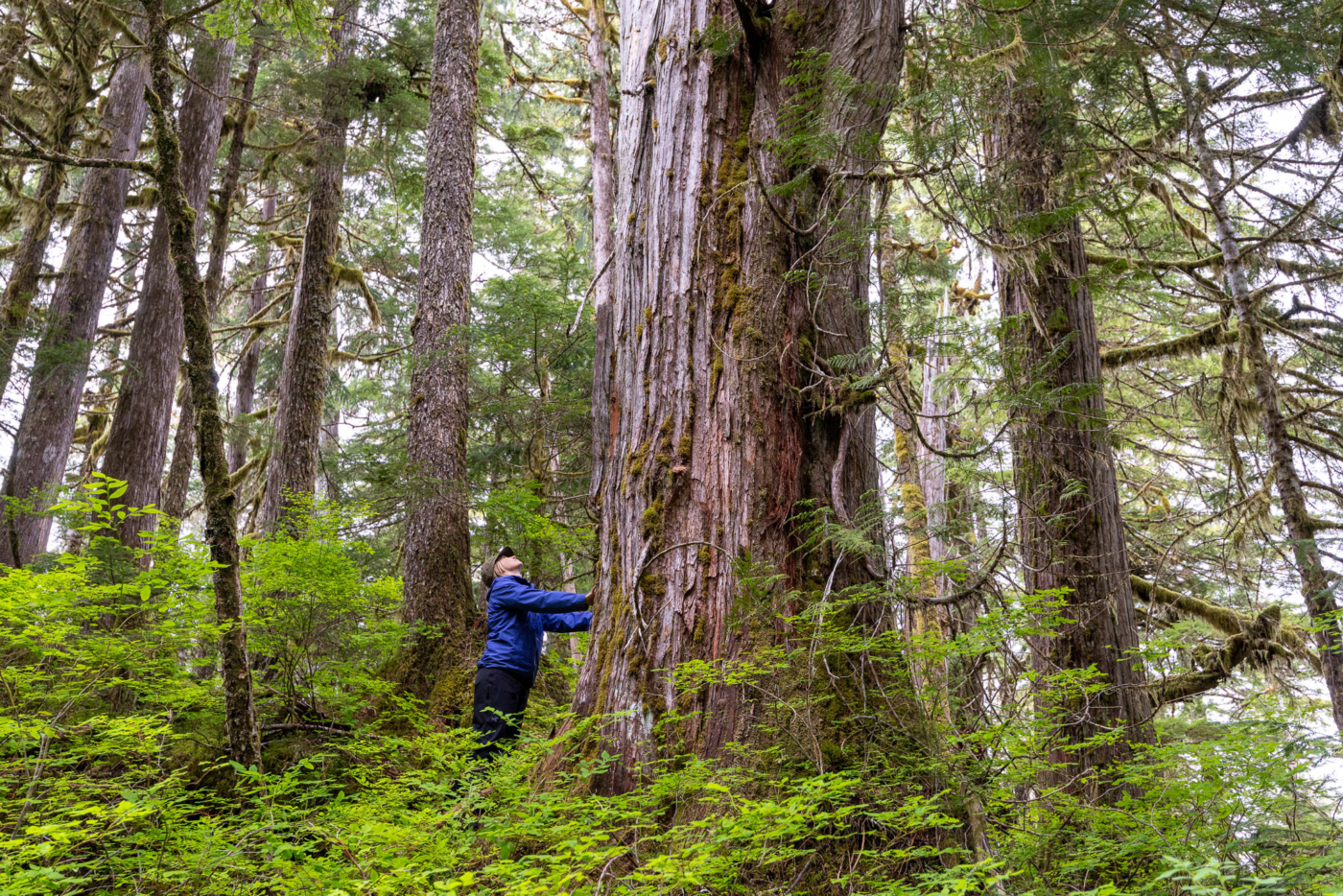
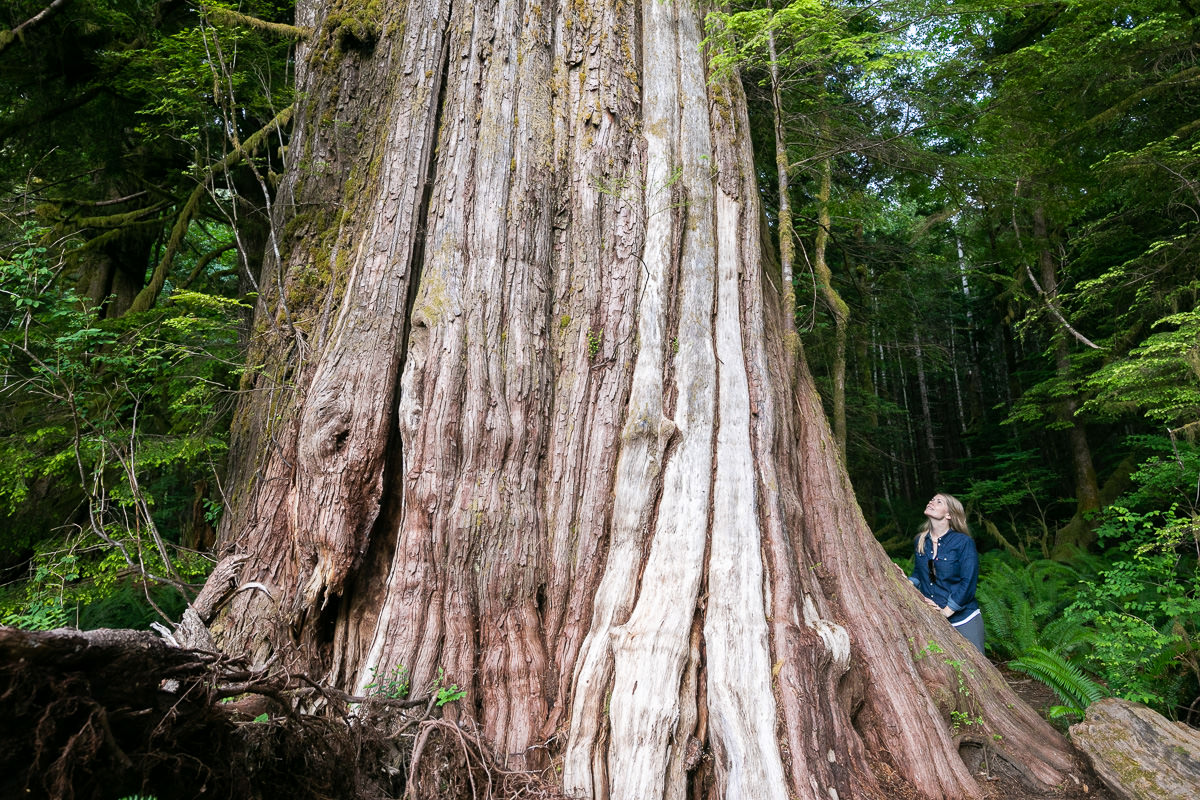
The approved cutblocks, which members of the AFA visited and explored in summer 2021, are located in Vernon Bay, a stunning stretch of coastal old-growth forest in Barkley Sound in the territories of the Uchucklesaht and Tseshaht nations. Conservationists measured unprotected monumental redcedar trees up to 12 feet in diameter.
Some of the ancient forests found here, where the BC government only recently granted approval for logging, have since been identified by the province’s independent Old Growth Technical Advisory Panel (TAP) for immediate deferral due to their very large old-growth trees. Despite the province having accepted, in principle, the TAP’s recommendation to defer logging in 2.6 million hectares of at-risk old-growth forests across BC last month, logging in the Vernon Bay cutblocks will likely proceed unless the local First Nations and the province immediately enact deferrals.
“These are some of the most remarkable and beautiful coastal old-growth forests we’ve explored this year,” stated AFA campaigner and photographer TJ Watt. “It’s incredibly rare to come across a large, intact stretch of unprotected ancient forest like this today. Allowing logging to proceed would turn these lush forests into a patchwork of ugly clearcuts.”
“Significant conservation funding is needed from the provincial government to support forestry-dependent communities where old-growth forests are protected, which would help ensure that the science panel’s deferral recommendations can be fully implemented. The federal government has put hundreds of millions of dollars on the table for permanent protection. It’s time for the province to meet or exceed that amount.”
Nine of the 33 approved cutblocks are also located within a “non-legal” Old Growth Management Area (OGMA), the result of a legal loophole that allows old-growth forests that have been identified for protection to still be logged.
“Non-legal OGMAs are areas that have been mapped, but haven’t been legalized by a ministerial Order,” stated Watt. “Some of these OGMAs have remained in draft form for as long as a decade, allowing forest companies to cherry-pick the best trees from them in exchange for setting aside forests that are less commercially and ecologically valuable elsewhere. One of the simplest steps the province could immediately take to protect old-growth would be to legalize all non-legal OGMA’s,” stated Watt.
The coastal old-growth in Vernon Bay comprises a habitat for diverse and abundant wildlife, including gray wolves, and is designated as an Important Bird Area for marbled murrelets, an old-growth forest-dependent seabird. Barkley Sound is also a renowned destination for sea kayakers and supports countless marine life, including Orcas, Humpback Whales, and Pacific Gray Whales. With many of the proposed cutblocks located immediately adjacent to the shoreline, the AFA is also concerned the logging will have adverse impacts on the area’s visual quality.
“Approaching the coastline by water, you can easily imagine earlier times when the island was blanketed with intact forests,” said Ian Illuminato, AFA Campaigner. “While its remote location has allowed Vernon Bay to remain largely intact for now, this area and others like it could be lost unless the BC government immediately commits funding to support the development of Indigenous Protected Areas through First Nations land use planning initiatives, which first requires logging deferrals,” said Illuminato.
“Recent studies have shown that old-growth forests are worth far more standing than logged, in terms of economics and in terms of climate change. Considering the catastrophic impacts of climate change felt throughout BC this year, it’s hard to imagine why we would choose to continue eliminating one of our best defenses against drought, floods, and fires through destructive old-growth clearcutting.”
TJ Watt Featured in CBC’s Podcast, The Doc Project: Big Tree Hunt
/in News CoverageWe’re excited to share that AFA photographer TJ Watt was featured in CBC’s podcast, The Doc Project: Big Tree Hunt, which highlights his efforts to explore, document, and protect ancient forests in B.C.
Read the article at the link or below: https://www.cbc.ca/radio/docproject/photographer-of-giant-old-growth-trees-has-best-and-worst-job-in-the-world-1.6251373
And listen to the podcast documentary: https://www.cbc.ca/listen/live-radio/1-115/clip/15880467
Tune in to hear more about TJ’s photography and conservation work and join a remote bushwhacking mission to Vernon Bay in Barkley Sound in the territory of the Uchucklesaht and Tseshaht First Nations, where they explore the area’s incredible-yet-unprotected ancient forests and find monumental redcedar trees up to 12 feet in diameter at risk of being logged.
Photographer of giant old-growth trees has ‘best and worst job in the world’
CBC Radio
November 26, 2021
TJ Watt’s before-and-after shots in clearcut forests part of renewed movement to protect B.C.’s oldest trees.
On an overcast day last August, TJ Watt made his way around the trunk of a giant western red cedar. In one hand, he clutched a yellow measuring tape. With his other, he pushed away a thick undergrowth of salal and ferns.
“It’s a small hike just to get around this thing,” Watt called out. A moment later, he read the measurement of the tree’s girth: a whopping 11.6 metres.
It was the biggest tree that Watt had found all day. To get here, he had hiked several hours off-trail, bushwhacking through dense, moss-laden rainforest, near Barkley Sound on Vancouver Island’s rugged west coast.
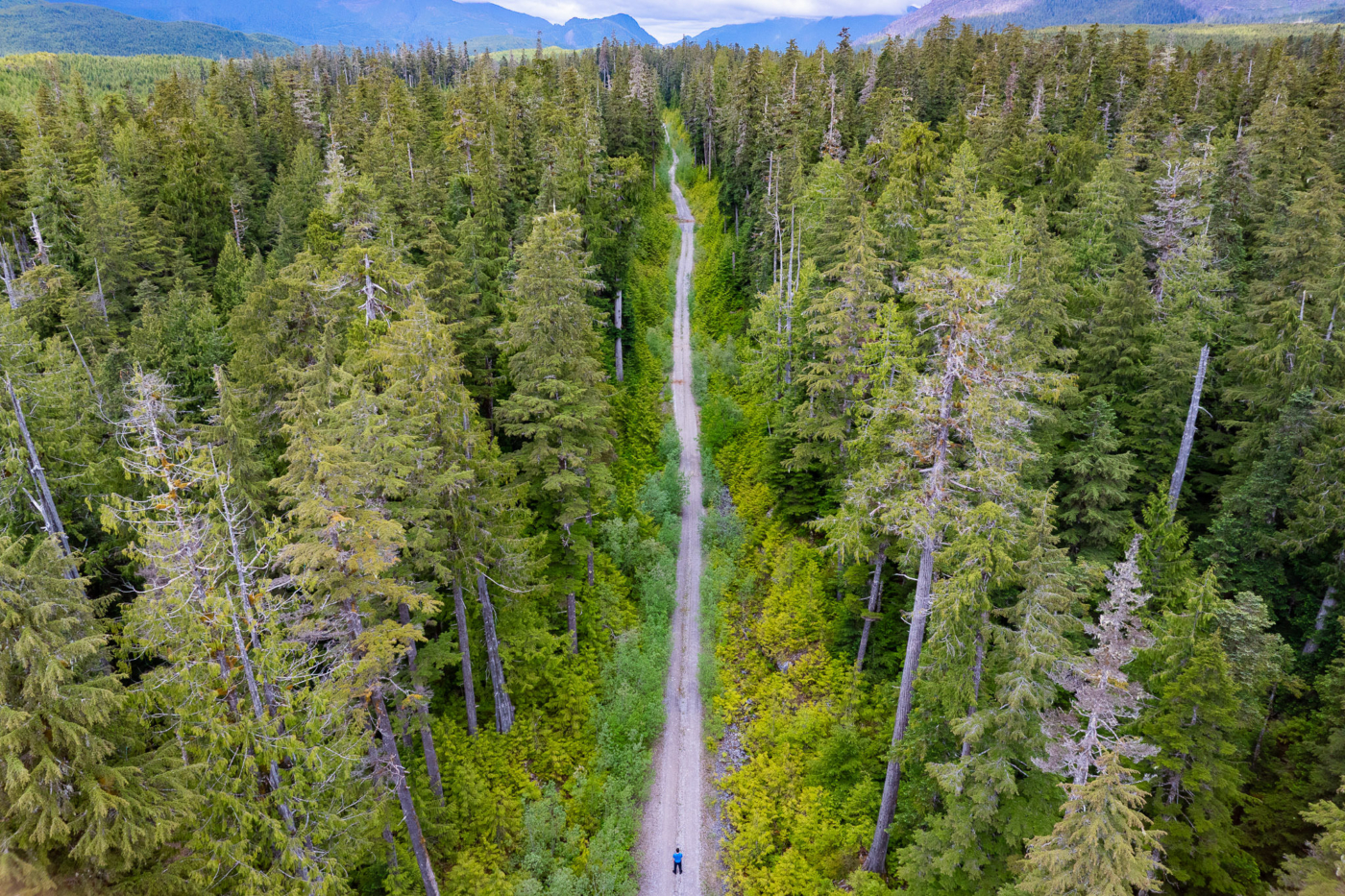
An aerial view of unprotected old-growth forests along the coastline of Barkley Sound in the territory of the Uchucklesaht and Tseshaht First Nations. (TJ Watt)
The Victoria-based photographer and activist has spent much of the past 15 years searching for and photographing some of Canada’s biggest, oldest trees. The trees he finds are often upwards of a thousand years old and wide enough to drive a car through.
His backcountry quests are more than just adventures though. Most of the trees that Watt finds are slated to be cut down. Watt’s photographs, which he posts on social media, have become a powerful tool for ramping up public support to protect B.C.’s old-growth forests.
“It can be hard to capture the complexity and the whole essence of this issue,” says Watt, who co-founded the non-profit advocacy group Ancient Forest Alliance 10 years ago. “You have to somehow find a single image that encapsulates all of that, and the feelings that go with it.”
Old-growth logging has long been contentious in B.C. The debate first made headlines in the early 1990s, when hundreds of protesters gathered near Clayoquot Sound for the so-called “war in the woods.”
The protests garnered international media attention and shone a spotlight on logging practices in the province. Clayoquot Sound was ultimately protected and local First Nations have stewarded the area’s forests ever since. But elsewhere in B.C., old-growth logging continued.
In the last fiscal year, the province said $1.3 billion in revenue and more than 50,000 jobs were linked to the forestry sector. Logging is particularly important for some smaller, more remote communities, says Jim Girvan, a forestry economist and former director of the Truck Loggers Association. “If the forest industry wasn’t there operating, those small towns would eventually become ghost towns,” Girvan said.
An old-growth tree is defined in B.C. as one that is older than 250 years in coastal forests, or 140 years in interior forests. According to provincial data, roughly 50,000 hectares of old-growth forest are cut annually. The older, bigger trees tend to have the highest value, says Girvan, which is important for an industry that’s been struggling to keep afloat. “Old-growth logs, for example, are very good for making guitars, and that’s one of the products that a lot of people come to British Columbia for,” he explained.
For his part, Watt says he’s not opposed to logging but argues that it needs to be done differently — for example, in second-growth tree plantations, which replace old-growth forests lost to fire and logging, with trees re-logged every 50-60 years. Watt also feels “there should be a more value-added side to the industry.” Rather than exporting raw logs to other countries, Watt says, those logs should be processed in B.C. to make higher-end products.
Watt’s photographs have also led to a different economic opportunity: tourism. A stand of thousand-year old conifers near Port Renfrew, known as Avatar Grove, was protected after Watt’s photos caught the attention of hikers, ecologists and activists 10 years ago. Today, the area is a protected park and draws thousands of tourists every summer seeking big trees.
Still, many of the trees that Watt has photographed have been cut down. Last year, he hiked into the Caycuse Valley, a few hours north of Victoria, just as logging was set to begin. He decided to try something different: photographing the forest before—and after—it was cleared. “I remember thinking that by tomorrow morning [these trees] won’t be here,” he said. “It’s a very odd experience to feel that you’re essentially taking a portrait of something in its final days.”
Watt returned after logging was complete and took photos from the same vantage points. Then he posted the before-and-after series on social media. The response was almost immediate, he says. “When you refresh the page just a few minutes later and it’s already got a hundred comments and a thousand shares, you can tell that it’s going to blow up in a big way.”
The photos generated some two million views on social media, along with international media coverage, and sparked public outcry. Since then, tensions over old-growth logging have reached a boiling point with more than 900 protesters arrested at anti-logging blockades in the Fairy Creek watershed—not far from the Caycuse Valley where Watt took the before-and-after photos.
In early November—facing increasing public pressure—the B.C. government announced, in principle, a temporary halt to logging in 2.6 million hectares of old-growth forests. The province stated its “intention to work in partnership with First Nations” to develop forest sustainability plans while logging of certain rare old-growth trees is deferred. If the deferrals become permanent, the province estimates that up to 4,500 jobs could be lost. Industry officials have suggested that number could be four times higher.
The announcement came a year and a half after the provincially commissioned old-growth strategy review panel released its recommendations, calling for a “paradigm shift” in logging practices. The panel called for a more ecological approach to managing B.C.’s forests, and a stronger oversight role for First Nations.
“The small communities and logging contractors we spoke with were just as concerned about not losing biological diversity, not damaging our environment, as the people who are protesting out the windows,” said Al Gorley, co-chair of the old-growth review panel.
The provincial announcement came as welcome news for Watt. The giant western red cedar that he’d photographed near Barkley Sound this summer is located in one of the logging deferral areas, meaning it won’t be cut down any time soon.
After more than a decade of documenting trees before they’re cut down, Watt sounded cautiously optimistic. “At the end of the day, I need to know that I did everything I could to make a difference,” he said. “Hopefully our efforts pay off.”
“I think for someone who loves trees,” he added, “I have the best job and the worst job in the world.”