 https://ancientforestalliance.org/wp-content/uploads/2026/08/Canoe-Creek-Cedar-Tree-262.jpg
800
1200
TJ Watt
https://ancientforestalliance.org/wp-content/uploads/2026/05/Ancient-Forest-Alliance-logo.svg
TJ Watt2026-08-04 17:15:512026-08-04 17:15:51Thank you to our monthly business donors!
https://ancientforestalliance.org/wp-content/uploads/2026/08/Canoe-Creek-Cedar-Tree-262.jpg
800
1200
TJ Watt
https://ancientforestalliance.org/wp-content/uploads/2026/05/Ancient-Forest-Alliance-logo.svg
TJ Watt2026-08-04 17:15:512026-08-04 17:15:51Thank you to our monthly business donors!Related Posts
https://ancientforestalliance.org/wp-content/uploads/2026/08/Canoe-Creek-Cedar-Tree-262.jpg
800
1200
TJ Watt
https://ancientforestalliance.org/wp-content/uploads/2026/05/Ancient-Forest-Alliance-logo.svg
TJ Watt2026-08-04 17:15:512026-08-04 17:15:51Thank you to our monthly business donors! https://ancientforestalliance.org/wp-content/uploads/2026/07/Kaska-Territory.-Credit-Johnny-Mikes-CPAWS-BC-scaled-1.jpg
1707
2560
TJ Watt
https://ancientforestalliance.org/wp-content/uploads/2026/05/Ancient-Forest-Alliance-logo.svg
TJ Watt2026-07-24 15:34:372026-07-28 11:05:22Speak up for Three Major New Protected Areas in Northern BC
https://ancientforestalliance.org/wp-content/uploads/2026/07/Kaska-Territory.-Credit-Johnny-Mikes-CPAWS-BC-scaled-1.jpg
1707
2560
TJ Watt
https://ancientforestalliance.org/wp-content/uploads/2026/05/Ancient-Forest-Alliance-logo.svg
TJ Watt2026-07-24 15:34:372026-07-28 11:05:22Speak up for Three Major New Protected Areas in Northern BC https://ancientforestalliance.org/wp-content/uploads/2026/06/tahsish-river-old-growth-karst-forest-285-1.jpg
1366
2048
TJ Watt
https://ancientforestalliance.org/wp-content/uploads/2026/05/Ancient-Forest-Alliance-logo.svg
TJ Watt2026-07-20 10:46:412026-07-20 12:16:45Victoria Buzz: Old growth advocates call for protection of at-risk Vancouver Island forest
https://ancientforestalliance.org/wp-content/uploads/2026/06/tahsish-river-old-growth-karst-forest-285-1.jpg
1366
2048
TJ Watt
https://ancientforestalliance.org/wp-content/uploads/2026/05/Ancient-Forest-Alliance-logo.svg
TJ Watt2026-07-20 10:46:412026-07-20 12:16:45Victoria Buzz: Old growth advocates call for protection of at-risk Vancouver Island forest https://ancientforestalliance.org/wp-content/uploads/2026/06/tahsish-river-old-growth-karst-forest-136-1.jpg
1365
2048
TJ Watt
https://ancientforestalliance.org/wp-content/uploads/2026/05/Ancient-Forest-Alliance-logo.svg
TJ Watt2026-07-17 11:54:012026-07-17 11:56:51In Photos: Old-Growth Forest on Karst in the Tahsish Valley
https://ancientforestalliance.org/wp-content/uploads/2026/06/tahsish-river-old-growth-karst-forest-136-1.jpg
1365
2048
TJ Watt
https://ancientforestalliance.org/wp-content/uploads/2026/05/Ancient-Forest-Alliance-logo.svg
TJ Watt2026-07-17 11:54:012026-07-17 11:56:51In Photos: Old-Growth Forest on Karst in the Tahsish ValleyTake Action
 Donate
Support the Ancient Forest Alliance with a one-time or monthly donation. Send a Message
Send an instant message to key provincial decision-makers.
Cast your vote for ancient forest protection!
/in Take ActionAncient Forest Enthusiast Cycles Across BC to Jasper
/in Thank YouWe’re extremely grateful and inspired by those who use their passions to help build the ancient forest movement! During September, big tree enthusiast and bicyclist, Michael, embarked on a cross-province cycling trip from BC to Jasper to raise awareness for the AFA and BC’s ancient forests. Michael also cycled in Mexico recently where he followed migrating animals like gray whales, vultures, and monarch butterflies. In his latest venture, he showed his support for BC’s old-growth forests and the many species and communities that depend on them.
Thank you, Michael! To learn more and to support the journey, check out his website: https://michaelrsuds.wixsite.com/mikebikesacrossbc
B.C.’s old-growth forest announcement won’t actually slow down logging: critics
/in News CoverageNote: Last week we welcomed the release of the Old Growth Strategic Review panel’s long-anticipated report, which includes strong recommendations to protect old-growth forests & overhaul BC’s forest management regime.
We also welcomed logging deferrals in 9 areas across BC, but closer inspection reveals that some of those areas were already deferred or have little at-risk, productive old-growth.
Meanwhile, the vast majority of BC’s most endangered ancient forests are still at risk. The NDP government must act quickly to protect the most at-risk stands (as the panel recommends) and commit to fully implementing their recommendations.
Read the Narwhal’s explainer piece below:
The Narwhal
September 16, 2020
As rumours swirl of a snap fall election, the NDP government has announced development deferrals for nine areas — but closer inspection reveals a startling absence of old growth, and some areas have already been clear cut
When governments make announcements on a Friday afternoon, it’s usually because they don’t want much scrutiny.
That was clearly the case on Sept. 11 when the B.C. government released a consequential old-growth strategic review report, barely giving reporters a chance to glance at the fine print and recommendations prior to a press conference with Doug Donaldson, Minister of Forests, Lands, Natural Resource Operations and Rural Development.
Donaldson’s ministry simultaneously sent out a news release announcing the “protection” of nine areas in B.C., totalling almost 353,000 hectares, to kickstart the NDP government’s “new approach to old forests.”
Sounds good, right?
But wait. As the adage goes, the devil is in the details.
“If you look at the facts … it still essentially preserves the core of the old-growth logging industry,” said Ken Wu, executive director of the Endangered Ecosystems Alliance.
“Left as it is, it will liquidate most of the remaining endangered old-growth.”
So what did the government commit to? And what did the old-growth strategic review report say?
Read on. Get The Narwhal in your inbox!
People always tell us they love our newsletter. Find out yourself with a weekly dose of our ad‑free, independent journalismYour emailYour emailSUBSCRIBE
Did the B.C. government implement permanent protections for old-growth?
In a word, no.
Donaldson announced that development will be temporarily deferred in nine old-growth areas while consultations about future designations are held. “The areas that are announced today are already areas where harvesting is not taking place, and therefore the economic impact in the immediate term is going to be insignificant,” he told reporters.
“Deferrals aren’t protection,” said Wilderness Committee national campaign director Torrance Coste. “They’re two-year deferrals, hopefully to buy time for those forests to be protected.”
Eight of the areas are in southern B.C. — omitting the northern boreal forest and rare and endangered interior temperate rainforest from logging reprieves.
It’s business as usual everywhere else in the province, including in the central Walbran and Fairy Creek on southern Vancouver Island, in endangered caribou habitat in the Anzac Valley northeast of Prince George and on the Sunshine Coast, where residents have stapled felt hearts on old-growth trees as part of an effort to protect the Clack Creek forest from clear-cutting.
“It’s largely talk and log in a lot of cases, with loopholes big enough to drive thousands of logging trucks through,” observed Wu, the founder of the Ancient Forest Alliance.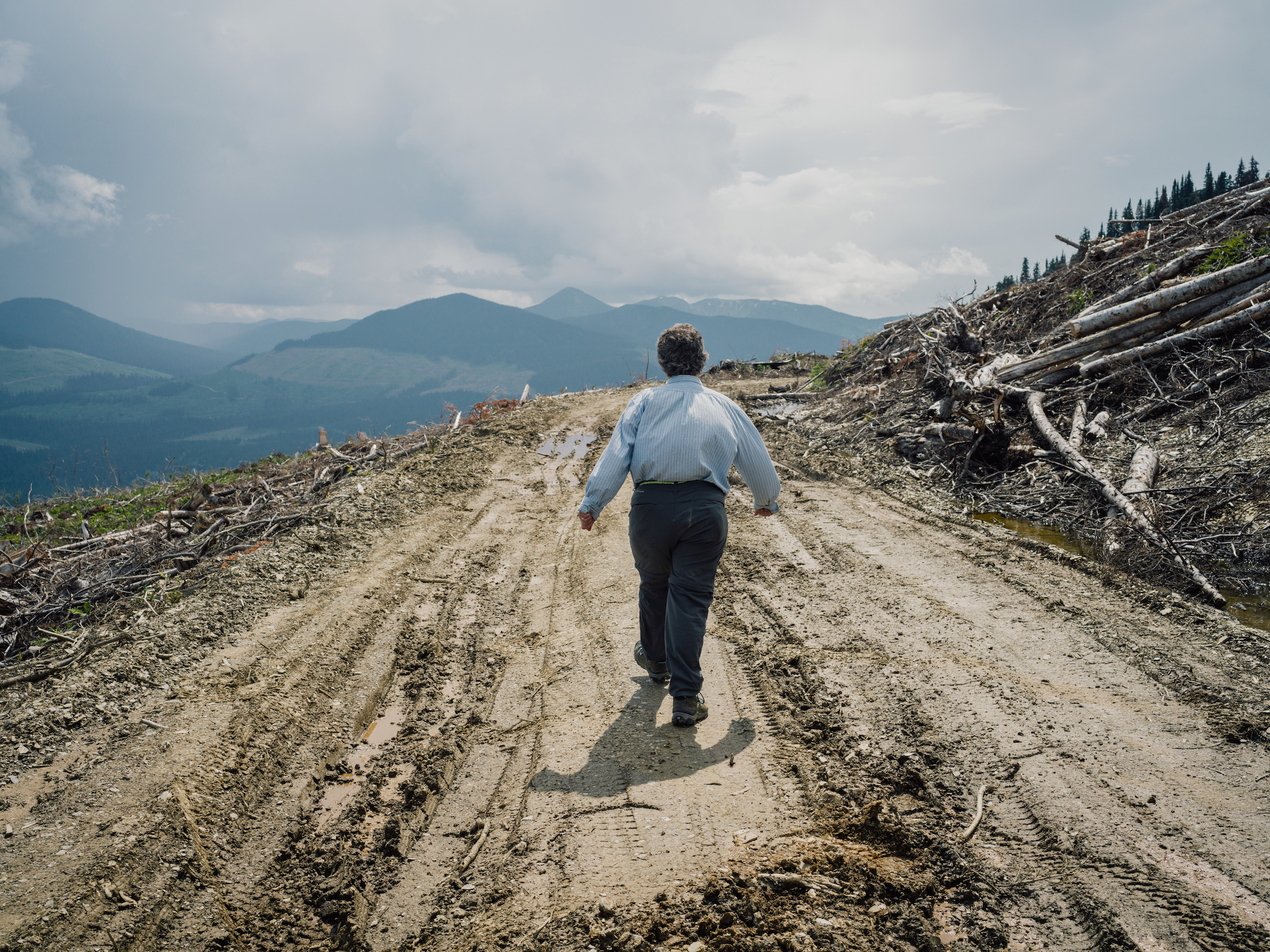
Retired B.C. government forester Judy Thomas surveys a clear cut near the Anzac Valley, just north of Prince George, B.C. Photo: Taylor Roades / The Narwhal
What about the development deferrals?
Clayoquot Sound, with more than 260,000 hectares deferred from development, represents almost three-quarters of the deferrals in size.
But when GIS mapper Dave Leversee crunched the numbers, he found that about 137,000 hectares of the land newly “deferred” from development in Clayoquot Sound is already under some form of protection, including parks, Wildlife Habitat Areas and Clayoquot management reserves.
Less than nine per cent of the total area announced for a development deferral consists of old-growth forests of medium to good productivity, meaning there are optimal conditions for supporting the biggest trees, Leversee discovered.
“There’s a lot of non-forested areas in that number: rocks, mountain peaks, swamps, things like that,” he said of the 260,000-hectare Clayoquot Sound “old growth development deferral” area on the government’s map.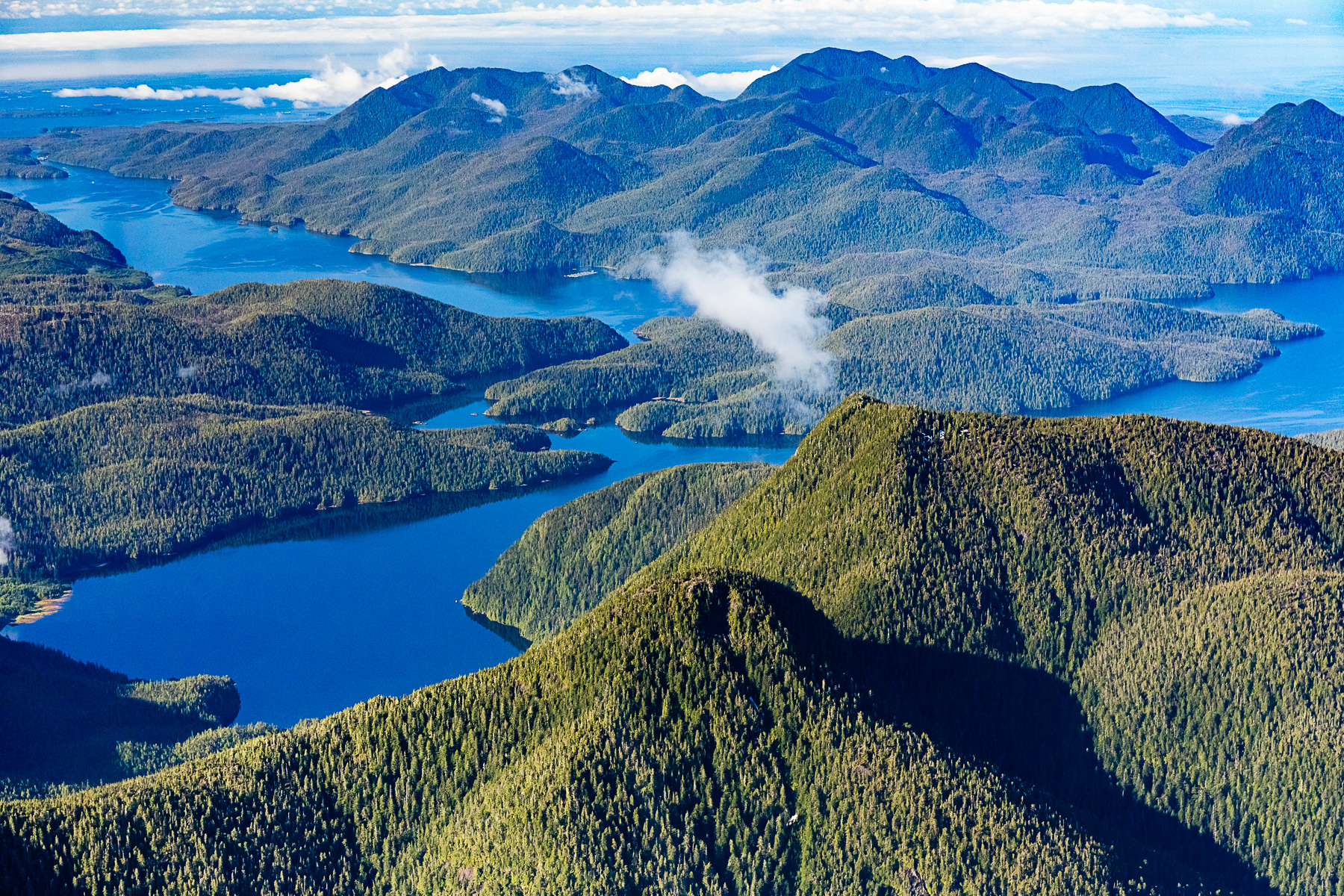
An aerial view of old-growth forests in Clayoquot Sound, part of a temporary deferral that will prohibit logging in this area for two years. Photo: TJ Watt / Ancient Forest Alliance
It’s much the same story in the Kootenays, where Stockdale Creek and Crystalline Creek in the Purcells are on the list of development deferrals.
Wildsight conservation specialist Eddie Petryshen pointed out that only 0.1 hectare of the 9,600 hectares deferred in Crystalline Creek area, a tributary of the south fork of the Spillimacheen River, was slated for logging.
In Stockdale Creek, just 223 hectares out of 11,500 hectares that received a development deferral were on the chopping block, Petryshen said, noting that both areas provide important grizzly bear and wolverine habitat and connectivity.
“It’s a far cry from the numbers they’re talking about,” Petryshen told The Narwhal.
“While both these watersheds are intact, have very high biodiversity values and need to be protected, most of the old growth in these drainages is not believed to be under immediate threat from logging.”
After Clayoquot Sound, the largest temporary deferral from development consists of 40,000 hectares in the Incomappleux Valley east of Revelstoke, an inland rainforest with trees up to 1,500 years old.
“The deferral areas appear to cover a lot of inoperable forest, or forest that’s already been clear cut,” said Valhalla Wilderness Society director Craig Pettitt.
The society is suggesting that 32,000 hectares of the Incomappleux deferral unit be allocated “to actual endangered forest elsewhere, instead of protecting inoperable or clear cut areas outside of the ancient forest.”
Pettitt said he is happy the Incomappleux has been acknowledged. But he said the inland temperate rainforest — hosting some of B.C.’s rarest ancient forests — is “severely underrepresented” in the government’s announcement.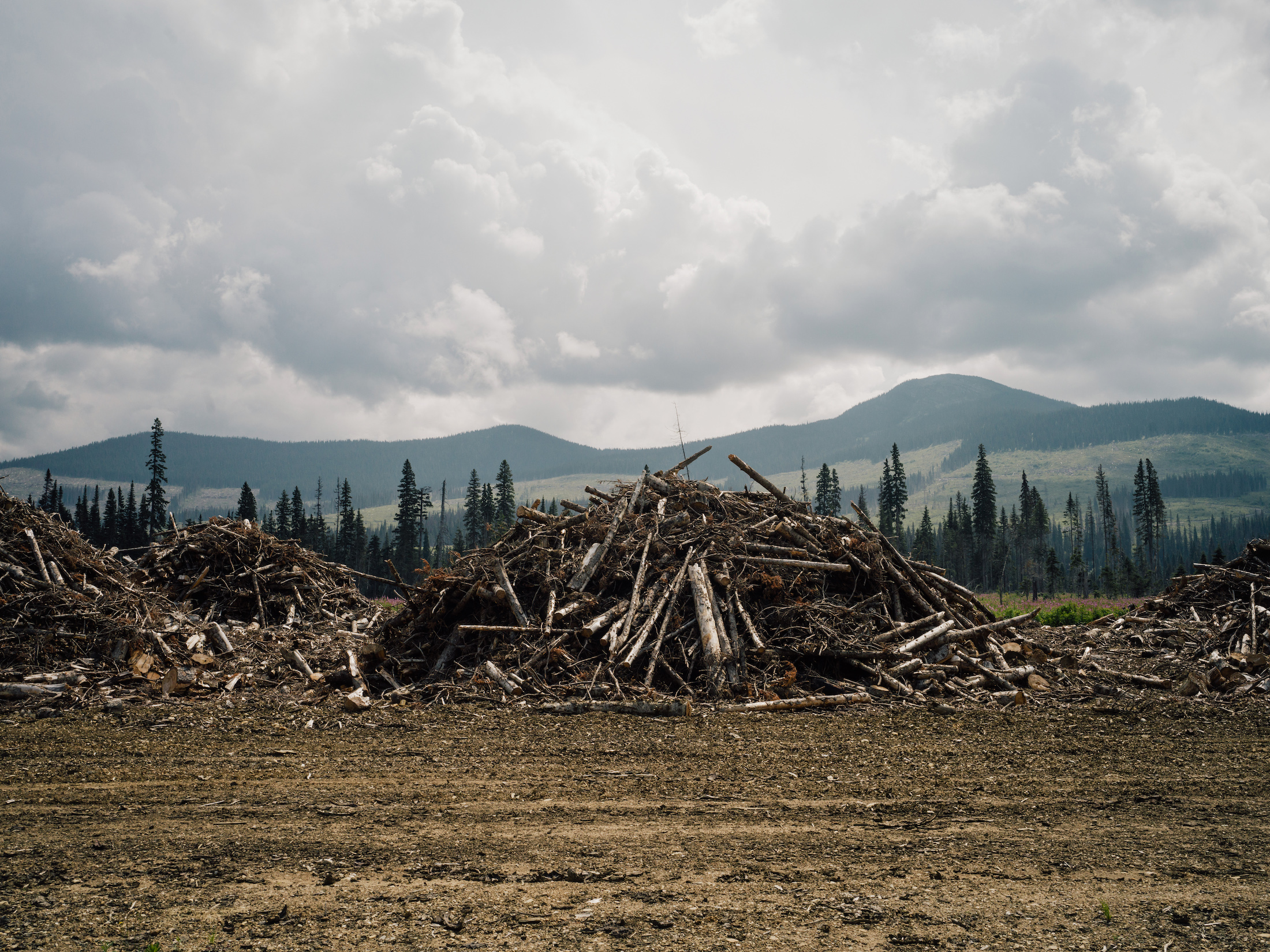
Clear-cut logging of spruce in B.C.’s interior. Less than one-third of the world’s primary forests are still intact yet in B.C.’s interior a temperate rainforest that holds vast stores of carbon and is home to endangered caribou is being clear-cut as fast as the Amazon. Photo: Taylor Roades / The Narwhal
And then there’s the deferral of about 5,700 hectares in the Skagit-Silver Daisy area, on the edge of Manning Park, where the B.C. government had already announced that logging permits in the Skagit River headwaters would no longer be permitted, but mining exploration has been causing friction with Americans downstream.
Also on Vancouver Island, more than 2,200 hectares were deferred from logging around McKelvie Creek — the last unprotected, intact watershed in the Tahsis region, in Mowachaht/Muchalaht territory. And just over 1,000 hectares, an area roughly the size of two and a half Stanley Parks, were deferred in H’Kusam, near Sayward.
The remaining deferrals consist of just over 4,500 hectares in an area known as the Seven Sisters, northwest of Smithers, and more than 17,000 hectares around the Upper Southgate River in Bute Inlet on B.C.’s mid-coast.
Coste said the Wilderness Committee is waiting on shapefiles and more information from the government so it can determine what portion of the nine deferrals lie in the 415,000 hectares of old forest left in B.C., home to trees expected to grow more than 20 metres tall in 50 years.
“That will be the real test,” he said.
Wait, what did the old-growth strategic review report actually say?
The report, commissioned by the B.C. government, was written by foresters Garry Merkel and Al Gorley.
The 216-page report calls for a paradigm shift in the way B.C. manages old-growth forests. It lays out a blueprint for change with 14 recommendations.
The report says old forests have intrinsic value for all living things and should be managed for ecosystem health, not for timber. It also says many old forests are not renewable, which counters the prevailing notion that trees, no matter how old, will grow back.
The report was widely praised by conservation groups, which welcomed the temporary development deferrals and called on the B.C. government to commit to implementing Merkel and Gorley’s recommendations.
“The report itself is fantastic,” Wu said. “It covers most of what we’ve actually been calling for for decades. What’s needed is to commit to those recommendations.”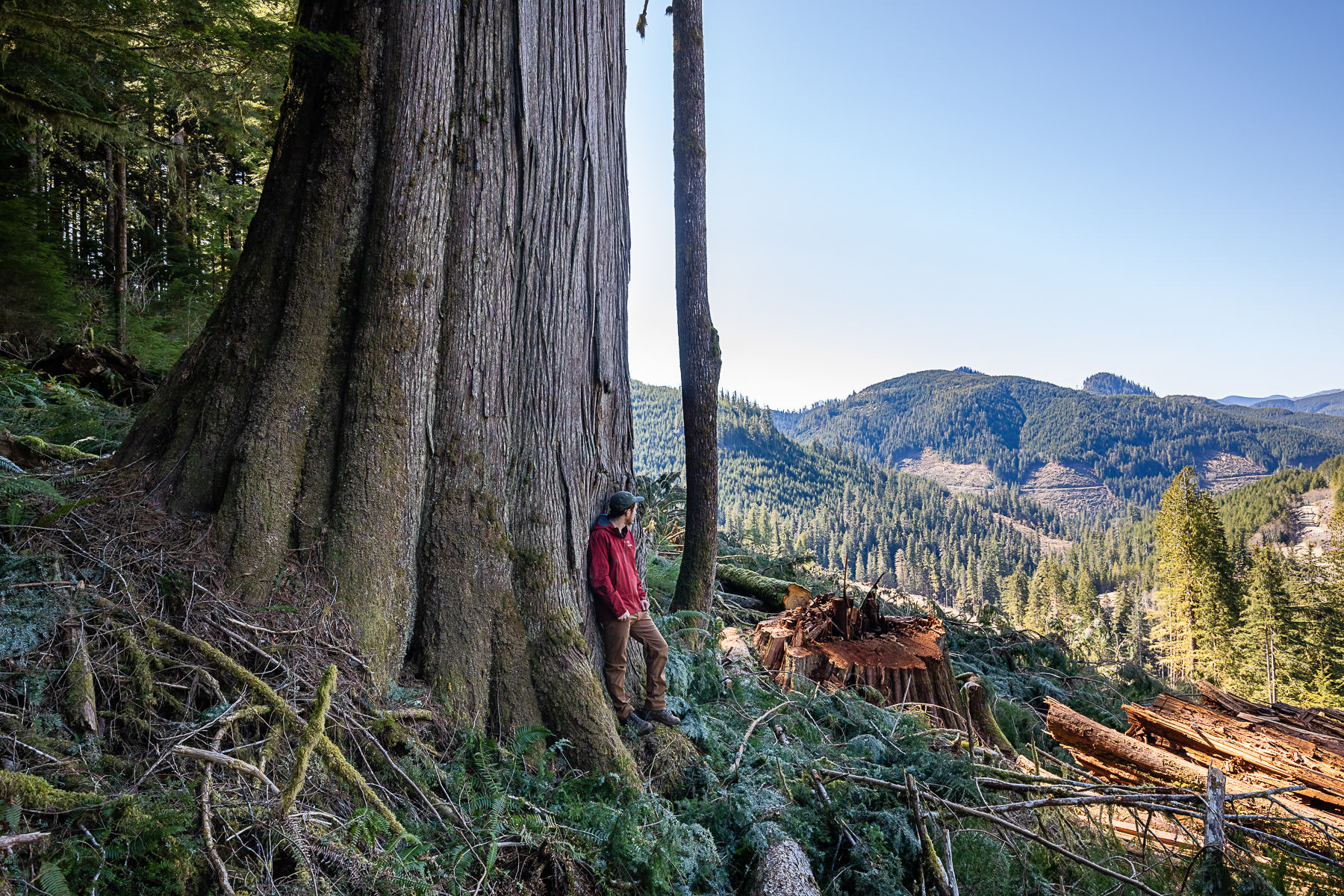
Ancient Forest Alliance campaigner and photographer TJ Watt surveys recent old-growth clearcutting by Teal-Jones in the Caycuse watershed in Ditidaht Territory on southern Vancouver Island. Areas of highly productive, endangered ancient forest like this still remain at risk in many regions. Photo: TJ Watt / Ancient Forest Alliance
What did the report recommend?
Top of the list is to engage “the full involvement” of Indigenous leaders and organizations in an old-growth strategy.
Immediately deferring development in old forests “where ecosystems are at very high and near-term risk of irreversible biodiversity loss” and “prioritizing ecosystem health and resilience” are among the other recommendations.
In an interview with The Narwhal, Merkel said people from all sectors, including forestry, recognize “that the path we’re going down needs to change” and that B.C. forest-dependent communities — which have suffered from recent mill closures and job losses — need sustainable economies.
As such, the report recommends the government support forest sector workers and communities as they adapt to changes resulting from a new forest management system.
“If the government does that, we can minimize the pain through this transition,” said Merkel, the former chair of the Tahltan Nation Development Corporation and the Columbia Basin Trust.
“But there is a transition coming in many areas … There are many, many areas that are going to have to do this regardless whether they implement our ideas or not. This is not a surprise.”
Did the government take immediate steps to prevent irreversible biodiversity loss?
No. The government has not followed the panel’s recommendation to immediately defer all logging in old-growth forests that are home to ecosystems at risk of irreversible biodiversity loss.
Under Section 13 of B.C.’s Forests Act, Donaldson can defer harvesting activities for up to four years without compensating tenure holders.
Conservation North director Michelle Connolly said areas at risk of ecological collapse include the Anzac River Valley north of Prince George, which provides critical habitat for endangered southern mountain caribou and a myriad other species, including at-risk migratory songbirds.
“The Anzac is an area of great ecological risk up here and it’s really odd that no protections have been announced for it,” Connolly said in an interview.
Cutting permits have been issued all the way up the Anzac Valley “and they’re going after the highest productivity old-growth spruce, the areas with the biggest trees,” she said.
Forestry giant Canfor and Coastal Gaslink, which is constructing a pipeline for the LNG Canada export project, recently teamed up to build a new road into the Anzac Valley wilderness, Connolly noted.
“The Hart [Ranges] caribou use that whole area. The road, the cut blocks, are in their core habitat.”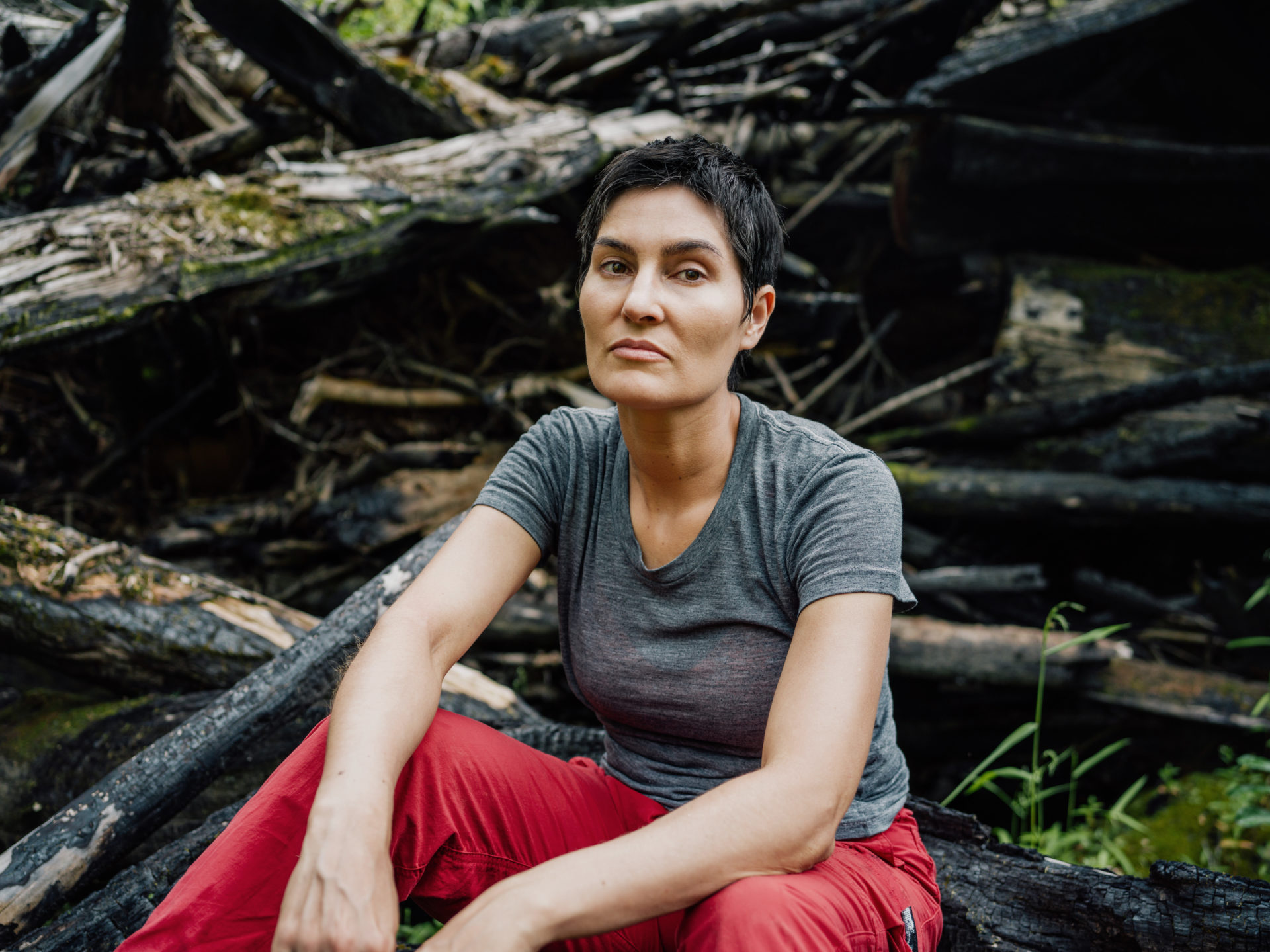
Scientist Michelle Connolly said the Anzac River Valley north of Prince George is at risk of ecological collapse and has not received any protection under the NDP government’s recent announcement. Photo: Taylor Roades / The Narwhal
Petryshen said development deferrals omit “an incredible” drainage in the North Columbia mountains that BC Timber Sales plans to road and log.
The Argonaut Creek drainage provides critical habitat for the endangered Columbia North caribou herd, which, at 150 animals, is the largest remaining caribou herd in the area.
“It’s spectacular old-growth at lower elevations and then Engelmann spruce and subalpine fir and spectacular summer and winter caribou habitat, and it’s federal critical caribou habitat.”
He said it is hypocritical to move forward with piecemeal deferrals while, on the other hand, “we’re seeing that critical caribou habitat move down the road on logging trucks on Highway 23.”
Coste said the B.C. government is limiting its future ability to ensure the survival of ecosystems by failing to follow the panel’s recommendation.
“There are hundreds of hectares of old-growth being cut down today and removed from the pool of old-growth that we could potentially protect six months, a year, two years, three years from now.”
What does the B.C. First Nations Forestry Council say?
B.C. First Nations Forestry Council CEO Charlene Higgins said the council is disappointed the government has chosen to engage with First Nations “after the fact” and not as partners in the process, especially given the cultural significance of many old-growth areas.
“Public consultation and engagement stakeholder processes, and asking for submissions, really doesn’t recognize First Nations as governments and as rights holders,” Higgins told The Narwhal.
“There’s been no meaningful input and engagement with First Nations.”
Higgins said the process doesn’t reflect commitments made in B.C.’s Declaration on the Rights of Indigenous Peoples Act and the government’s commitment to work in cooperation and collaboration with Indigenous peoples on forest policy changes, legislation and practices.
She said the council supports the nine development deferrals provided they were decided in full consultation with First Nations in whose territories the deferrals lie. (Donaldson underscored that the deferrals all have the support of local First Nations.)
“Many First Nations have their own policies around old growth and they have their own old growth areas that they recognize, and the province needs to ensure that these areas line up,” Higgins said.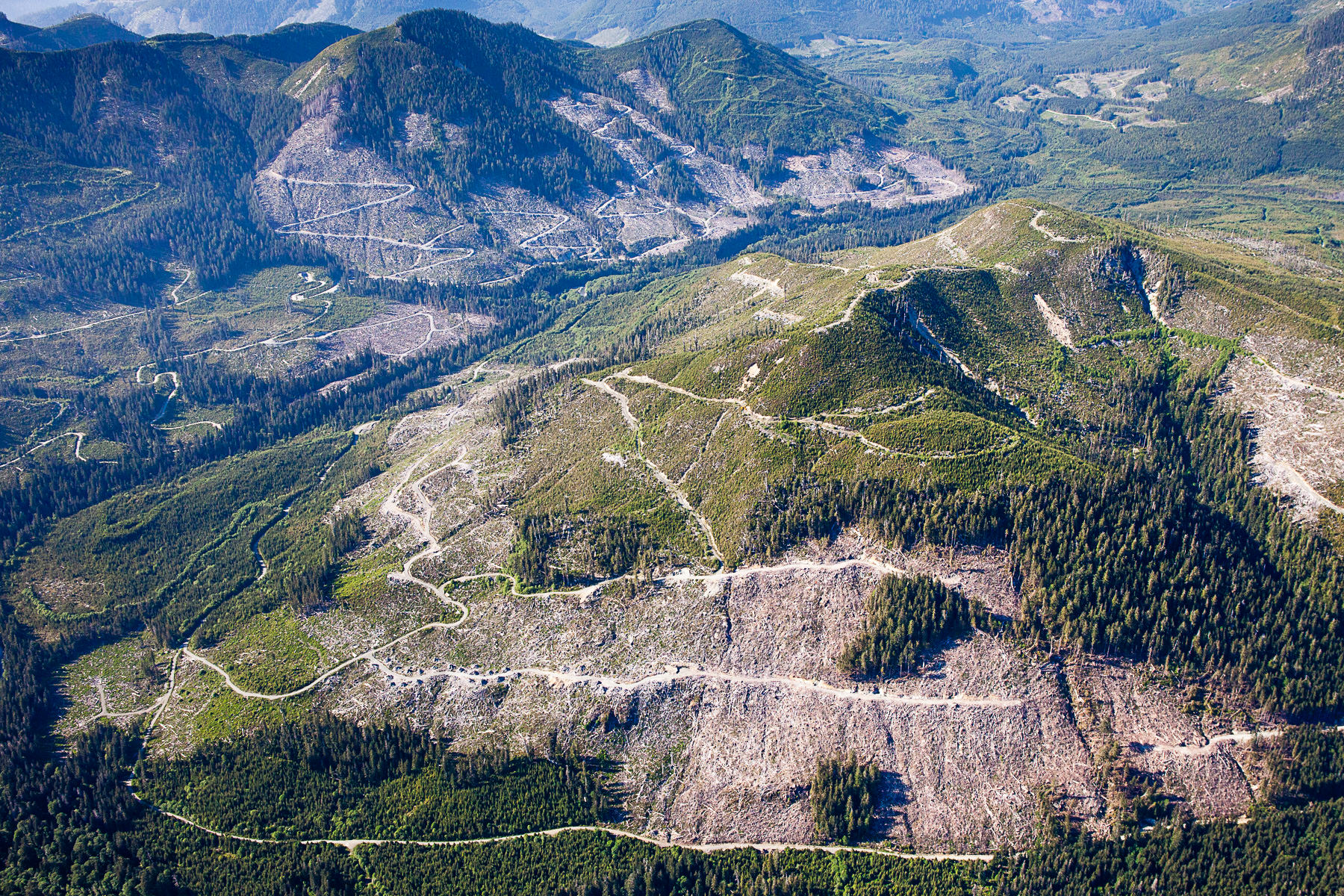
An aerial view highlighting extensive clearcut logging of productive old-growth forests in the Klanawa Valley on southern Vancouver Island, B.C. Photo: TJ Watt / Ancient Forest Alliance
What about protections for big trees?
Donaldson’s ministry also announced that work is underway to protect up to 1,500 “exceptionally large, individual trees” under the special tree protection regulation, introduced last year by the government to protect monumental trees.
Coste called the big tree protections a “drop in the bucket.” They represent, at most, the preservation of 1,500 hectares of old-growth across the province — an area smaller than four Stanley Parks — because each monumental tree gets a one-kilometre buffer zone around it, he pointed out.
“Big trees are important but there’s so much more to old-growth forests than just those big trees.”
Connolly, from Conservation North, called the protection of individual trees “a joke,” saying her science-based group sees more than 1,500 trees from the interior wet belt going down Highway 97 in a single day.
“They don’t understand what is a minimum expectation for conservation,” she said.
Higgins, from the B.C. First Nations Forestry Council, said there has been no First Nations input into the protection of individual trees.
“Without nations having any input into what is considered a large tree species, there’s a potential for a disconnect.”
“Many First Nations have developed their own strategy for what they deem as culturally significant areas,” she said. “It’s been a really flawed process that really doesn’t reflect First Nations input.
But Wu said big tree protections are an important part of protecting what little remains of B.C.’s high productivity old growth.
“The goal is, and has always been, protection of old growth ecosystems. That’s got to happen on the trees and groves level, and on the level of watersheds, landscapes and ecosystems.”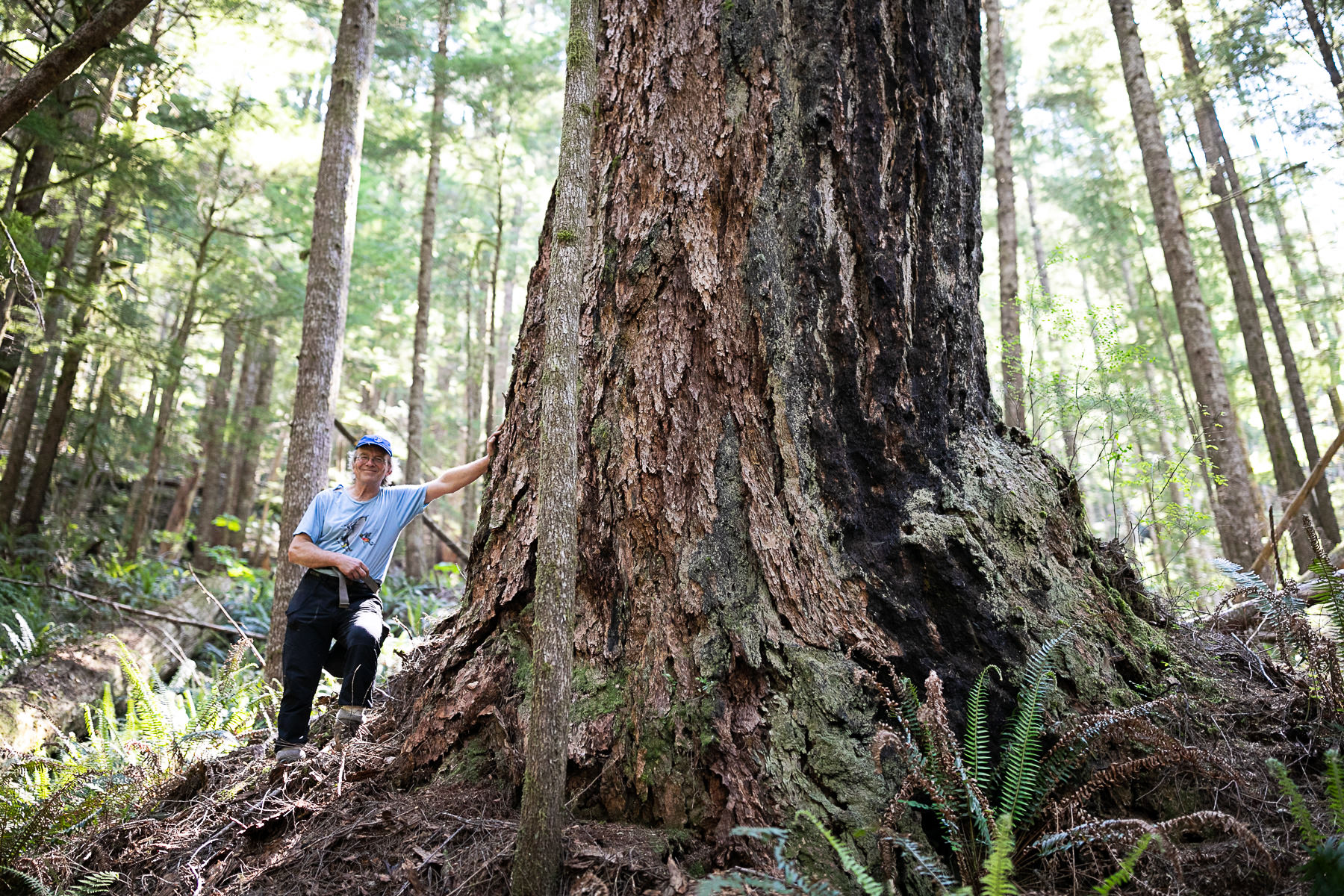
Tahsis Mayor Martin Davis stands beside a giant old-growth Douglas-fir tree in the McKelvie Valley, part of a temporary deferral that will prohibit logging in this area for two years. Photo: TJ Watt / Ancient Forest Alliance
Is this really a new approach to managing old-growth?
No — at least not yet.
Merkel said the panel is recommending deep structural changes that go far further than saving a few key areas, although he said that is also important.
“If that’s all we do, we won’t change the way we’re doing things.”
“We’re talking about changing a system that started almost a century ago. We’re fundamentally turning a corner here in how that whole thing works. That’s going to take a little bit of time.”
For example, it will take several years to figure out the pieces that need to change to align with the panel’s recommendation to make ecosystem health a priority as an overarching directive for managing old-growth, he said.
If the government acts on the panel’s recommendations immediately, Merkel said there will be substantial changes in the short-term “and we will get incrementally better over time.”
What happens next?
Conservation groups want the government to implement the report’s 14 recommendations within the timeline laid out in the report, with immediate, mid-term and long-term actions taken over the next three years.
So far, the government hasn’t committed to any of the recommendations, or to the timeline.
Donaldson told reporters that managing old-growth forests while supporting workers and communities “has been a challenge in the making for more than 30 years and it won’t be solved immediately.”
“But we know that the status quo is not sustainable,” the minister said. “Obviously, it’s not good for the industry to cut it all down, there’s no plan for transition. And we know that unchecked logging in old-growth threatens crucial biodiversity values. But at the same time, putting an abrupt halt to old-growth logging would have devastating impacts on communities and workers across B.C., especially on the coast.”
As rumours swirl of a snap provincial election this fall, Donaldson said the government will provide a progress report on a “renewed old-growth strategy” in the spring of 2021. (Shortly after announcing the deferral areas, Donaldson announced he will not be seeking re-election.)
Merkel said he and Gorley have agreed not to judge the government at this point. “They haven’t outright said they aren’t going to do it,” he said regarding the recommendations.
“Our job was to think about what needed to happen,” he said. “We needed to put it out there. Now, the world has to think: ‘Are we ready, and can we do it?’ ”
Read the original article