 https://ancientforestalliance.org/wp-content/uploads/2026/09/Old-Growth-Clearcut-Caycuse-Vancouver-Island.jpg
1364
2048
TJ Watt
https://ancientforestalliance.org/wp-content/uploads/2026/05/Ancient-Forest-Alliance-logo.svg
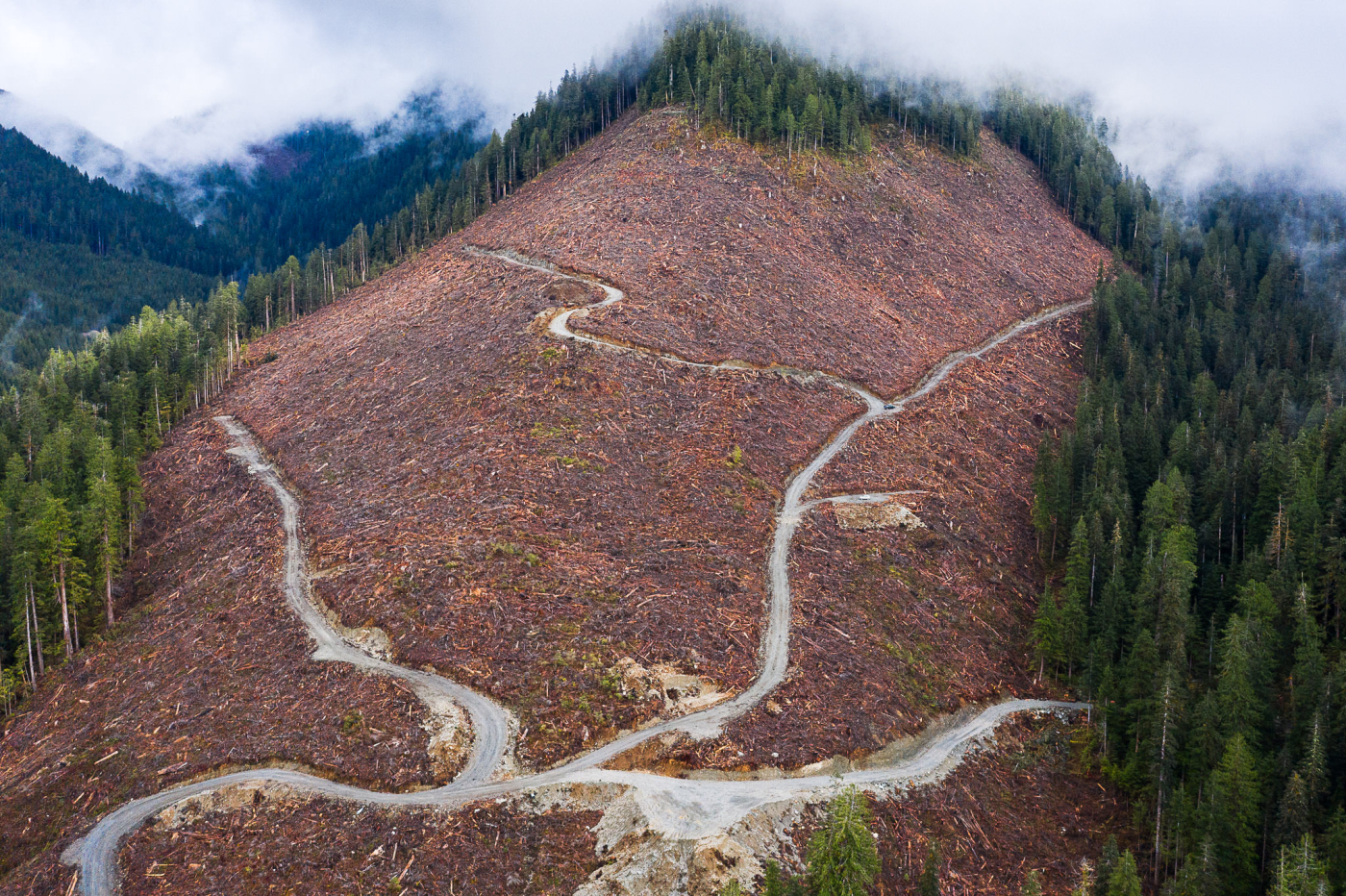
TJ Watt2026-10-26 15:06:162026-10-26 15:06:16Victoria Buzz: Environmental advocates concerned over results of BC election
https://ancientforestalliance.org/wp-content/uploads/2026/09/Old-Growth-Clearcut-Caycuse-Vancouver-Island.jpg
1364
2048
TJ Watt
https://ancientforestalliance.org/wp-content/uploads/2026/05/Ancient-Forest-Alliance-logo.svg
TJ Watt2026-10-26 15:06:162026-10-26 15:06:16Victoria Buzz: Environmental advocates concerned over results of BC electionRelated Posts
https://ancientforestalliance.org/wp-content/uploads/2026/09/Old-Growth-Clearcut-Caycuse-Vancouver-Island.jpg
1364
2048
TJ Watt
https://ancientforestalliance.org/wp-content/uploads/2026/05/Ancient-Forest-Alliance-logo.svg
TJ Watt2026-10-26 15:06:162026-10-26 15:06:16Victoria Buzz: Environmental advocates concerned over results of BC election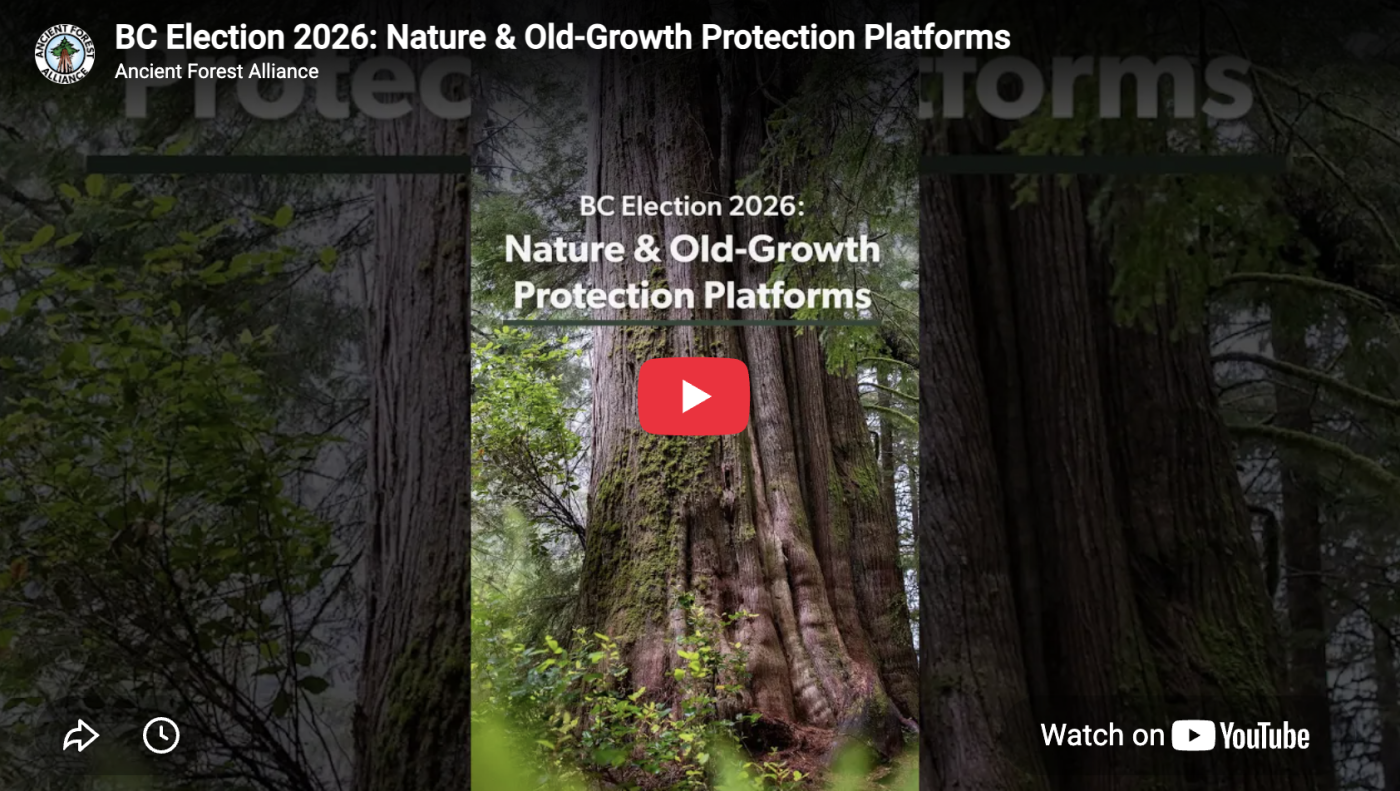 https://ancientforestalliance.org/wp-content/uploads/2026/10/Screenshot-2026-10-22-at-4.54.32-PM.png
952
1684
TJ Watt
https://ancientforestalliance.org/wp-content/uploads/2026/05/Ancient-Forest-Alliance-logo.svg
TJ Watt2026-10-22 16:54:062026-10-22 16:59:41NEW Video: BC Election 2026: Nature & Old-Growth Protection
https://ancientforestalliance.org/wp-content/uploads/2026/10/Screenshot-2026-10-22-at-4.54.32-PM.png
952
1684
TJ Watt
https://ancientforestalliance.org/wp-content/uploads/2026/05/Ancient-Forest-Alliance-logo.svg
TJ Watt2026-10-22 16:54:062026-10-22 16:59:41NEW Video: BC Election 2026: Nature & Old-Growth Protection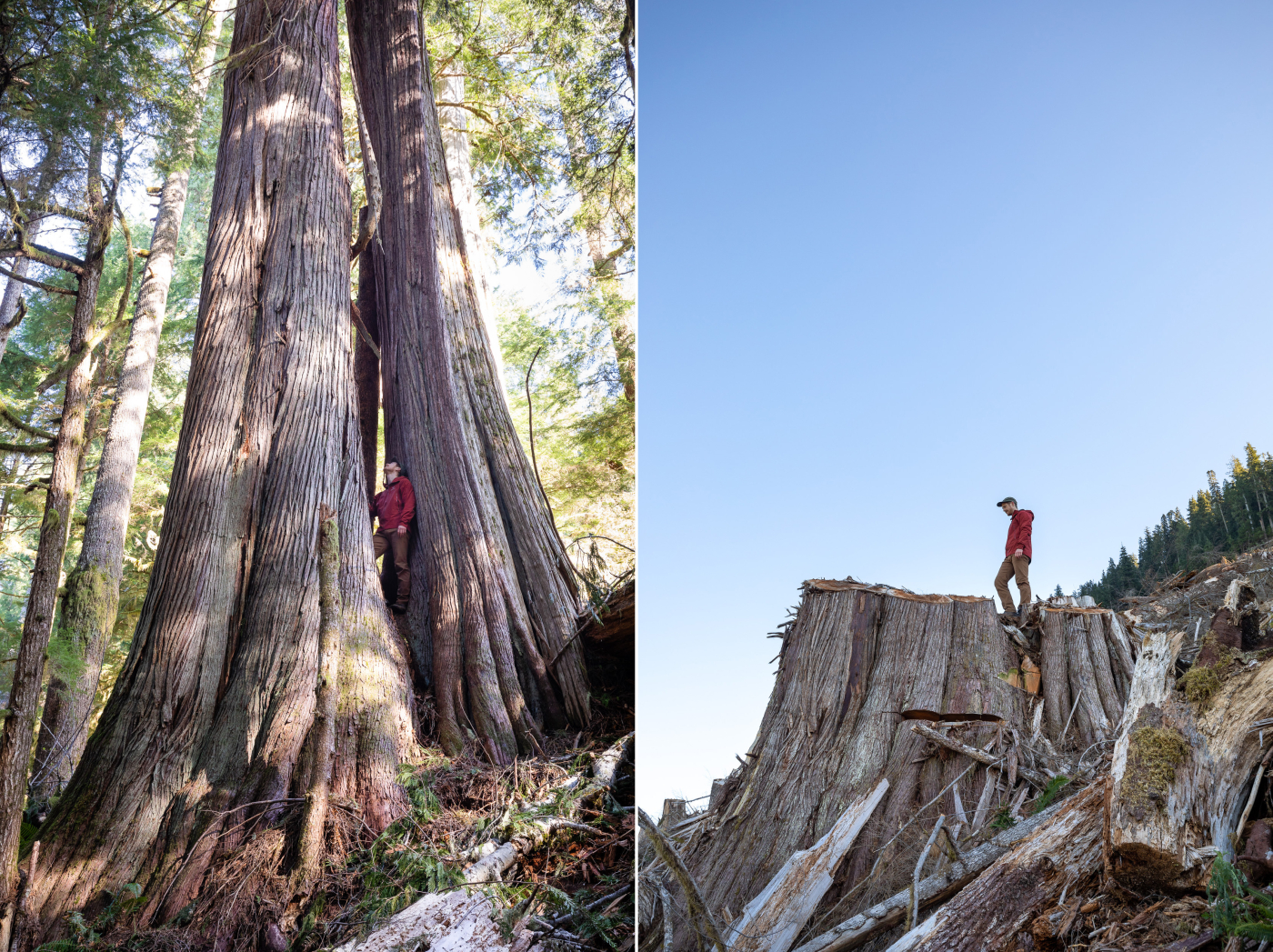 https://ancientforestalliance.org/wp-content/uploads/2026/10/Before-After-Caycuse-TJ-Watt-4-scaled.jpg
1915
2560
TJ Watt
https://ancientforestalliance.org/wp-content/uploads/2026/05/Ancient-Forest-Alliance-logo.svg
TJ Watt2026-10-16 17:36:002026-10-21 13:40:23BC Election 2026: Where do Parties Stand on Nature & Old-Growth?
https://ancientforestalliance.org/wp-content/uploads/2026/10/Before-After-Caycuse-TJ-Watt-4-scaled.jpg
1915
2560
TJ Watt
https://ancientforestalliance.org/wp-content/uploads/2026/05/Ancient-Forest-Alliance-logo.svg
TJ Watt2026-10-16 17:36:002026-10-21 13:40:23BC Election 2026: Where do Parties Stand on Nature & Old-Growth? https://ancientforestalliance.org/wp-content/uploads/2026/10/BC-Election-2026-Banner-1-1-scaled.jpg
1439
2560
TJ Watt
https://ancientforestalliance.org/wp-content/uploads/2026/05/Ancient-Forest-Alliance-logo.svg
TJ Watt2026-10-09 18:16:372026-10-16 17:44:41Where do BC’s Major Political Parties Stand on Nature Protection?
https://ancientforestalliance.org/wp-content/uploads/2026/10/BC-Election-2026-Banner-1-1-scaled.jpg
1439
2560
TJ Watt
https://ancientforestalliance.org/wp-content/uploads/2026/05/Ancient-Forest-Alliance-logo.svg
TJ Watt2026-10-09 18:16:372026-10-16 17:44:41Where do BC’s Major Political Parties Stand on Nature Protection?Take Action
 Donate
Support the Ancient Forest Alliance with a one-time or monthly donation. Send a Message
Send an instant message to key provincial decision-makers.
Overharvesting – Who is watching our forests?
/in News CoverageIt is an outrageous amount. According to a document from the Ministry of Forests that was recently brought to light in the provincial legislature (1), for the five years between 2008 – 2013, the forest company giants, Canfor and West Fraser, overcut 928,000 cubic metres of non-pine wood in the Morice Timber Supply Area (TSA), a region in north-western British Columbia. This overharvesting was done in direct violation of the Allowable Annual Cut (AAC), and is equivalent to about 23,000 logging truck loads of timber.
What is particularly galling is that, while this flagrant overcutting has been taking place, communities in the BC Interior have been facing dozens of mill closures and thousands of job losses in the wake of the pine beetle devastation of the forests and looming drop in the AAC. Having an adequate mid-term supply of non-pine wood is crucial to see the communities through this rough period, but it is precisely this mid-term supply that, in defiance of forestry regulation, Canfor and West Fraser targeted for severe overharvesting. Indeed, as part of a controversial timber swap with Canfor, West Fraser has since announced it would be closing its Houston mill in the Morice TSA by the summer of 2014.
The Morice TSA case raises the question: How much overharvesting has been going on in other Timber Supply Areas of the Interior? But to catch overharvesting and other violations of the Forest Act, oversight is needed from forestry inspectors and scientists. Unfortunately, the number of government forestry personnel has been dramatically slashed over the last decade in British Columbia.
In 2010, forestry analyst Ben Parfitt noted that the BC Forest Service had lost 1,006 positions or about a quarter of its workforce. Between 2001 and 2005 alone, field inspections fell by 46 per cent “opening the door to a range of potential abuses, including illegal logging and log theft, unmarked logs and therefore unpaid provincial stumpage fees, and environmentally destructive logging operations.” He further pointed out that, in Northeast BC, each forest service employee oversees an average of 232,240 hectares of land, compared to just 2,666 hectares of land for a US forest service employee (2).
The provincial government’s own Auditor General issued a devastating report in 2012 that sharply criticized the Ministry of Forests for its forest management, inspection and monitoring practices. The report noted that there had been a steady decline of forest practice inspections from over 31,000 in 2000/01 to about 15,000 in 2008/09. It concluded that “the ministry has not demonstrated whether its existing compliance and enforcement inspections are sufficiently robust to ensure industry compliance” (3).
In July of 2013, the Forest Practices Board weighed in with a Special Investigation of its own. It found that, since 2008/09, the number of inspections further plummeted from about 15,000 to less than 5,000 with only 2,800 of those focusing on harvesting and roads. It expressed concern that, with the “steep drop” in inspections and cuts to forest service staff, “licensees’ activities may not be inspected enough, particularly harvesting and road activities that pose a high risk of harm to resource values” (4).
The board also found that government figures regarding violations of the Forest Act and other statutory requirements were not accurate because they only took into account cases where actual enforcement actions had been taken, and did not include instances where warning tickets or non-compliance notices were issued.
Most recently, in March 2014, the Professional Employees Association released a report noting that the number of Licensed Science Officers working for the provincial government dropped by 15 percent between 2009 and 2014. For forestry science officers, the drop was even more dramatic – 27 percent.
The Association states that many technical reports used to make regulatory decisions are now being prepared by external consultants paid for by the companies. It argues that a significant number of these reports “included conclusions that were inappropriate due to incorrect or biased analyses,” and that, if left uncorrected, “would have resulted in regulatory decisions that favoured the regulated party [i.e. companies] and adversely impacted the environment.” Furthermore, as a result of staff cutbacks, much of the data regarding timber resource management and the health of the forests is no longer being collected.
The Association report concludes that professionally trained Licensed Science Officers “are the first-line stewards of B.C.’s natural resources and primary protectors of the safety of public infrastructure facilities.” Yet there are not enough of these experts to “adequately look after the interests of British Columbians” (5).
None of these reports inspire much confidence in the state of forestry oversight in the province of British Columbia. Especially with severe shortages of timber supply looming in some regions.
Oh, and what did happen to Canfor and West Fraser as a result of the 23,000 truckloads of timber they overharvested from 2008 to 2013? Were they prosecuted? Did they receive severe penalties of some kind?
Not quite. The Ministry did issue a penalty of triple stumpage for volume of timber illegally harvested. But there was a catch. It only applies to timber that may be illegally harvested in the future, i.e. it did not apply to the 2008-2013 period. In other words, the companies got away virtually scot-free. Even the Houston mill closure was not criticized or disputed.
There was one very feeble slap on the wrist. And that was a requirement that Canfor and West Fraser work with the Ministry on a plan that promises how, in the future, their harvesting will only “target the highest priority [timber] stands and protect the mid-term timber supply.”
So how much overharvesting has taken place in other Timber Supply Areas of the province? Can the Minister of Forests honestly say that he really knows, given the dramatic cutbacks in forest service staff and oversight? This is not a minor question given the increased pain that Interior communities will be feeling in the wake of dramatic AAC reductions.
We live in an era dominated by globalized corporations that continually lobby governments to reduce regulation and oversight. But what are the consequences? Without proper oversight, do British Columbia and its vast forests risk being reduced to the status of a squeezed lemon – to be thrown away once all the juice is extracted?
Big Lonely Doug coverage in Epoch Times
/in News Coverage“Big Lonely Doug” is covered in a Chinese-language newspaper, the Epoch Times.
See here:
https://www.epochtimes.com/gb/14/3/30/n4118760.htm%E5%8A%A0%E5%9B%BD%E7%AC%AC%E4%BA%8C%E5%A4%A7%E5%B7%A8%E6%9D%89-%E7%9F%97%E7%AB%8B%E6%B8%A9%E5%93%A5%E5%8D%8E%E5%B2%9B.html
Canada’s second largest Douglas fir tree may have been found near Port Renfrew
/in News CoverageAn ancient giant that has been discovered in a logging clearcut area on southern Vancouver Island could be the second largest Douglas fir tree in Canada.
The tree that was named “Big Lonely Doug” was found standing alone among dozens of giant stumps in a 20-hectare clearcut area that was logged two years ago near Port Renfrew.
Preliminary measurements of the tree found it stands 69 meters (226 feet) tall, nearly twice the size of the B.C. Legislature building (130 feet).
It also measures 12 meters (39 feet) in circumference and four meters (13 feet) in diameter.
Official measurements will be made next month by the Ministry of Forests.
The Big Lonely Doug grows in the Gordon River Valley on southern Vancouver Island, known as the “Tall Trees Capital” of Canada.
It comes in second behind the world’s largest Douglas fir, the Red Creek Fir, located just 20 kilometers to the east of Big Lonely Doug in the San Juan River Valley.
It has been measured to be 13.28 meters (44 feet) in circumference or 4.3 meters (14 feet) in diameter, and 73.8 meters (242 feet) tall.
“It is pretty incredible that Port Renfrew is becoming known as the big trees capital of Canada,” says TJ Watt with the Ancient Forest Alliance, an organization that works to protect endangered, old-growth trees in B.C.
It is estimated Big Lonely Doug is around a thousand years old.
Watt says Big Lonely Doug’s longevity could be explained by the fact it is growing in a prime spot at the valley bottom alongside the river.
But its largest branch was torn off in a storm just a few weeks ago.
“Whereas before, it would have been sheltered in the woods,” says Watt.
Activists with the Ancient Forest Alliance say provincial government should do more to protect the province’s biggest trees.
“There is an urgency to protect these areas because old-growth logging continues right near Port Renfrew,” says Watt.
The organization has been calling for provincial legislation to protect big trees and monumental groves.
“This tree could receive some special recognition, but ideally we would be finding them and protecting them before they are left alone in a clearcut,” says Watt.
Read more and view video at: https://globalnews.ca/news/1235236/canadas-second-largest-douglas-fir-tree-may-have-been-found-near-port-renfrew/