 https://ancientforestalliance.org/wp-content/uploads/2026/09/Old-Growth-Clearcut-Caycuse-Vancouver-Island.jpg
1364
2048
TJ Watt
https://ancientforestalliance.org/wp-content/uploads/2026/05/Ancient-Forest-Alliance-logo.svg
TJ Watt2026-10-26 15:06:162026-10-26 15:06:16Victoria Buzz: Environmental advocates concerned over results of BC election
https://ancientforestalliance.org/wp-content/uploads/2026/09/Old-Growth-Clearcut-Caycuse-Vancouver-Island.jpg
1364
2048
TJ Watt
https://ancientforestalliance.org/wp-content/uploads/2026/05/Ancient-Forest-Alliance-logo.svg
TJ Watt2026-10-26 15:06:162026-10-26 15:06:16Victoria Buzz: Environmental advocates concerned over results of BC electionRelated Posts
https://ancientforestalliance.org/wp-content/uploads/2026/09/Old-Growth-Clearcut-Caycuse-Vancouver-Island.jpg
1364
2048
TJ Watt
https://ancientforestalliance.org/wp-content/uploads/2026/05/Ancient-Forest-Alliance-logo.svg
TJ Watt2026-10-26 15:06:162026-10-26 15:06:16Victoria Buzz: Environmental advocates concerned over results of BC election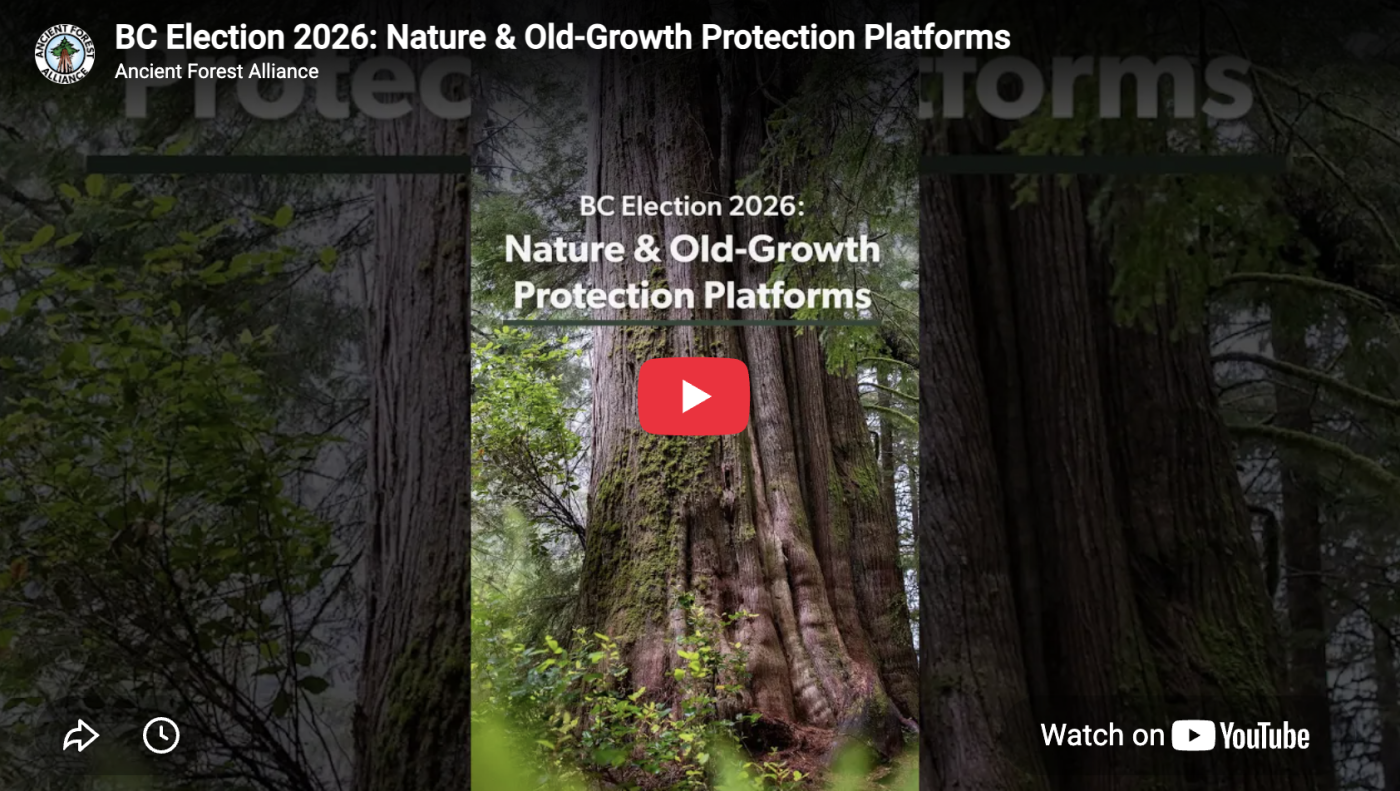 https://ancientforestalliance.org/wp-content/uploads/2026/10/Screenshot-2026-10-22-at-4.54.32-PM.png
952
1684
TJ Watt
https://ancientforestalliance.org/wp-content/uploads/2026/05/Ancient-Forest-Alliance-logo.svg
TJ Watt2026-10-22 16:54:062026-10-22 16:59:41NEW Video: BC Election 2026: Nature & Old-Growth Protection
https://ancientforestalliance.org/wp-content/uploads/2026/10/Screenshot-2026-10-22-at-4.54.32-PM.png
952
1684
TJ Watt
https://ancientforestalliance.org/wp-content/uploads/2026/05/Ancient-Forest-Alliance-logo.svg
TJ Watt2026-10-22 16:54:062026-10-22 16:59:41NEW Video: BC Election 2026: Nature & Old-Growth Protection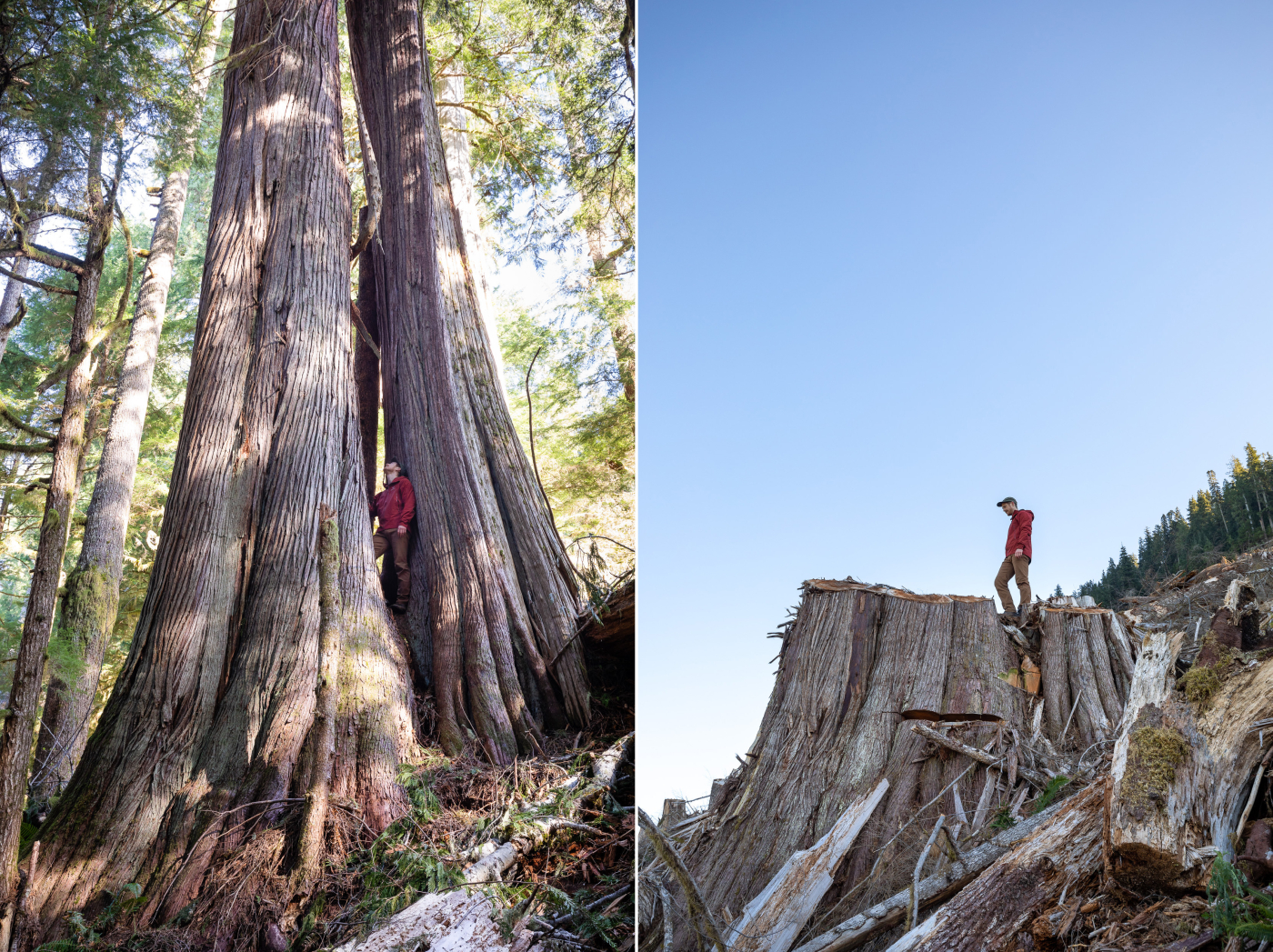 https://ancientforestalliance.org/wp-content/uploads/2026/10/Before-After-Caycuse-TJ-Watt-4-scaled.jpg
1915
2560
TJ Watt
https://ancientforestalliance.org/wp-content/uploads/2026/05/Ancient-Forest-Alliance-logo.svg
TJ Watt2026-10-16 17:36:002026-10-21 13:40:23BC Election 2026: Where do Parties Stand on Nature & Old-Growth?
https://ancientforestalliance.org/wp-content/uploads/2026/10/Before-After-Caycuse-TJ-Watt-4-scaled.jpg
1915
2560
TJ Watt
https://ancientforestalliance.org/wp-content/uploads/2026/05/Ancient-Forest-Alliance-logo.svg
TJ Watt2026-10-16 17:36:002026-10-21 13:40:23BC Election 2026: Where do Parties Stand on Nature & Old-Growth? https://ancientforestalliance.org/wp-content/uploads/2026/10/BC-Election-2026-Banner-1-1-scaled.jpg
1439
2560
TJ Watt
https://ancientforestalliance.org/wp-content/uploads/2026/05/Ancient-Forest-Alliance-logo.svg
TJ Watt2026-10-09 18:16:372026-10-16 17:44:41Where do BC’s Major Political Parties Stand on Nature Protection?
https://ancientforestalliance.org/wp-content/uploads/2026/10/BC-Election-2026-Banner-1-1-scaled.jpg
1439
2560
TJ Watt
https://ancientforestalliance.org/wp-content/uploads/2026/05/Ancient-Forest-Alliance-logo.svg
TJ Watt2026-10-09 18:16:372026-10-16 17:44:41Where do BC’s Major Political Parties Stand on Nature Protection?Take Action
 Donate
Support the Ancient Forest Alliance with a one-time or monthly donation. Send a Message
Send an instant message to key provincial decision-makers.
Vancouver Island Douglas-fir may be Canada’s second biggest
/in News CoverageOn their continual treasure hunt for the region’s largest trees, two Victoria conservationists have found what could be one of the largest Douglas-firs measured in Canada.
“Basically, it’s one giant Douglas-fir in a sea of enormous stumps,” said the Ancient Forest Alliance’s Ken Wu of the tree dubbed Big Lonely Doug. “The largest branch, the size of a second-growth tree, was torn off in a recent wind storm. Its days might be numbered.”
Wu thinks the tree was likely left as a seed tree or so the area could not be deemed a complete clearcut. The Crown land was logged by Teal-Jones in 2012 under tree farm licence 46. The company could not be reached for comment.
Big Lonely Doug was spotted by Wu’s co-worker T.J. Watt a few months ago in a logged area outside of Port Renfrew. Watt and Wu drove 45 minutes down a rough road outside the west coast town on Thursday to measure it.
“You don’t get how big it is until you get close and see the scale,” Wu said. The Douglas-fir stands 69 metres tall and has a 12-metre circumference. Watt described it as big around as a living room and as tall as most skyscrapers.
Judging from the rings on nearby stumps, Wu said, the tree could be nearly 1,000 years old.
“These types of colossal growth trees historically built B.C.’s logging industry. Now they’re just about gone,” Wu said. The group is calling for legislation to protect old-growth ecosystems and the big trees they contain.
Douglas-firs grow along the west coast of North America from southern B.C. to California and in the Rocky Mountains toward Mexico. The Interior variety of the Douglas-fir tends to grow only to about 42 metres in height.
Wu noted the area where Big Lonely Doug was found now has even greater claim as the tall tree capital. The world’s largest recorded Douglas-fir stands in the nearby San Juan River Valley and is measured to be 73.8 metres tall and 13.28 metres in circumference.
“The biggest spruce is also there, there’s the biggest cedar in Cheewhat Lake, and then there’s Avatar Grove,” Wu said. “A hundred years ago, southwestern Vancouver Island was the land of the giants.”
Andy MacKinnon, a research ecologist for the B.C. Ministry of Forests, Lands and Natural Resource Operations, said the discovery of the giant Douglas-fir is exciting.
He manages a Big Tree Registry through the University of British Columbia that tracks the 10 largest trees of each species in the province, and plans to measure Big Lonely Doug next month.
“There’s no legal protection for trees on the list, but it is a way to highlight and champion them,” said MacKinnon, citing the advocacy for a giant Sitka spruce that led to protection of the Carmanah Valley as an example.
Of the 1.9 million hectares of Crown forest on Vancouver Island, 840,125 hectares are considered old growth and 313,000 hectares are available for timber harvesting.
Read more: https://www.timescolonist.com/news/local/vancouver-island-douglas-fir-may-be-canada-s-second-biggest-1.916676
Canada’s second largest Douglas Fir tree found in B.C.
/in News CoverageBig Lonely Doug is a survivor.
The gigantic Douglas fir has weathered storms, earthquakes and a massive logging operation, but according to environmentalists on Vancouver Island, its days are numbered.
“With the other trees gone, there’s no more wind buffer,” said Ken Wu, executive director of the Ancient Forest Alliance. “Its largest branch was blown off by the wind a few weeks ago, and the whole tree itself is in peril.”
Along with his colleague T.J. Watt, Wu spotted the tree months ago in a logged-out area near Port Renfrew, but only had the chance to measure it last week.
At approximately four metres wide and 69 metres tall, it’s believed to be the second largest Douglas fir ever recorded in Canada.
“It’s so big it’s like arriving at a small planet,” Wu said. “It’s one of those trees that produces awe in people.”
The area around Big Lonely Doug was logged in 2012 by a Vancouver-based timber firm, leading Wu and Watt to give the tree its “lonely” moniker.
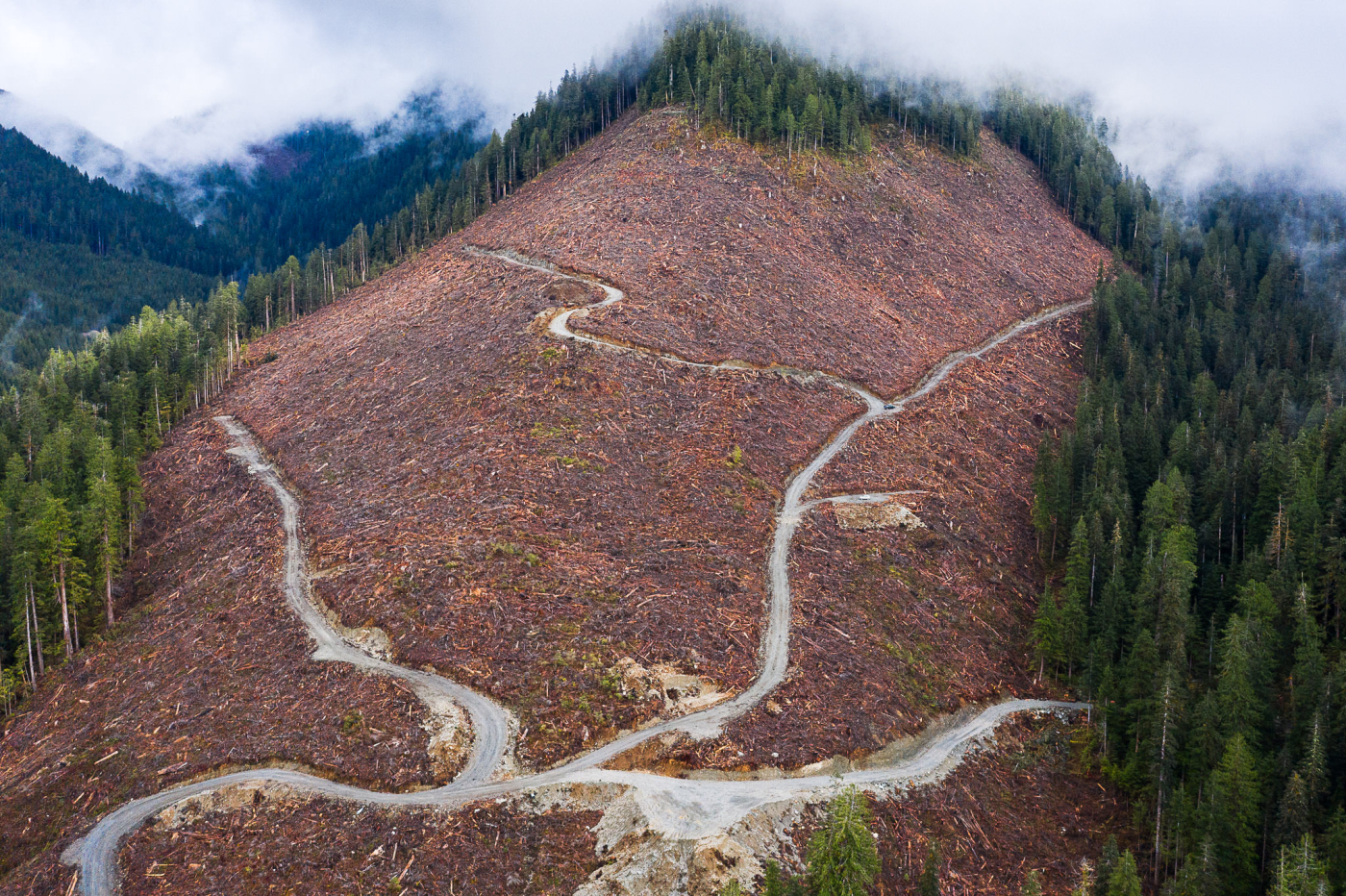
“I can only imagine what a spectacular landscape it would have been two years ago, filled with Douglas firs and ten-foot wide cedars,” Wu said. “Now it looks like a moonscape, except for this one, huge tree.”
Based on the rings of nearby stumps, Wu estimates Lonely Doug is 1,000 years old.
The Ancient Forest Alliance has spent years tracking down Vancouver Island’s largest trees in an effort to bring awareness to the plight of old growth forests. Claiming only 10 per cent of the productive, old growth forest on the Island is under protection, Wu believes more regulation is needed.
“Second-growth forests in B.C. are logged every 50 years, so if you lose something that doesn’t come back for another 1,000 years, it’s gone for good,” he said. “And all the creatures associated with these ancient forests lose their habitat.”
Wu said the forest around Big Lonely Doug would have served as habitat for the endangered Queen Charlotte goshawk.
To bring attention to their cause, Wu and Watt have dubbed the old growth tract around Doug the “Christy Clark grove,” after B.C.’s premier.
“The grove was named after the premier as a strategy to put her on the spot and in the spotlight to have to take responsibility to protect the area’s ancient forests,” Wu said.
The area is definitely home to some large trees. In fact, the world’s largest Douglas fir — standing 73.8 metres tall — is only one valley away, and record-setting cedars and spruces are also nearby.
Andy MacKinnon, an ecologist who manages the B.C. Big Tree Registry, said the discovery of Lonely Doug could help spur conservation efforts in the area.
“If you’re trying to save a grove of trees and you can point to a tree as being one of the largest in the world… that gets a lot more press and a lot more attention, and it indirectly affords the area a kind of protection,” he said.
MacKinnon points to a giant Sitka spruce that led to a portion of the Carmanah Valley on Vancouver Island being designated a provincial park.
“That whole campaign and some of its best publicity was built around the Carmanah Giant,” he said.
MacKinnon expects Big Lonely Doug may be among the world’s ten largest Douglas firs, but he’s waiting until he can officially measure it before adding it to the registry.
For more information on large trees in the province, visit the B.C. Big Tree Registry, or consult the Google map below (follow news link below to view) created by Craig Williams.
Read more: https://metronews.ca/news/victoria/981658/photos-giant-douglas-fir-tree-found-in-b-c-may-be-largest-in-world/
Canada’s second largest Douglas-fir discovered
/in News Coverage“This may very well be the most significant big tree discovery in Canada in decades. This is a tree with a trunk as wide as a living room and stands taller than downtown skyscrapers,” said TJ Watt, Ancient Forest Alliance (AFA) photographer and campaigner, who first noticed the exceptional tree several months ago before returning to measure it with AFA co-founder Ken Wu yesterday, in a press release from AFA to Vancouver Observer.
Here's more on the discovery of Canada’s second largest recorded Douglas-fir tree from the press release:
Conservationists with the Ancient Forest Alliance (AFA) have found and measured what appears to be Canada’s second largest recorded Douglas-fir tree, nick-named “Big Lonely Doug”. Preliminary measurements of the tree taken yesterday found it to be about 12 meters (39 feet) in circumference or 4 meters (13 feet) in diameter, and 69 meters(226 feet) tall. Ministry of Forests staff will visit the site and take official measurements of the tree in early April. Big Lonely Doug is estimated to be about 1000 years old, judging by nearby 8 feet wide Douglas-fir stumps in the same clearcut with growth rings of 500-600 years.
“This may very well be the most significant big tree discovery in Canada in decades.This is a tree with a trunk as wide as a living room and stands taller than downtown skyscrapers,” stated TJ Watt, AFA photographer and campaigner, who first noticed the exceptional tree several months ago before returning to measure it with AFA co-founder Ken Wu yesterday. “Big Lonely Doug’s total size comes in just behind the current champion Douglas-fir, the Red Creek Fir, the world’s largest, which grows just one valley over.”
“The fact that all of the surrounding old-growth trees have been clearcut around such a globally exceptional tree, putting it at risk of being damaged or blown down by wind storms, underscores the urgency for new provincial laws to protect BC’s largest trees, monumental groves, and endangered old-growth ecosystems,” stated Ken Wu, AFA executive director. “The days of colossal trees like these are quickly coming to an end as the timber industry cherry-picks the last unprotected, valley-bottom, lower elevation ancient stands in southern BC where giants like this grow.”
Big Lonely Doug grows in the Gordon River Valley near the coastal town of Port Renfrew on southern Vancouver Island, known as the “Tall Trees Capital” of Canada. It stands on Crown lands in Tree Farm Licence 46 held by the logging company Teal-Jones, in the unceded traditional territory of the Pacheedaht First Nation band.
Big Lonely Doug stands alone among dozens of giant stumps – some 3 meters (10 feet) wide – of old-growth western redcedars, Douglas-firs, and western hemlocks, in a roughly 20 hectare clearcut that was logged in 2012. Its largest branch was recently torn off in a fierce wind/snow storm a few weeks ago, with a 50 centimeter wide base (the size of most second-growth trees) and still fresh needles lying on the ground adjacent to the tree.
The world’s largest Douglas-fir tree is the Red Creek Fir, located just 20 kilometers to the east of Big Lonely Doug in the San Juan River Valley. The Red Creek Fir has been measured to be 13.28 meters (44 feet) in circumference or 4.3 meters (14 feet) in diameter, and 73.8 meters (242 feet) tall.
The University of British Columbia runs a “BC Big Tree Registry” which lists the 10 largest trees of each species based on circumference, height, and crown spread.
Judging by the registry of the top 10 largest recorded Douglas-fir trees in BC, Big Lonely Doug has the 2nd-largest timber volume (ie. overall size), the 2nd largest circumference/diameter, and is the 7th tallest for its kind in BC.
Big Lonely Doug was likely left behind as a seed tree or through a logging practice known as “variable retention harvesting”, where companies claim they are “not clearcutting” the forest because they “retain” varying amounts of trees (in this case, two trees, including Big Lonely Doug) in each cutblock. The tree might have also been used as a cable anchor to yard other trees for the logging operation across the clearcut, judging by the long horizontal lines scarred into its bark.
The stand of ancient trees in which Big Lonely Doug grew was part of a 1000 hectare tract of provincially-significant, largely intact old-growth forest on Edinburgh Mountain, home to species at risk including the red-listed or endangered Queen Charlotte Goshawk.
While some of the area has been reserved as a core Wildlife Habitat Area for the goshawk and as an Old-Growth Management Area, about 60 per cent of the forests there – including the finest, valley-bottom stands with the largest trees, such as the stand where Big Lonely Doug once grew in – are open to clearcut logging.
This area was nicknamed the “Christy Clark Grove” in 2012 after BC’s premier as a strategy to put her on the spot and in the spotlight to have to take responsibility for the fate of this spectacular ancient forest. So far, the premier has failed to ensure the area’s full protection. See photos of this nationally-significant but threatened forest here.
Government data from 2012 show that about 75 per cent of the original, productive old-growth forests on BC’s southern coast (Vancouver Island and Southwest Mainland) have been logged, including over 91 per cent of the highest productivity, valley bottom ancient stands where the largest trees grow. 99 per cent of the old-growth Douglas-fir trees on BC’s coast have also been logged. See recent “before and after” maps and stats here.
The BC Ministry of Forests, Lands, and Natural Resource Operations is currently working on following up on a 2011 promise by then-Forests Minister Pat Bell to develop a new “legal too” to protect the province’s biggest old-growth trees and grandest groves. Such a legal mechanism, if effective and if implemented, would be a greatly welcome step forward towards protecting BC’s finest stands. More comprehensive legislation would still be needed to protect the province’s old-growth ecosystems on a larger scale, to sustain biodiversity, clean water, and the climate, as the biggest trees and monumental groves are today a very small fraction of the remaining old-growth forests.
BC’s old-growth forests are important to sustain numerous species at risk that can’t live or flourish in second-growth stands; to mitigate climate change by storing two to three times more atmospheric carbon than the ensuing second-growth tree plantations that they are being replaced with; as fundamental pillars for BC’s multi-billion dollar tourism industry; to support clean water and wild salmon; and for many First Nations cultures who use ancient cedar trees for canoes, totems, long-houses, and numerous other items.
The Ancient Forest Alliance is calling on the BC government to protect our endangered old-growth forests, ensure the development of a sustainable, value-added second-growth forest industry (second-growth forest now constitute the vast majority of productive forest lands in BC), and to end the vast export of raw, unprocessed logs to foreign mills.
“The vast majority of BC’s remaining old-growth forests are at higher elevations, on rocky sites, and in bogs where the trees are much smaller and in many cases have low to no commercial value. It’s the valley-bottom, low elevation stands where trees like the Big Lonely Doug grow that are incredibly scarce now. 99 per cent of the old-growth Douglas-fir trees on BC’s coast have already been logged. It’s time for the BC government to stop being more enthusiastic about big stumps than big trees, and for them to enact forest policies that protect our last endangered ancient forest ecosystems,” stated TJ Watt.
Read more: https://www.vancouverobserver.com/news/canadas-second-largest-douglas-fir-discovered