https://ancientforestalliance.org/wp-content/uploads/2026/02/Keith-River-Old-Growth-BC-333.jpg
1365
2048
TJ Watt
https://staging.ancientforestalliance.org/wp-content/uploads/2014/10/cropped-AFA-Logo-1000px.png
TJ Watt2026-03-03 09:07:112026-03-04 14:36:34NOW HIRING: Forest CampaignerRelated Posts
https://ancientforestalliance.org/wp-content/uploads/2026/02/Keith-River-Old-Growth-BC-333.jpg
1365
2048
TJ Watt
https://staging.ancientforestalliance.org/wp-content/uploads/2014/10/cropped-AFA-Logo-1000px.png
TJ Watt2026-03-03 09:07:112026-03-04 14:36:34NOW HIRING: Forest Campaigner
It’s AFA’s 16th Birthday!
On Tuesday, February 24th, we’re celebrating 16 years of working together with you, our community, to ensure the permanent protection of old-growth forests in BC. To mark the date, will you chip in $16 or more to support our work?

Budget 2026 Shortchanges Nature Protection and Sustainable Forestry Transition At a Critical Time for British Columbia
BC’s Budget 2026 fails to provide the funding needed to secure lasting protection for endangered ecosystems and at-risk old-growth forests in the province.

Welcome, Zeinab, our new Vancouver Canvass Director!
We're excited to welcome Zeinab Salenhiankia, our new Vancouver Canvass Director, to the Ancient Forest Alliance team!
Take Action
Donate
Support the Ancient Forest Alliance with a one-time or monthly donation.
Send a Message
Send an instant message to key provincial decision-makers.Get in Touch
AFA’s office is located on the territories of the Lekwungen Peoples, also known as the Songhees and Esquimalt Nations.
Copyright © 2026 Ancient Forest Alliance • All Rights Reserved
Earth-Friendly Web Design by Fairwind Creative


Billion-dollar BC Nature Agreement will Supercharge Protected Areas Expansion across the Province
/in Media ReleaseFor Immediate Release
November 3rd, 2023
Conservationists thank the BC and federal governments for the $1.1 billion launch of the BC Nature Agreement. The federal government has provided $500 million and BC is providing $563 million from diverse funding sources — now purposed toward achieving BC’s 30% by 2030 nature protection, conservation, and restoration goals via First Nations conservation agreements.
The Ancient Forest Alliance (AFA) and Endangered Ecosystems Alliance (EEA) are greatly applauding the BC and federal governments and the First Nations Leadership Council for launching the BC Nature Agreement, with $1.1 billion in funding to start, to help achieve BC’s minimum protected areas target of protecting 30% by 2030 of its land area. The tripartite agreement, negotiated between the BC government, the federal government, and the First Nations Leadership Council (FNLC), comes with a $563 million contribution from the province and a $500 million federal contribution. The fund will continue to grow with major contributions from the philanthropic community and potentially from future government budgets over time.
Funds will be used for supporting First Nations to establish Indigenous Protected and Conserved Areas (IPCAs) and conservation initiatives, endangered species recovery, compensation of resource licensees, and habitat restoration, with a central mandate to achieve the 30% by 2030 protection target of BC in line with Canada’s national protection target.
“This is the largest provincial funding package in Canada’s history for nature conservation, and we understand it will continue to grow beyond the initial sum of $1.1 billion,” stated Ken Wu, Executive Director for EEA. “Our central campaign focus for years has been on the necessity of government funding for First Nations to establish new protected areas to save old-growth forests and endangered ecosystems in BC. Today, Premier Eby, federal Environment Minister Steven Guilbeault, and the First Nations Leadership Council delivered, and we thank them greatly. The funds will be critically important as the ‘fuel’ to enable Indigenous conservation initiatives to help BC reach its minimum protection target of 30% by 2030. Now we need ecosystem-based protection targets connected to these conservation funds to prioritize the most endangered and least protected ecosystems in BC. Without ecosystem-based targets to aim protection priorities wisely, it’ll be like a fire brigade hosing down all the non-burning houses while the houses on fire are largely ignored. Or a surgeon who doesn’t make distinctions between organs, instead just aiming to reach an overall target of removing a couple of kilograms.”
“Because First Nations are legally in the driver’s seat in BC when it comes to on-the-ground protection of their unceded territories, a major fund such as the one announced today is vital to support them and to deal with all the various costs of establishing new protected areas, particularly in contested landscapes,” stated TJ Watt, Campaigner for AFA. “It would be impossible to essentially double the protected areas in BC from 15% now to 30% over the next seven years without it. The major funding that Eby and Guilbeault have just put forward is a big deal. Step by step, the province is moving forward with support from the federal government to create the policy vehicle and funding streams that will enable First Nations to drive where we all need to go: the protection of native ecosystems and old-growth forests in BC. Funding for First Nations-led deferrals in the most at-risk old-growth stands is still outstanding, and we will keep working to see that these vital ‘solutions space’ funds are provided.”
In BC, the province cannot unilaterally establish protected areas and “just save the old growth” on Crown/ unceded First Nations lands — the support and shared decision-making of local First Nations governments is a legal necessity in their territories. Protected areas establishment and logging deferrals move at the speed of the local First Nations whose territories it is — the BC government’s policies and funding can facilitate or hinder, help speed up or slow down, the abilities of First Nations to protect ecosystems. Conservation financing, included in this funding package, is a vital enabling condition that can greatly facilitate and speed up the protection of old-growth forests.
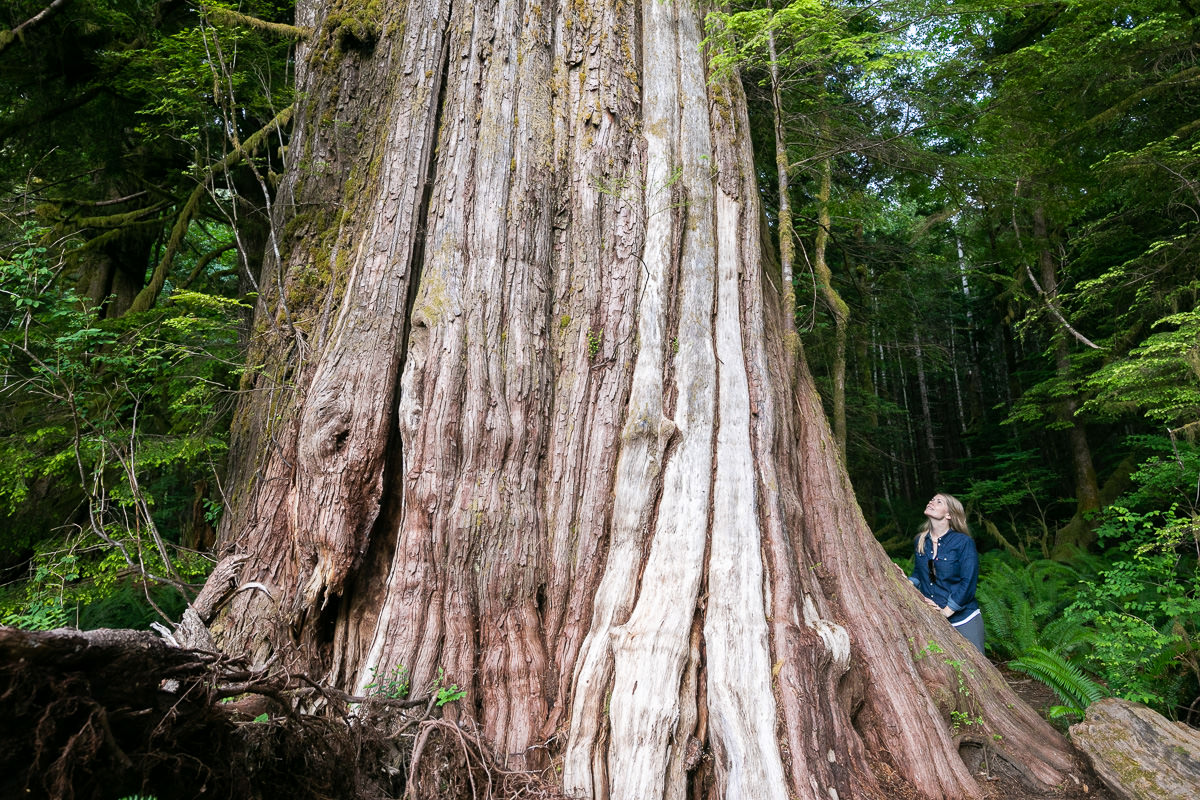
Endangered Ecosystems Alliance executive director, Ken Wu, stands beside a monumental old-growth redcedar tree in the unprotected Eden Grove near Port Renfrew, BC in Pacheedaht territory.
Today’s BC Nature Agreement funds come from four federal funding pots (Enhanced Nature Legacy, Nature Smart Solutions Fund, BC Old-Growth Fund, and 2 Billion Trees program) and most of the funding was, until now, largely inaccessible for BC protected areas. The provincial funds also come from diverse sources — disparate funds that are now newly tasked to fulfill the mandate of the BC Nature Agreement’s 30% by 2030 goal to protect, conserve and restore ecosystems via First Nations’ shared decision-making initiatives. These include the $150 million in provincial contributions to BC’s Conservation Financing Mechanism announced last week, another $100 million from the Watershed Security Fund and $200 million from the Northeast Restoration Fund, and a host of other smaller funding pots.
In addition, the BC Old-Growth Fund, worth $50 million from federal funds and which must be matched by a $50 million provincial contribution (ie. $100 million), comes into force (and will grow by an additional $32 million in federal funds committed earlier, or $64 million in matching total funds), and is mandated to protect the most at-risk old-growth forests (ie. grandest, rarest and oldest stands) in the Coastal and Inland Rainforests, and the Coastal Douglas-Fir biogeoclimatic zone. These are among the most endangered ecosystems in BC, which evolved to naturally exist with high proportions of their landscapes in an old-growth condition, with greater levels of biodiversity adapted to old-growth forests than most other ecosystems (hence, the prioritization of funds for these ecosystems is sensible from a conservation perspective — the other $1 billion is available to protect forests including old-growth in other ecosystems).
While a minor subset of the overall BC Nature Agreement, the BC Old-Growth Fund is indispensable to help protect the “biggest and best” remaining old-growth stands in BC, with a mandate akin to ecosystem-based targets to protect 400,000 hectares to 1.3 million hectares of old-growth and mature forests in the most at-risk old-growth forest types by supporting First Nations conservation initiatives. Some of these hectares might come from the finalization of the ecosystem-based management reserves negotiated years earlier in the Great Bear Rainforest final agreement. Hopefully, with support from the greater BC Nature Agreement funds, most of the remaining tracts of the at-risk old-growth forests in the Coastal and Inland Rainforests and Coastal Douglas-Fir ecosystems are picked up for protection with this fund.
TJ Watt said, “We want to flag that provincial leadership is now vital to fulfilling the mandate of the BC Old-Growth Fund, to identify the key sites, which have already been largely mapped by the province’s appointed Technical Advisory Panel, and to pro-actively approach and work with First Nations and to bring them the resources and support needed to work on protecting these most important at-risk stands. BC bureaucrats sitting on their haunches and waiting to be approached won’t get the job done.”
The BC Nature Agreement fund comes on the heels of the $300 million Conservation Financing Mechanism and in fact, includes the $150 million provincial contribution to that fund. The BC Nature Agreement fund can also be used to augment the Conservation Financing Mechanism, which, unlike the BC Nature Agreement itself, can be used to support First Nations economic development initiatives linked to new protected areas.
Endangered Ecosystems Alliance executive director, Ken Wu, stands beside a monumental old-growth redcedar tree in the unprotected Jurassic Grove near Port Renfrew, BC in Pacheedaht territory.
EEA and AFA are now focused on closing several additional gaps in BC’s old-growth and protected-areas policies, which include:
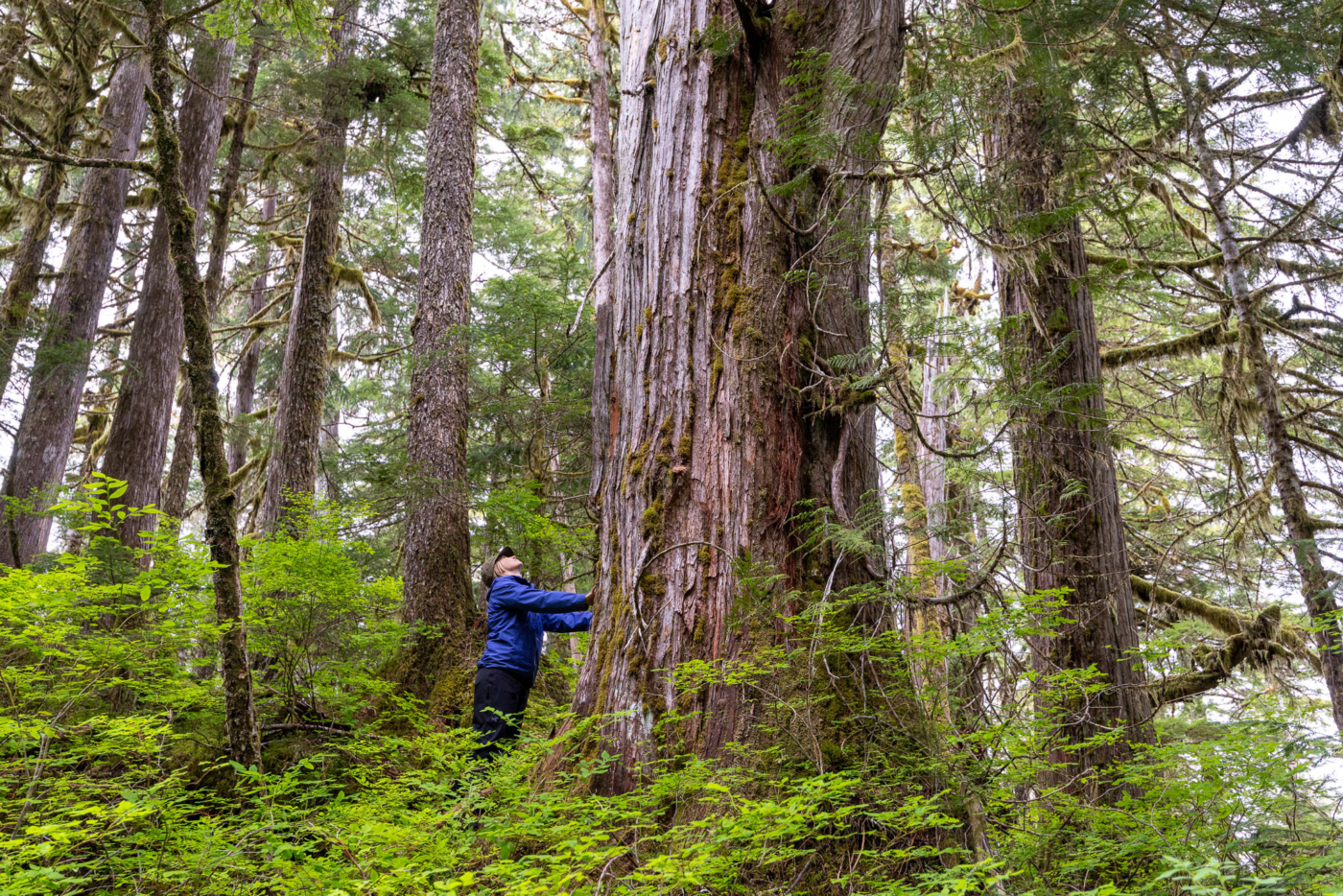
Ancient Forest Alliance photographer & campaigner, TJ Watt, stands between two enormous old-growth Sitka spruce growing unprotected near Port Renfrew, BC in Pacheedaht territory.
EEA and AFA are also noting that much of the funding agreement, with the exception of the conservation financing component ($150 million from BC, and $150 million from the BC Parks Foundation), is narrowly defined so as not to fund First Nations’ owned businesses as alternatives to the nations’ old-growth logging dependencies. The lack of funding to support economic alternatives in First Nations communities, which keeps these communities dependent on old-growth logging revenues and jobs, is the single greatest barrier to the protection of old-growth forests across BC. This barrier is not lost upon many of the key timber-centric senior provincial bureaucrats who continue to marginalize the availability of such funds for First Nations’ economic development, along with the lack of deferral funding. This will also be an issue that our organizations will also be watching and working on.
More Background Info
Thank you to our amazing business supporters!
/in Thank YouWe would like to extend a massive thank you to the following businesses for generously supporting the old-growth campaign:
Songbird Environmental Consulting Ltd. for contributing monthly to AFA.
The 2022/2023 Grade 4 class at Kelset Elementary and Bird Canada for their generous donations.
And Exige International and Built For Good podcast for donating and supporting the old-growth campaign all the way from the United Kingdom!
Your support makes our important work possible and we’re extremely grateful to each and every one of you.
ACTION ALERT: Tell your MLA to stand up for old-growth protection and sustainable forestry jobs!
/in Take ActionWrite, phone, and/or meet with your provincial Member of the Legislative Assembly (MLA) and ask them to support ancient forest protection and sustainable, second-growth forestry.
BC is home to some of the world’s finest remaining old-growth temperate rainforests, where trees growing as wide as a living room and living to be more than a thousand years old are vital pillars in supporting endangered species, First Nations cultures, the climate, clean water, wild salmon, tourism, and more.
After more than a century of logging, however, well over 90% of the most productive, “big-tree” old-growth forests in BC have been cut and much of what remains is still under threat. Currently, only about 15% of the province is safeguarded in legislated protected areas, and endangered old-growth forests continue to be logged on an industrial scale.
Thankfully, after years of enormous pressure from the Ancient Forest Alliance (AFA) and our thousands of supporters, the province, under the leadership of Premier David Eby, has now taken major steps to support the protection of old-growth forests.
These steps include committing to doubling protected areas in BC to 30% by 2030, launching a $300 million conservation financing mechanism to support the creation of new Indigenous Protected and Conserved Areas, and announcing the tripartite BC Nature Agreement which will provide over $1 billion toward protecting 30% of the land base in BC by 2030. This also includes a $100 million BC Old-Growth Fund (set to grow to $164 million with matching funding from the province) specifically to protect the grandest old-growth temperate rainforests in BC!
On the heels of these major funding announcements, the province also released a draft Biodiversity and Ecosystem Health Framework (BEHF) to guide all new protection, conservation, and land-use activities.
These incredible steps did not happen by accident. Tens of thousands of AFA supporters have sent messages to BC government ministers and politicians demanding action. British Columbians from diverse segments of society, including the BC Chamber of Commerce, the Union of BC Municipalities, and the Public and Private Workers of Canada union, have all called on the provincial government to increase the protection of the remaining old-growth forests in BC. We have seen enormous progress, but more needs to be done! There are still major policy and funding gaps that must be addressed to ensure the protection of the most endangered old-growth forests and other ecosystems in BC.
The recent influx of funding provides the resources necessary to preserve old growth but now those funds must be geared toward protecting the most threatened and biodiverse ecosystems. It is still entirely possible, and without dedicated work probable, that these new commitments and funds will mainly support protection in low productivity areas of rock, ice, and small trees, rather than in the productive valley-bottom ecosystem where the giant trees grow. Now we need to push hard for the complete, permanent protection of our threatened old-growth forests while this window of opportunity is open.
If you live in British Columbia, please contact your own Member of the Legislative Assembly (MLA), the elected provincial politician who is supposed to represent YOU. It’s imperative that as your representative, they make it a top priority to protect the most threatened and productive old-growth forests and support sustainable economic development in First Nations communities that can replace old-growth logging. Please write, phone, or meet with your local MLA — or better yet…do all three!
Start by visiting the BC legislature’s website to find your MLA’s name and contact information.
Start by visiting the BC legislature website to find your MLA’s name and contact information.
Important points to include when emailing your MLA:
* Be sure to include your full name and address so that they know you’re a real person!
When PHONING your MLA’s constituency office:
You’ll likely speak to a constituency assistant, so briefly let them know your name, home address (so they know you’re a constituent), and include these points:
When MEETING with your MLA:
Request a face-to-face meeting when writing or phoning your MLA. Provide your name and residential address so they know you’re from the Member’s constituency. Before meeting with your MLA, review the background information below and read these talking points, which will help you get prepared. In the meeting, ask them what they will do to help and write down their answer. Be polite, but firm, and listen carefully. If your MLA makes a commitment or shares something noteworthy that you would like to share with us at the Ancient Forest Alliance, email us at info@ancientforestalliance.org. Please feel free to contact us in advance if you need advice on meeting your MLA.
BACKGROUND INFORMATION on Old-Growth Forests in BC
The old-growth forests in BC are among the most magnificent forests on Earth. Home to some of the world’s largest trees, old-growth forests are not only iconic parts of BC, but they also support unique plants, animals, and cultures.
Despite their environmental, cultural, and economic value, these magnificent ancient forests are now highly endangered due to industrial logging. On the southern coast of BC, 80% of the original productive old-growth forests have been logged, including well over 90% of the lowland ancient forests where the richest biodiversity and largest trees are found. The logging of these carbon-rich forests contributes significantly to BC’s CO2 emissions and is driving old-growth-dependent species toward extinction.
Only about 8% of the original, productive old-growth forests on Vancouver Island are protected in parks and Old-Growth Management Areas (OGMAs). Old-growth forests, with trees that can be 2,000 years old, are a non-renewable resource under BC’s system of forestry, where second-growth forests are re-logged every 50 to 100 years, never to become old-growth again.
Protecting old-growth forests is critical because they:
Environmental groups have been advocating for the protection of endangered old-growth forests in BC for almost 50 years, but we now have a unique opportunity to finally lay this conflict to rest. The BC government has committed to a “paradigm shift” in how it manages forests, for the first time in history pledging to prioritize ecological health over industrial extraction. This is a profound change, and the BC government has taken some major leaps forward, such as creating a $300 million conservation financing fund to support the protection of old-growth forests through the creation of new Indigenous Protected and Conserved Areas, committing to protecting 30% of lands in BC by 2030 in collaboration with First Nations, and more.
However, key funding and policy gaps will remain, allowing irreplaceable old-growth forests to continue to fall.
The Ancient Forest Alliance is calling on the BC government to ensure a successful paradigm shift is implemented which includes:
For more information, visit our website to read the AFA’s 10 policy recommendations in more detail, read our general old-growth Q&As or see old-growth statistics and before and after maps.